The Winning Content Mix for LinkedIn in 2026 (Pillars, Formats, Exact Scheduling)
Author's Note:
This is the most comprehensive, strategic deep dive I've done on building a personal brand on LinkedIn. We're covering setting up your content pillars for the 2026 algorithm, picking the formats that actually move the needle this year, and how to schedule it all so you don't burn out trying to keep up.
I walked through all of this in workshop called "The Winning Content Mix, Live: Build Your 2026 LinkedIn System in 60 Minutes."
You can catch the replay here.
And, grab the corresponding workbook here.
If you want to follow along with what I am doing, you can start a free Stanley trial here. I'll be showing you exactly how I plug Stanley into my content operating system so you can build yours alongside me.
Twice a year, I wait around like a kid on Christmas Eve for Richard van der Blom's "Algorithm Insights Report." Richard is kind of the godfather of LinkedIn algorithm analysis, a term I'm sure he'd loathe (I don't know him personally) because it feels a bit kitschy when you consider the man-hours and depth of analysis he pours into this bi-annual report. No kidding, this edition was 217 pages long! (Buy your copy here; so worth the read)

Us, pleading to the algorithm. Richard, answering the call.
Regardless, I binged it with the same vigor I take down Netflix dating shows (Anyone else watch the trainwreck that was "Age of Attraction?")
Richard and his team conduct this research with AuthoredUp (my favorite tool for LinkedIn post scheduling and publishing — Ivana Todorovic is a genius) and shared more about the dataset that powers their findings here:
"The 2026 edition is built on an analysis of over 1.3 million posts, collected between September 2025 and February 2026, drawn from more than 50,000 individual profiles and 30,000 company pages across 60+ countries and 25+ languages. Our team, together with our research partner AuthoredUp, invested over 3,000 hours into gathering, cleaning, analysing, and interpreting this dataset."
That's a semi-long preamble to say that giving an in-depth breakdown of what I have been seeing as "the winning content mix in 2026" for both myself and my clients in a year when everyone has been kvetching about reach has been on my heart and mind for a while.
But it's one thing to break down what's working in an anecdotal sense, and another to read a report that essentially substantiates what you've been experiencing and dives into why.
So, this week, I'm blending my own strategic breakdown based on client and personal performance with the analytical roll-ups and high-level takeaways I found from Richard's report to give you the most comprehensive content mix I've ever published. It's a longy, but a goodie, and trust me, you'll want to save and come back to it. 💾

First things first — structure your 2–3 topic areas
As Richard and other algorithm experts have long suspected and discussed, LinkedIn has definitively shifted from a relationship graph to an interest graph.
That's fancy language for this: the feed has become less about who your first-degree connections are, or even who you're following, and more about content the algorithm is actively predicting — moment by moment — based on your patterns of behavior like:
What you've read.
What you've commented on.
What you've stopped scrolling long enough to actually consume.
If you're on TikTok, this will sound familiar. The "For You page" was TikTok's breakthrough innovation: watch one or two videos on, say, sourdough starter, and suddenly your entire feed is that of a TradWife. TikTok does this very quickly. LinkedIn has effectively shifted to the same model — just on its own timeline. It wants to identify the two to three areas you're most interested in and saturate your feed with that content.
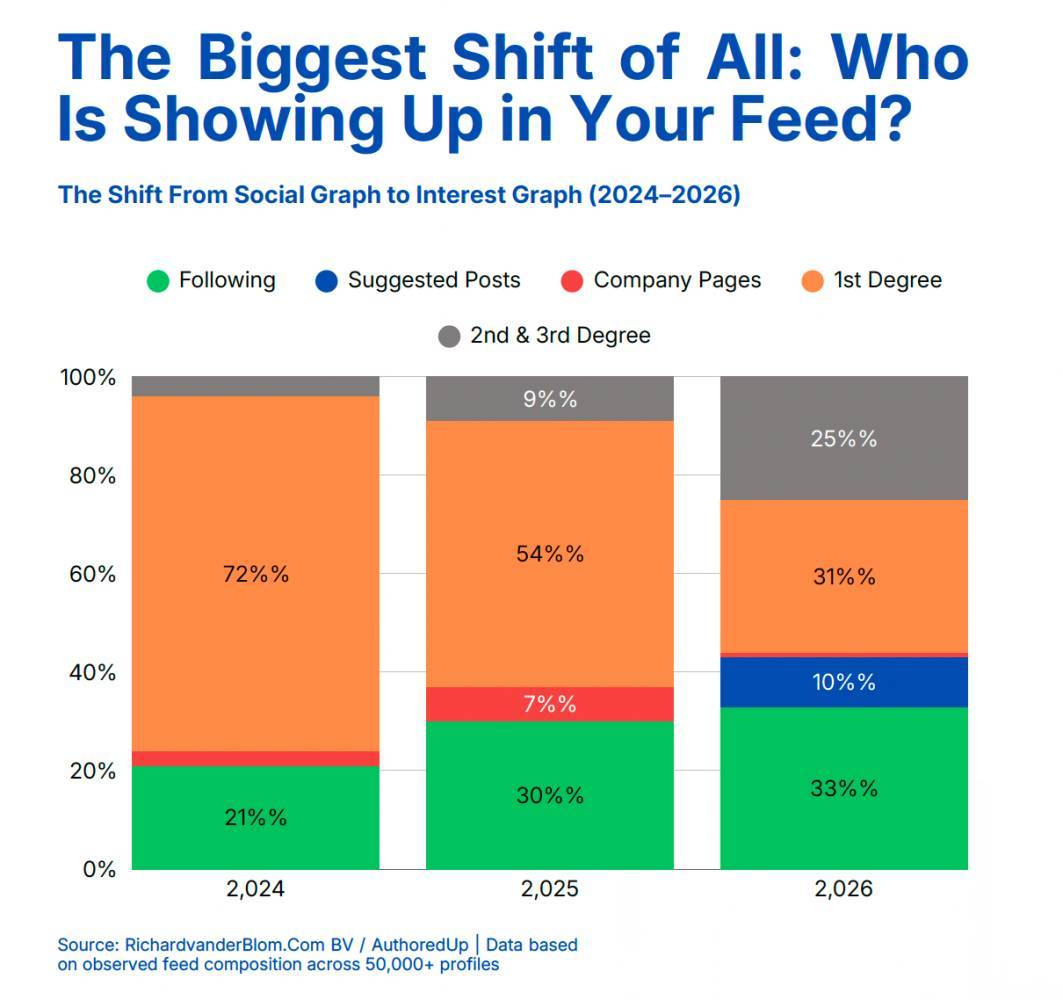
At first blush, this is frustrating. (Indeed, it has been frustrating — if you've felt like your reach has nosedived or your connections' posts have vanished from your feed, that's why.) Take a look at how the report says your feed has restructured over the last 3ish years:
Source: RichardvanderBlom.com
But according to Richard's report, we're finally reaching a point of stabilization.
What this means for us as creators is that we need to do the same thing the algorithm is doing — narrow in.
Identify the two to three topic areas that define our brand, and let those drive both our content and our behavior on the platform.
For me, those three areas are:
Personal branding
Speaking and book writing
LinkedIn growth
That's it. Three lanes. Everything I post and everything I engage with on LinkedIn ladders back to one of them.
Now — I can already hear the pushback: "But I don't want to niche down."
Here’s what I want you to consider, though.
When you narrow your topic areas, the people who actually see your content are the exact right people. Three years ago, you may have reached 10,000 people with a single post and only 1,000 (probs less) of them were actually your target reader or potential client. Today, you may only reach 3,000 — but 80%+ of them are dialed into your topic.
I've been seeing this in my own analytics. Other creators I talk to are saying the same thing. Yes, raw impressions have nosedived from where they were three years ago. But DMs are up. Saves are up. Profile visits from the right kind of person are up. Every leading indicator that says the right people are reading my posts is present.
So before you write another post, get clear on your two to three topics. Then we build the mix.

The Three-Pillar Content Spread
Once you've locked in your two to three topic areas, I have my clients break their content into three pillars.

Teaching & Authority — 60–70% of Your Content
This is the heaviest pillar by design. It's where you teach and establish authority around your two to three topics. Inside this pillar, four sub-types are working right now.
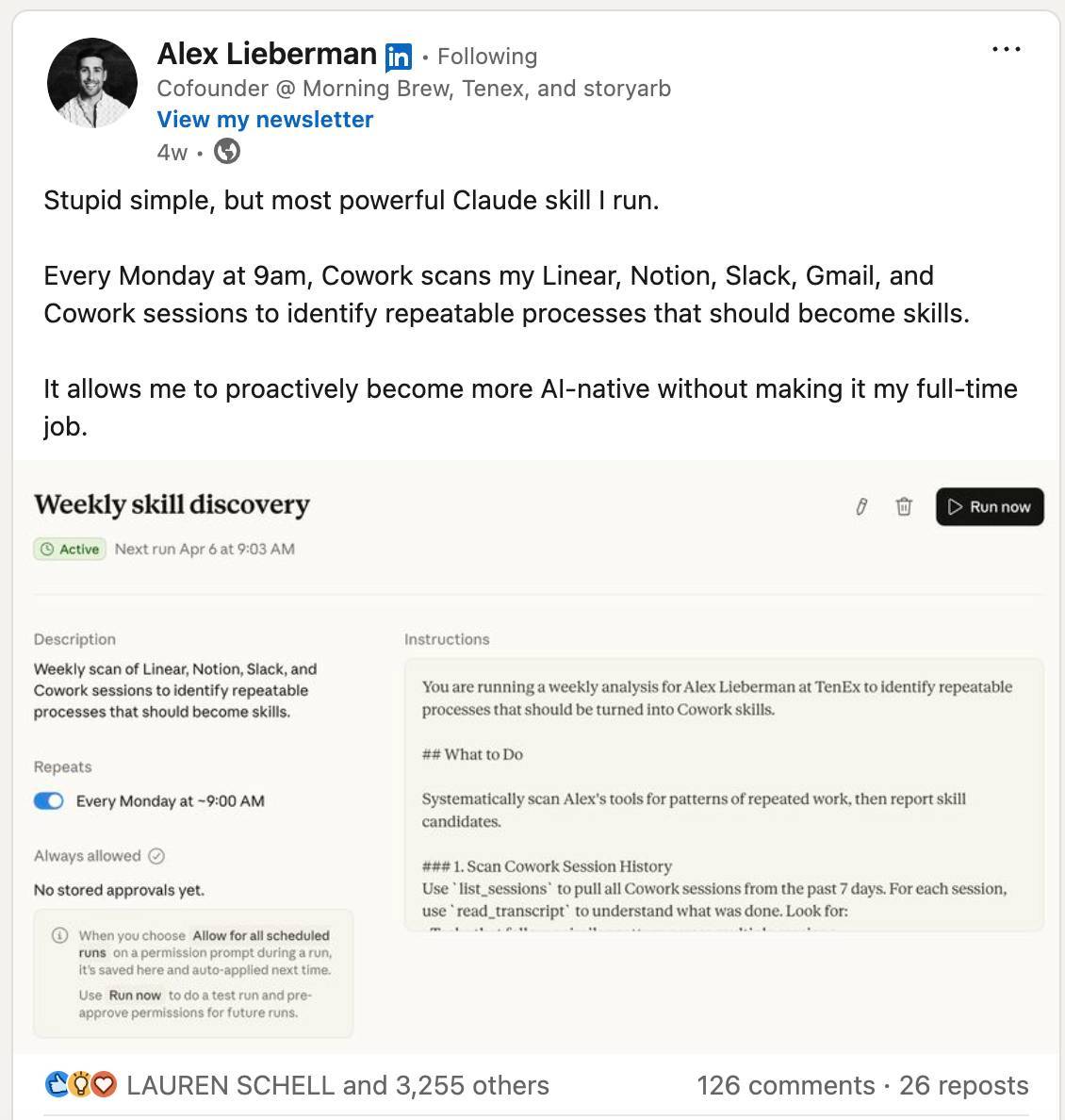
Frameworks. Methodologies, models - the actual systems you use to teach or do your job. The best-performing formats for frameworks are infographics, screenshots, and carousels. Here's a great example from Alex Lieberman:
↳ "How I" (not "how to"). How-to content reads as generic — and the algorithm is increasingly looking for content rooted in your personal knowledge and lived experience, not just information someone could have pulled off Google. Reframe every how-to as a "how I." How I achieved X with Y. How I built X in spite of Z. It's algorithmically smarter and frankly more interesting to read.
↳ Insider baseball. Reporting on your own industry — from inside it. Look at homebuilder Doug French’s take on the fact that Japanese home builders are increasingly encroaching on the American market and what that means for U.S. builders. He has earned the right to that take because he's in the work. Anytime you can report on your own industry from inside the industry, with a clear point of view, it tends to land.

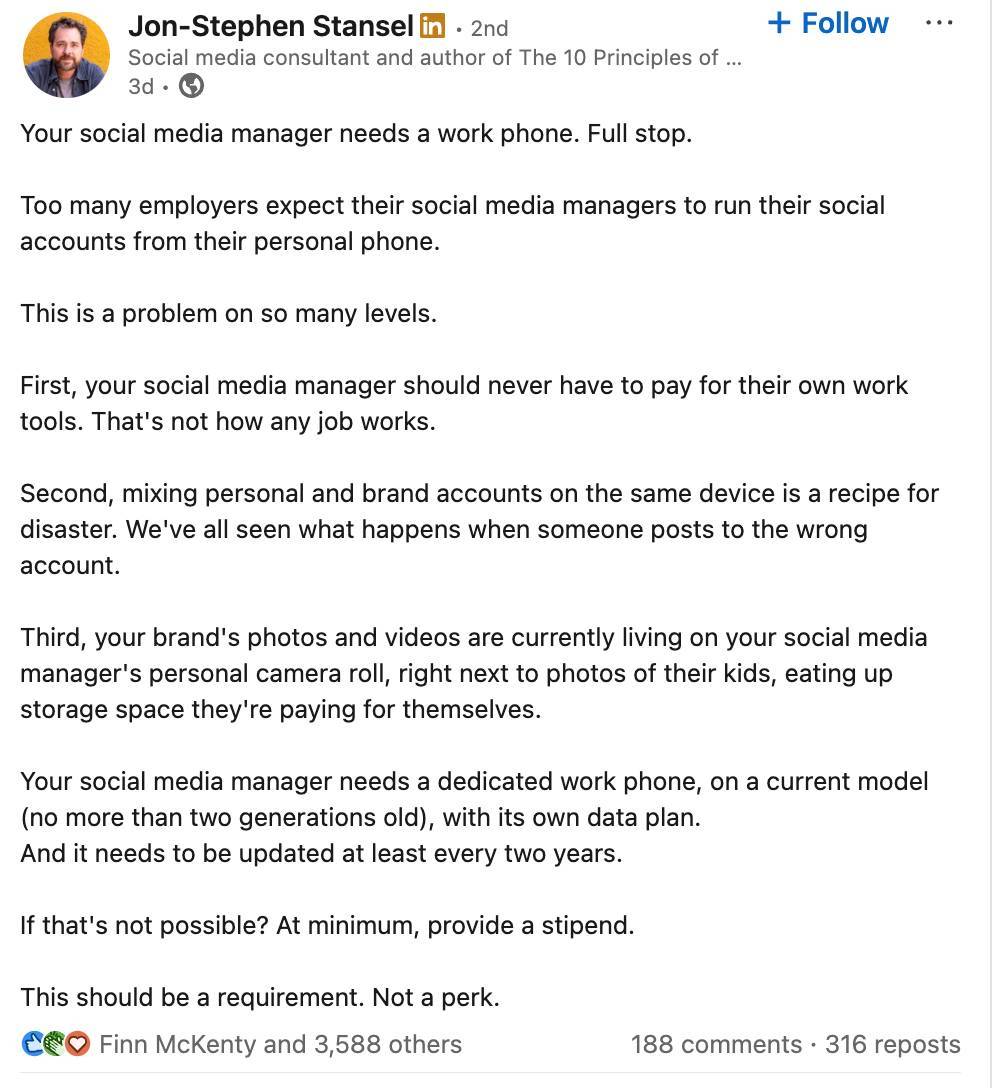
↳ Quippy takes and opinions. Make no mistake: in a sea of mediocre, generic teaching, the most valuable thing you can have is a strong opinion. Opinions are also nearly impossible for AI to replicate — AI cites information and runs analysis on it; it doesn't have takes. That makes a real point of view, both a strategic and a competitive advantage in the feed. Think Twitter. Look at the one from Jon-Stephen Stansel here:

Write a LinkedIn Newsletter
This deserves its own moment, because I'd argue it's the single most underused asset on the platform.
A LinkedIn newsletter does two things almost no other content type does:
LinkedIn does the subscriber-acquisition work for you. When you publish, your network is prompted to subscribe. You compound an owned audience without running ads or building a separate funnel.
It powers your entire content mix. I'm able to put out the volume of LinkedIn content I do because every week I'm not creating seven posts from scratch — I'm publishing one deep-dive newsletter and pulling seven standalone posts off the back of it.
Then there's what Richard's report tells us. According to the 2026 algorithm insights:
Article reach is up 13.1% year over year.
Engagement multiplier on articles is up 51.7% — the single biggest positive shift of the year, by format!!!
And in the era of AI-powered search, articles are doing something else important: they're getting cited. LinkedIn itself has published guidance on how to use articles to improve visibility in AI chats and searches. That's significant. Your LinkedIn article can become the source an AI assistant pulls from when someone asks a question in your space.
You can rip my LinkedIn newsletter from my cold, dead hands before I'd ever abandon it. It is such an underused, underutilized asset, and I will die on that hill. In fact, when I work with my Brand Inner Circle clients, one of the very first things I have them do is claim their category via a LinkedIn newsletter. All the more important in this era of AI.
The way I actually pull seven posts out of one newsletter is by running it through Stanley. I drop the long-form in, Stanley breaks it into draft posts that match my voice and stay locked to one of my three topic lanes (the topic discipline part the algorithm now rewards). You can watch me do this on the replay of "The Winning Content Mix, Live: Build Your 2026 LinkedIn System in 60 Minutes."

Personal Stories — ~20% Of Your Content
This is the content that makes people like you and trust you. It's how you create intimacy at scale, so that by the time someone gets on a call with you, they already feel like they know you.
What lives here:
Quippy takes and opinions. These can appear in this pillar as well. They don't strictly have to be about your two to three topic areas, though they certainly can be if you want to bolster topical authority. Example from Tobias van Schneider:
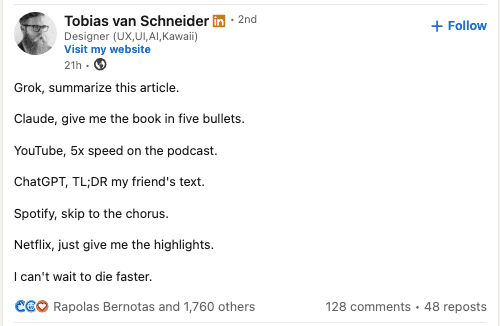
LinkedIn meets Twitter. Here for it.
"Building out loud." I had a client throwing his first in-person, inaugural destination event. He asked me how to market it. My answer: document the build. Write about the milestones. Write about how you found your sponsors. Write about how it's coming together. Building out loud lets your audience cheer you on, feel part of the process, and — yes — ultimately convert. Regina Quartey is doing this full-out right now and I'm eating it up like candy:
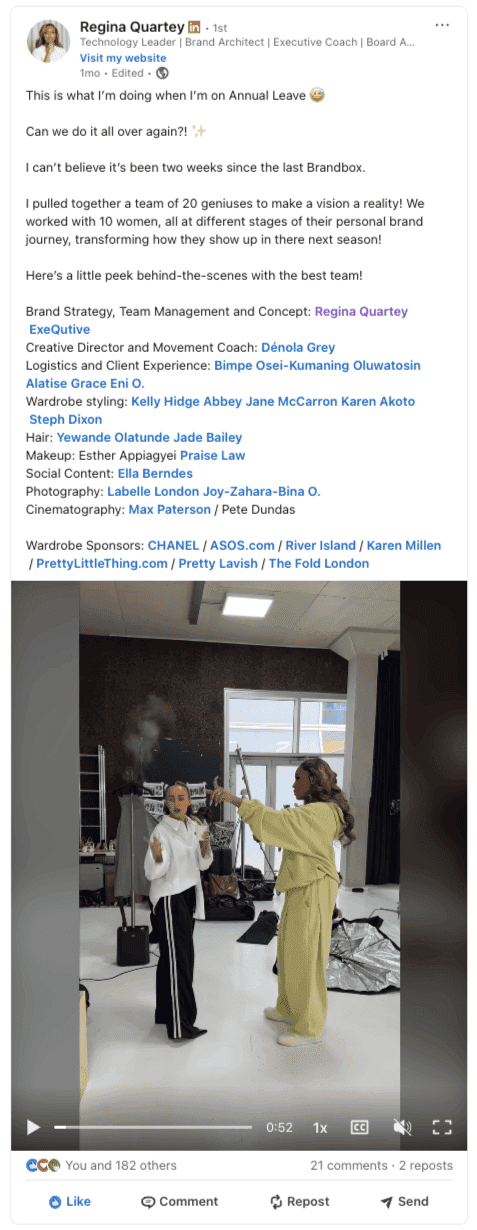
Wardrobe sponsor Chanel? FLEX!
Behind-the-scenes. What does a day in your life actually look like? What's on your calendar this week? What industry events are you headed to? Morgan Young is my favorite at this:
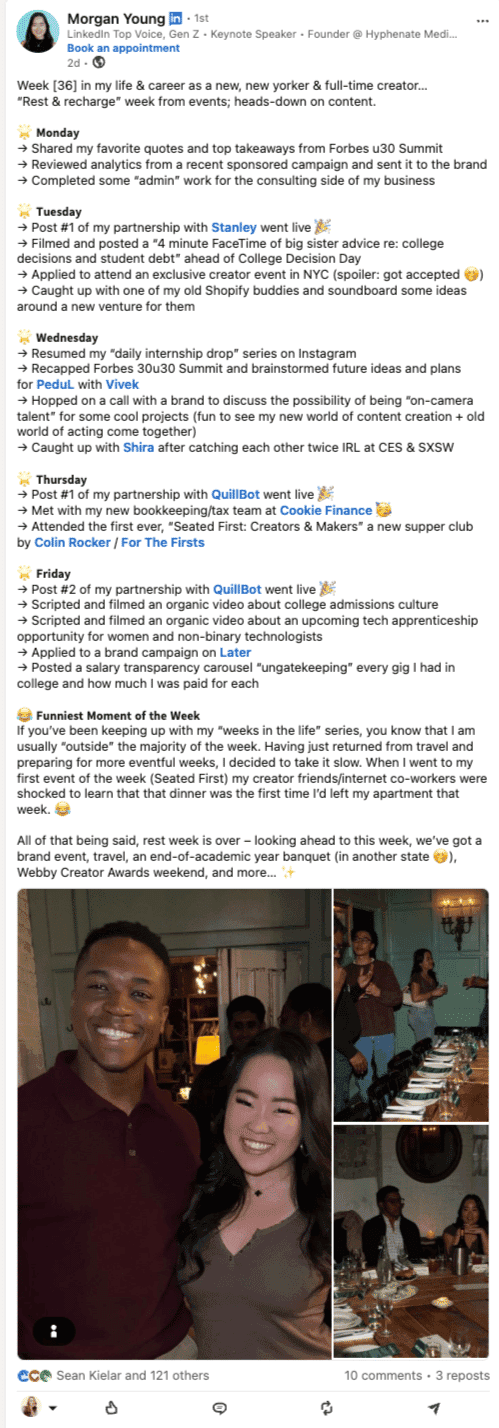
Loveee Morgan's weekly series documenting her life as a creator and NYC resident.
Career and life reflections. Mistakes you made. Decisions you'd make again. Things that turned out to be enormous strides forward but didn't feel like wins at the time. Lookbacks of that nature land really, really well here.

Case Studies — ~15% Of Your Content
This is where you hook on a specific client problem, walk through the work, and show the results and the proof. It's bottom-of-funnel content. It's not a direct conversion play — but it lives in the sales zone, and it does the work of making your offer feel real and tangible.
You can occasionally blend case studies with product or program announcements, but I keep direct calls to action at roughly 5% of total output — almost nothing. I'd rather empower people to take action through a strong profile than overwhelm the feed with conversion asks.
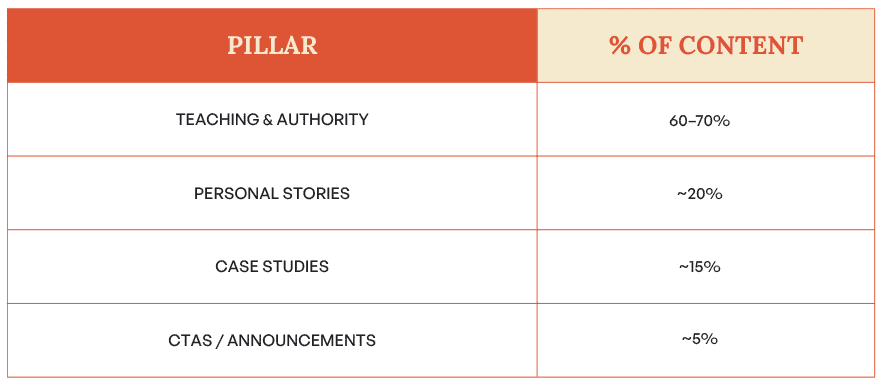

Let's run the numbers on a 3x-per-week cadence, since that's where most of my clients land.
3 posts per week × 4 weeks = 12 posts per month.
Apply the ratio:
Teaching & Authority (60%) → ~7 posts/month
Personal Stories (20%) → ~2–3 posts/month
Case Studies (15%) → ~2 posts/month
CTAs (5%) → ~1 posts/month (usually pooled into a launch month)
Plus: one LinkedIn newsletter per week.
That newsletter is the engine (and your AEO buddy). It's the deep dive you mine for the rest of your week's posts — your frameworks, your "How Is," your hot takes, all of it. You don't write seven things a week. You write one thing well, then re-express it across the feed.
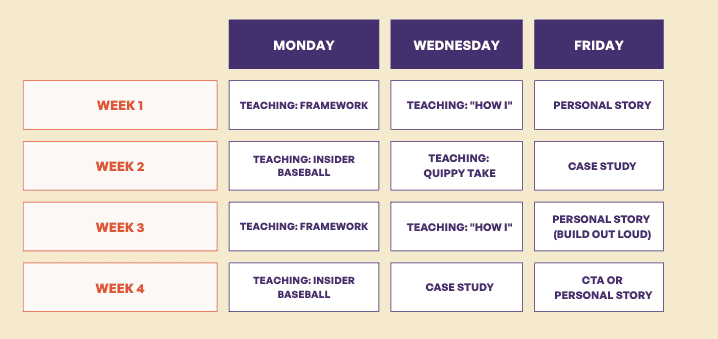
That's the mix! Three pillars, weighted heavily toward teaching, anchored by a weekly newsletter, with personal stories building trust and case studies doing the closing work in the background.
Save this one. I'll be referencing it for the rest of the year. 💾