Read Time: 8 minutes
You're Not Shadowbanned. LinkedIn Just Changed the Rules. Here's What's Actually Going On
It was the best of times, it was the worst of times. It was LinkedIn in 2026.
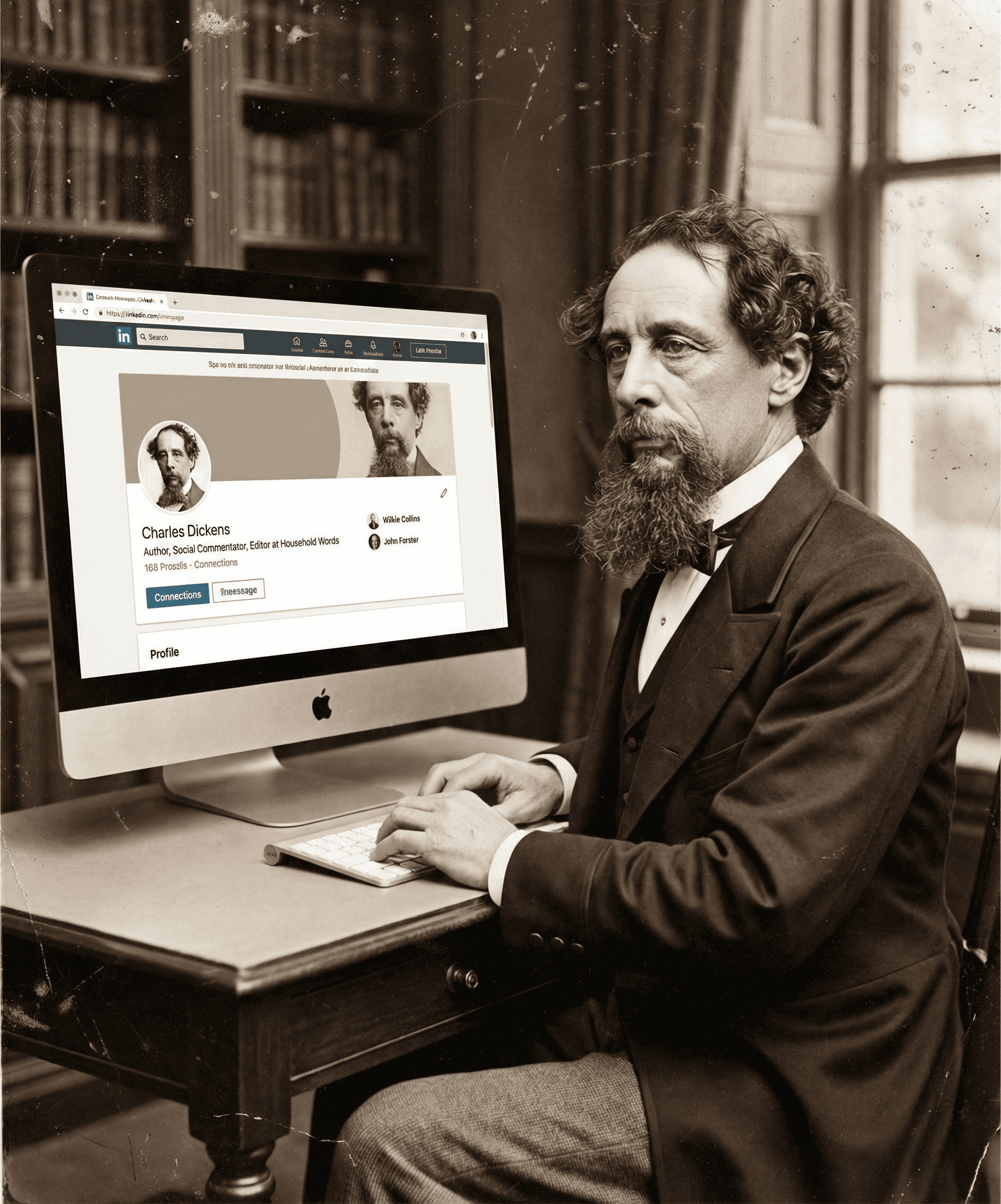
In the past year, two interlocking paradigm shifts rocked LinkedIn at once: the introduction of “360Brew,” LinkedIn’s new algorithm, and the mass adoption of AI tools for content creation.
And if you want any shot at building real influence on this platform in 2026, it’s imperative that you understand the two forces at play, how they impact your performance, and what to do in light of it all.
The first is the introduction of LinkedIn’s new large-language-model algorithm, 360Brew.
What 360Brew is (the “non-techy” breakdown)
We can think of LinkedIn like a giant networking conference (I mean that’s pretty much its value prop, so why not).
Old LinkedIn: the “host” mostly decided what to show people based on obvious signals like quick likes/comments and some basic topic matching.
360Brew LinkedIn: the host is now way better at understanding what a post is actually about, who it’s truly for, and whether it’s genuinely useful—not just whether it gets fast engagement.
Under the hood, 360Brew is LinkedIn’s newer, smarter “brain” for deciding which content to distribute and to whom.
How this makes the platform different from before
1) It’s less “format-based” and more “meaning-based”
Before, certain formats could punch above their weight:
engagement bait (“Comment YES and I’ll send it”)
gimmicky hooks that create quick reactions
posts engineered to trigger shallow comments
Now, LinkedIn is better at recognizing what’s real value vs what’s just engineered to get clicks.
2) It connects more dots across the platform
LinkedIn doesn’t just look at your post in isolation.
It’s getting better at combining signals like:
what you post about
who you interact with
what you tend to read / engage with
what your profile suggests you do
So your “brand” becomes more like a consistent pattern LinkedIn can understand rather than a series of one-off posts.
3) It’s more personalized
Two people can see totally different versions of LinkedIn now, because LinkedIn is more confident about matching content to specific people who will care.
This is why your impressions may have been “down” lately. I’ve experienced this myself! But you know what else I’ve experienced in the last 3 months? More DMs from people wanting to work with me. So this is a good thing! Because at the end of the day, if your content goes viral with people that would never pay you or give you your industry flowers, what’s the point of all this effort?
How it has changed the platform (what you’ll notice)
More reward for clarity and topical consistency
If you talk about 5 unrelated topics, LinkedIn has a harder time knowing who to show you to.
If you repeat clear themes (ex: leadership, hiring, sales strategy), LinkedIn learns:
“This person is for this audience.”
Result: more stable reach over time. (Weather the storm! It takes about 90 days for this to kick in)
More reward for substance (especially in comments)
“Nice post!” doesn’t do much anymore.
Adding a real point, example, or disagreement helps LinkedIn understand your expertise and your network relevance.
Less reward for cheap engagement tricks
Some tactics still “work” briefly, but they tend to burn out faster because the system is better at detecting low-value patterns.
Here’s where things get dicey, though…
360Brew made the platform more discerning than ever — hooks, engagement bait, and generic prompts that used to go viral now get deprioritized immediately. But at the exact same time, we’ve reached a fever pitch of LinkedIn members using AI tools to create content. And while this isn’t unique to LinkedIn, it’s probably most notable here because, by and large, this platform is still “written word” forward. Instagram and TikTok are mostly video-forward, so we haven’t seen as much mass inundation of AI there quite yet.
That’s a real problem because those AI writing tools most people are using? They're essentially engineered for those hooks and generic prompts. They've been trained on the very content the algorithm is now punishing.
So on one hand, you have an algorithm cracking down on inauthenticity. On the other, you have tools that are basically a factory for it. When these two things collide, it creates this wildly frustrating situation where it finally feels like you have everything you need to show up — and yet nothing is working.
So now what?
Enter the era of the personality hire!
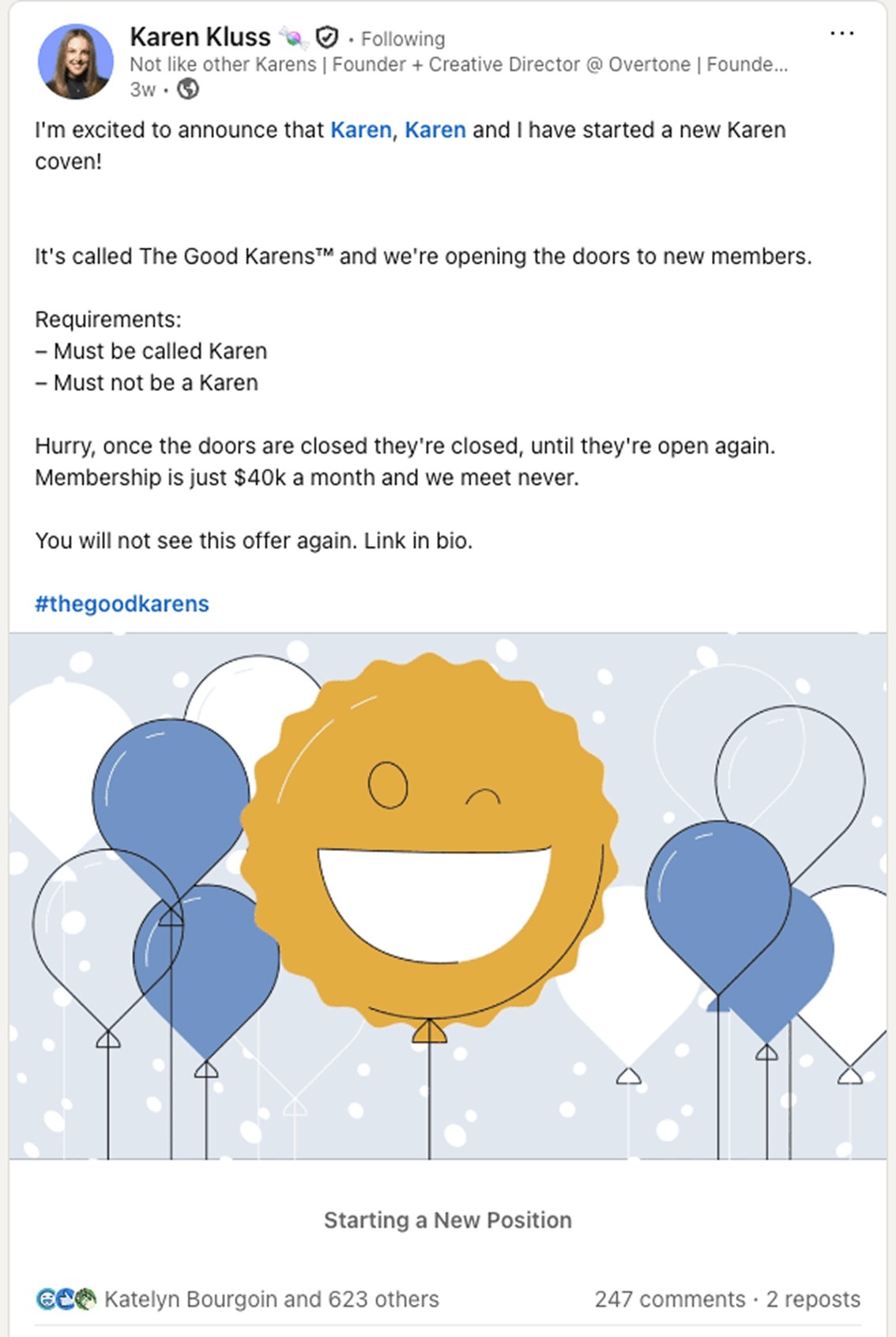
If you’ve been seeing so many fun creators crop up and smashing it with eyeballs on this platform, it’s because of this maddening paradox. We, as audience members, are hungry for content that is innately human — things that only a human could understand and articulate. Like this post about “Karens.”
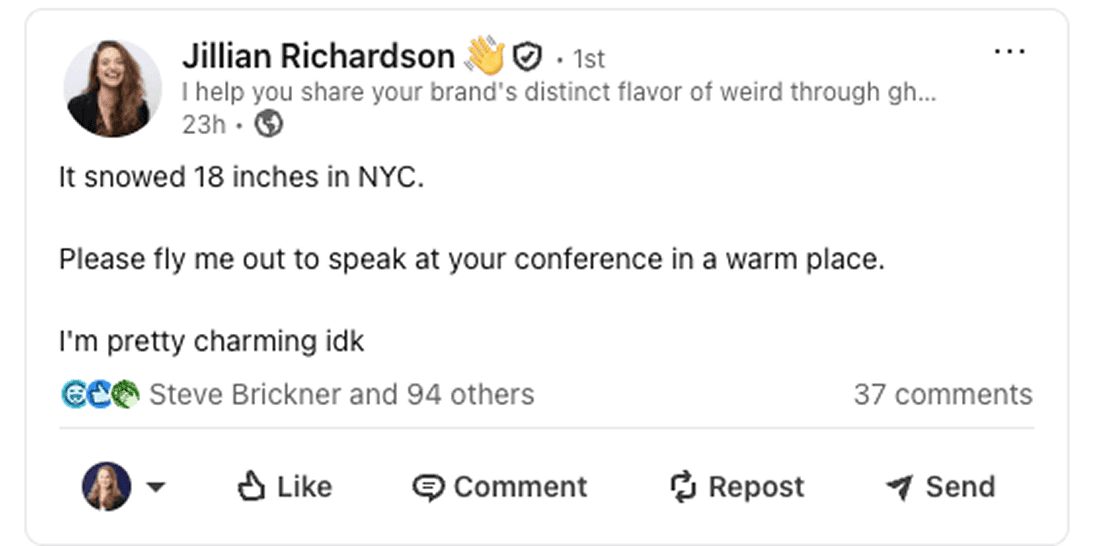
And this post about the fact us NYC-ers are soooooo over the snow…
Or this one, which jokes at how the typical go-to message after you connect with someone on LinkedIn is, “I’m curious to know what made you connect with me?”
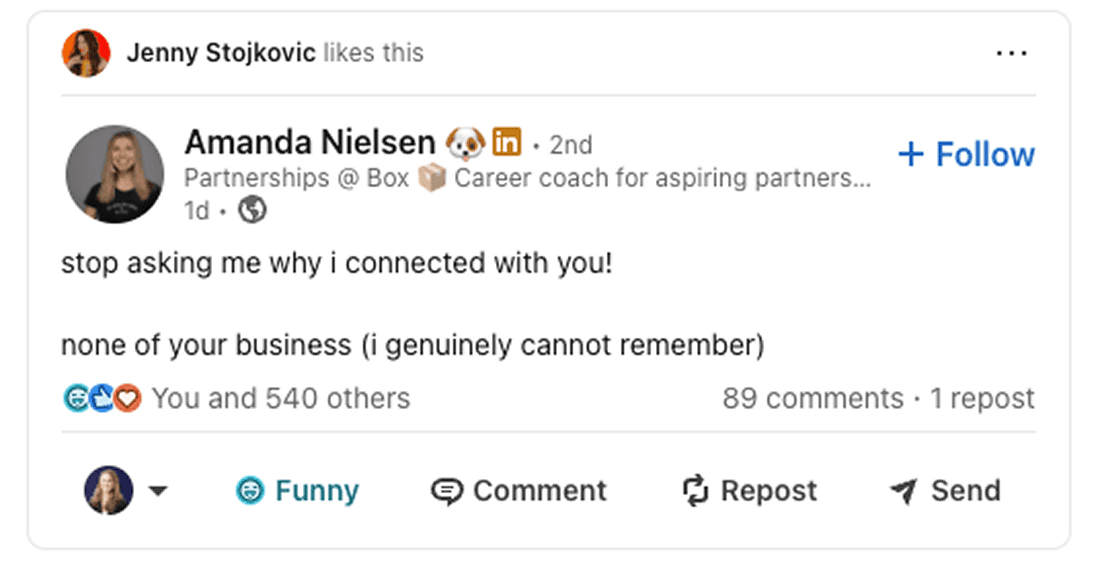
I mean, I genuinely LOL-ed reading these, and many others like them. Because AI could neverrrrrr.
Alec Paul summed this up beautifully in a post I saved:
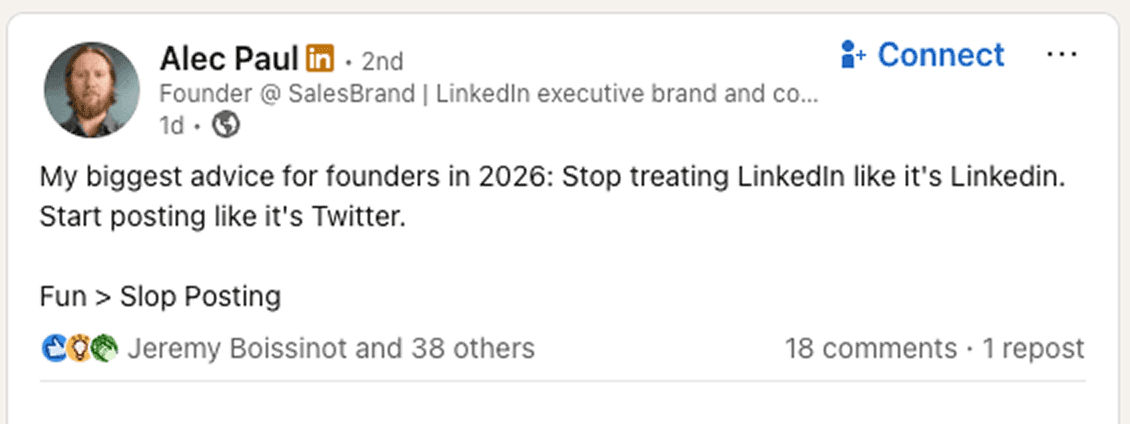
What he’s basically saying here is in a world where AI has proliferated boring, educational content, it’s better to do something the robots haven’t quite cracked yet: use your personality, nuance, and voice to entertain, update, and delight.
Well, what a relief, right?…RIGHT?
Except for maybe not! Sure, quippy snappy posts can be great for copywriters where writing and voice is the literal product, or start-up founders and employees where being innovative and irreverent is expected, but what about someone who works in the aviation industry and wants to become a thought leader in security protocols?
Think about Neil DeGrasse Tyson. I don’t think many people would immediately call him “hilarious.” But he is completely, unmistakably himself — and his superpower is taking impossibly complex things and translating them in a way that makes you feel like you're in on something. He literally wrote a book called "Astrophysics for People in a Hurry." That's a personality and point of view.
So our aviation security person doesn't need a punchline. They can be a translator, "You see a flight delay. We see a cascade of 14 decisions that started breaking down 6 hours ago." That's insider baseball and a lens only they could have.
What’s needed is a blend of really understanding your area of expertise/topics, your unique voice (doesn’t need to be Comedy Cellar-ready), and your unique point of view.
What you should do (a simple playbook)
If you want to grow your brand now, do these 5 things:
1) Pick 2–3 topics you want to be known for
Example: “executive communication + stakeholder management + career growth.”
2) Make your posts easy to categorize
Who is this for?
What problem does it solve?
What’s the takeaway?
3) Write like you’re helping one person, and speak like you’re speaking to that person
Really lean into specificity, and let your personality shine. Example: When I’m frustrated, even when I’m talking to clients, I say “oh my lanta!” Don’t censure that kind of stuff! Write like you speak. It’ll help zoom in on a narrow audience while naturally enhancing your personality. (This is where dictation tools can really be your friend. Try as we might, we often suck at writing like we talk. So just cut the keyboard and go right to the mic and then let tools like Wispr transcribe for you.)
4) Comment with substance in your lane
5 strong comments/week on relevant posts can do more than 5 extra posts.
5) Make your profile match your content
If your content says “I help X,” but your profile reads like a generic resume, LinkedIn (and humans) get mixed signals.
Take a look at this absolute banger of a post from a member of my Brand Inner Circle Community:
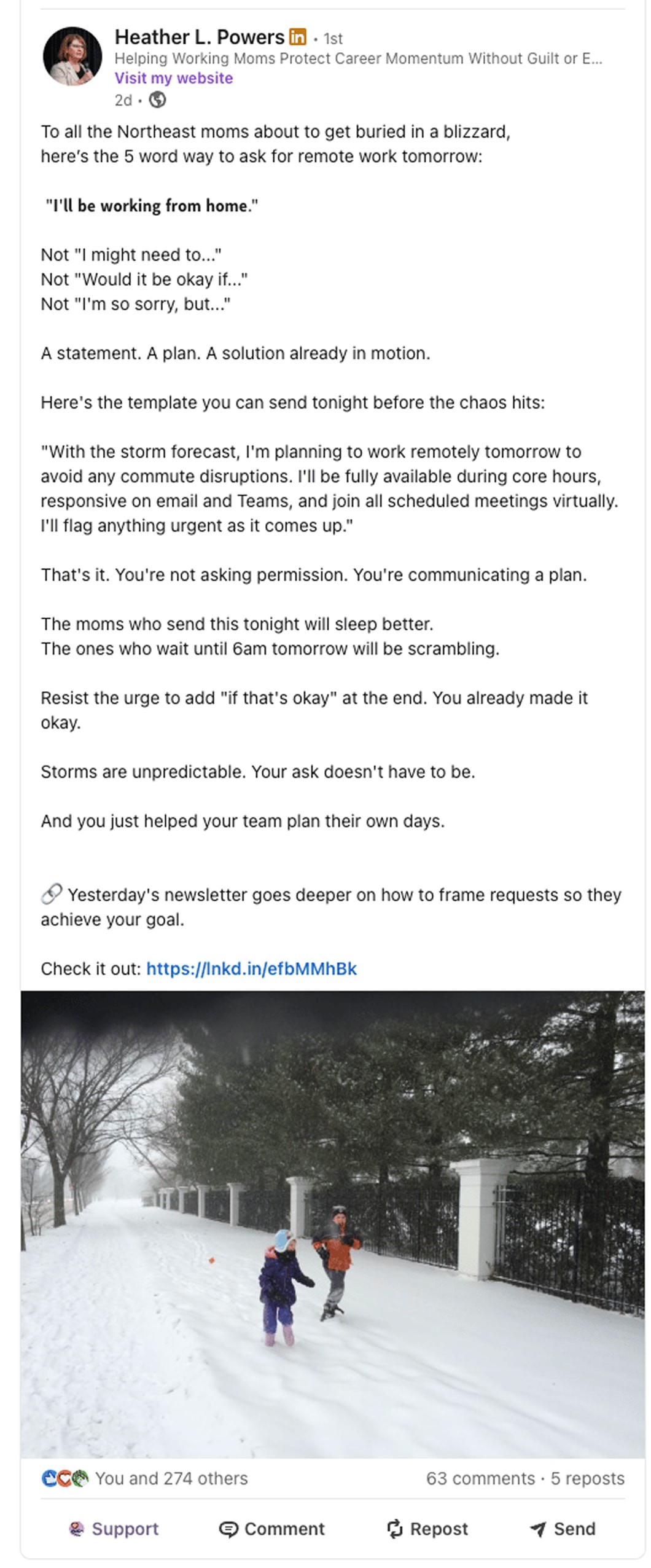
Here’s why this worked so well, given the algo:
Notice Heather’s title, “Helping Working Moms Protect Career Momentum Without Guilt.” It aligns perfectly with this post. The algorithm sees that immediately.
Over the last 90 days, Heather has been really leaning into that lane. Updating her profile, creating more content (newsletters, too!) around it, and commenting on women who fit that description.
Look at the specificity of the opening lines of this post (addressed her audience/topic directly + extremely timely and relevant)
You also get a sense of her personality (”Not, ‘I might need to…’”; “Not, ‘Would it be okay if…’). You can tell she is firm and caring.
The photo is highly contextual to the post.