Read Time: 8 minutes
Your Peer Network Becomes Your Net Worth: How Strategic Peers Create Faster Growth
Work with any LinkedIn coach (any good one, at least), and you’ll notice that the fundamentals of a sound LinkedIn strategy don’t really change. You need to cover these 4 bases if you want to grow on the platform:
A messaging strategy - I call this your magnetic message. It needs to blend your million-dollar market, your unique skills and personality, and a problem/pain that creates demand in a punchy, concise way (fail at this, you’ll build a house of cards)
A content strategy - frequency (2x/week min), style that will keep you consistent, your unique angles that will increase the time someone stays on your post, the amount of times they save it, and its “shareability.”
A connection and engagement strategy - how to add the right people to your network and interact with them meaningfully
Bonus: A packaging/offer strategy - because at the end of the day, if your offer isn't good or packaged well, you'll be popular and broke (note: this is applicable to those with their own business/side hustle. If you are going for employment, not as necessary). I say "bonus" because some LinkedIn coaches don't go deep on this aspect. That's no shade to them, but if you're looking for actual money in the bank vs. visibility alone, it's not just clarity and algo stuff that will get you there; it's packaging.
Now, there are specific tactics that fall into these roll-up buckets. Example: Overhauling your headline and profile falls within bucket one — messaging.
Today, I want to zoom in on a tactic underneath bucket three, your connection and engagement strategy.
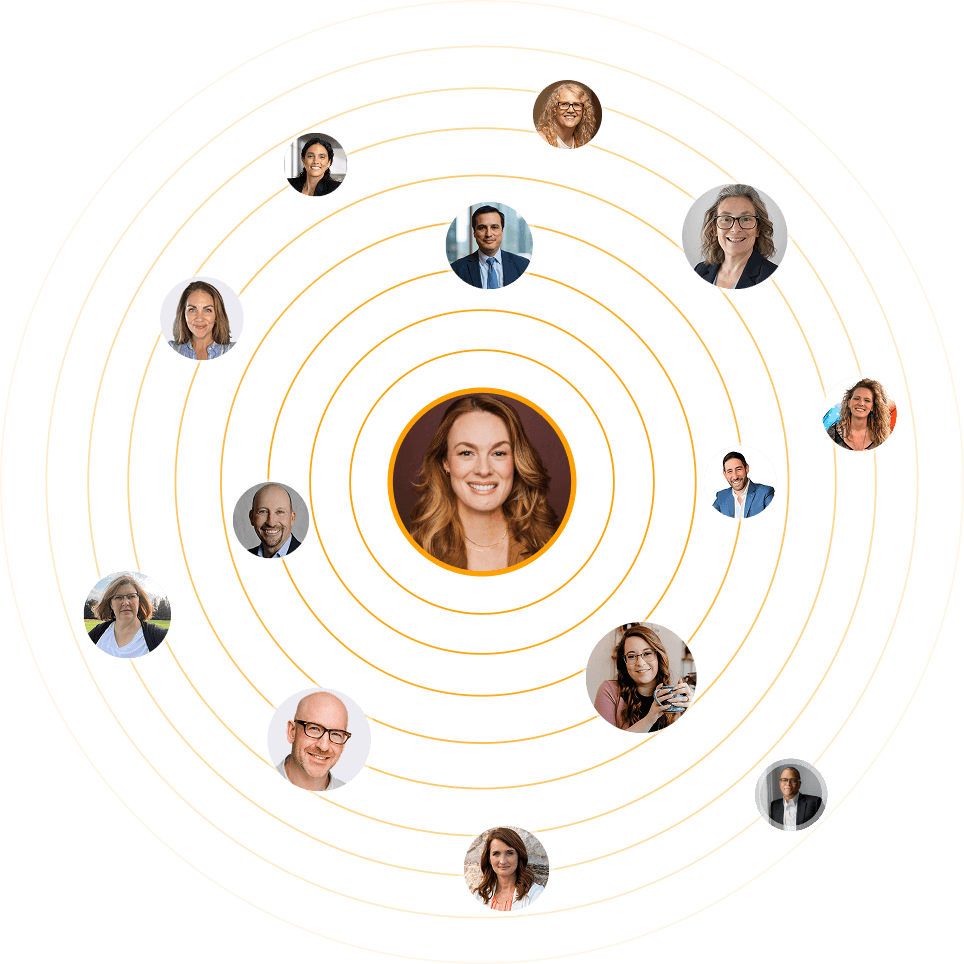
In my courses and community, I cover the 4 types of people you need to activate on LinkedIn to grow eyeballs on your profile and dollars in your bank account. Here’s a snapshot from my 30-Day Brand Builder Program:
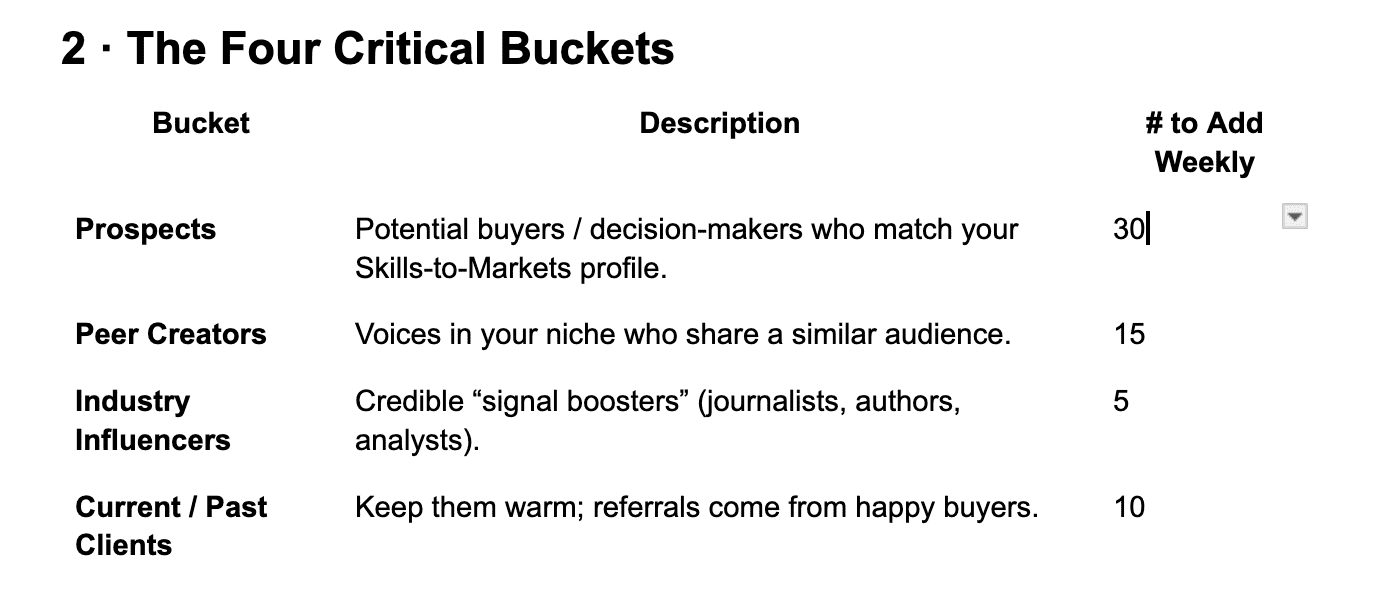
I see most of the chatter on here dialed into activating prospects and “industry influencers” to siphon eyeballs. But I don’t see nearly as many discussing “peer creators/collaborators.” These are people who aren’t ahead of you; they’re people who are also interested in growing in the same vertical you are.
These can be the hidden accelerators that will push you to grow quickly.
But making them an intentional part of your personal brand strategy feels antithetical because:
Aren’t they, like… technically… competition?
The allure of spending more time engaging with larger influencers feels faster
How do you even find them??
But look at most creators’ activity (not posts, activity), and you’ll see that they all “came up with” other creators.
Charlie Hills 🤝 Fatima Kahn
Jasmin Alic 🤝 Lara Acosta
The reality is this:
You can either muscle your way through growth in a vacuum, bemoaning people in your space and secretly being envious, OR bake a big, delicious pie together and divvy up really hearty slices.
Take it from me…option 2 is so much more fun. (and lucrative)
Ground Work: Recognizing this isn't a “Creator Thing” or “Growth Hack”
This is a professional thing.
It’s the same reason the best networking events are worth it… and also why most people misunderstand what they’re paying for.
The best networking events don’t give you 10 new clients
They give you 1–3 relationships.
The kind that turn into:
partnership opportunities,
steady referrals,
warm intros,
credibility by association,
and pipelines that compound for months or years.
What you’re doing on LinkedIn is effectively building that same outcome—but at scale, in public, and in a way that can be shockingly lucrative when you do it with intention.
Because trust is the whole game. Nielsen’s global research has found that people trust recommendations from friends and family more than any other advertising format. That same dynamic is why peer-driven visibility works: it’s not you claiming you’re credible—it’s someone else vouching for you in a context that already has attention.
So here’s the model…
The Peer Flywheel (the 3-step version that actually works)
1) Pick your Peer Bench (Selection)
Build a Peer Bench of 5 go-tos: people in your lane or adjacent lane, similar stage, strong thinking, consistent enough to collaborate.
Why 5?
Simple. You can count them on one hand.
You shouldn’t need a spreadsheet to remember the close relationships you’re actively cultivating. If you do, that’s a sign this is turning into “networking” instead of real peer relationship building.
This isn’t a transactional growth hack. This is you deciding, on purpose, who you’re going to build alongside. Like two rookies that are bound and determined to push themselves to greatness. You want to find the Dwayne Wade to your Lebron. (And if you don’t like Lebron, idk what to tell you, it was the best sports analogy I could come up with here that I felt most people would know.)
To do this, use three filters:
Audience overlap: your clients would also benefit from them
Values overlap: you’d be proud to be associated
Energy match: they got the goods, respond, and follow through
This part matters more than people want to admit.
Because most professionals don’t struggle with effort—they struggle with misaligned effort.
They spend months trying to get the attention of “industry influencers,” when the faster path is building with people who are right next to them… and rising.
2) Warm the Relationship (Credibility + Context)
Once you’ve engaged enough to have real context, do something most people avoid:
Ask directly.
Not in a 9-paragraph LinkedIn DM. Not with a “hey, love your content!!” copy/paste. Not with an immediate ask for something you haven’t earned.
Do it over the phone or IRL if you can.
“I’m trying to become unignorably visible on LinkedIn to [this type of person]. I think you are, too, and I genuinely enjoy your content. And I think we can grow faster together. Here’s what I envision this looking like…”
And here’s the key: you’re not proposing a growth pact. You’re proposing an actual relationship.
That’s the magic of peer creators. It’s not growth-hacky or transactional. I align with you, I want to grow with you, and I have your back.
Once you’ve had that conversation and you actually know each other, keep it simple and consistent.
Weekly:
Comment on each other’s posts (add real perspective, not claps)
Tag each other in relevant comments (when it genuinely helps the reader)
Share thoughts + ideas in DMs (hooks, angles, contrarian takes, “here’s what I’d say if I were you”)
This works because you’re creating repeated, credible touchpoints.
And credibility compounds.
Harvard Business Review has covered research showing how powerful referrals are—so powerful they can be “contagious,” meaning one referral can trigger more referrals downstream. That’s the invisible engine you’re building with peers: not just attention, but trust transfer.
3) Co-Create Assets (Collaboration)
Now you turn the relationship into something visible.
I’m doing this with two of my favs to follow on LinkedIn, Alicia Teltz and Jillian Richardson, in an upcoming LinkedIn live (I know, get excited, I am!). We all have somewhere between 20k and 50k followers, we all have different angles of a similar niche (LinkedIn growth + personal branding), and our audiences would benefit from those different perspectives.
In this way, the audience doesn’t feel like they’re being passed around. They feel like they’re getting a fuller view of the problem.
These collaborations don’t need to be complicated. It can be:
A “3 questions” mini-interview (post format)
A joint live/workshop
A webinar swap
A roundup (”5 peers answer 1 prompt”)
A friendly debate post (two perspectives, same topic)
One of my favorite examples of this is from my client, Patrick Shurney, who partnered with a Peer Creator-turned-collaborator, Jerry Aliberti.
Both serve construction trade contractors. Patrick helps them reliably take home $1M annually from their business. Jerry helps them scale effectively with operations.
They started collaborating: webinars, shared visibility, complementary expertise.
And it worked so well, they’re now hosting an entire summit in Tampa in May.
This isn’t about likes.
This is about your brand becoming the thing that creates:
paid events,
high-trust demand,
partnerships,
and a real ecosystem you can monetize.
That is a bankable brand.
The hidden win: you stop building alone
There’s also a non-monetary benefit here that matters more than people admit:
Building a personal brand can be lonely.
You get in your head a lot. And as one of my favorite sayings goes, “Your mind is a bad neighborhood to walk through alone at night.” When you have peers who are in it with you—who understand the grind, who can sense-check your thinking, who can tell you when your post is meh—you don’t just grow faster, you stay in the game longer.
And staying in the game is what makes you dangerous.
If you're wondering, “Does this apply to me?”
Yes.
This is not reserved for creators. This is for:
consultants,
operators,
sales leaders,
founders,
recruiters,
real estate pros,
attorneys,
executives,
anyone building thought leadership to create opportunity.
The “creator” label is optional.
The outcome isn’t.
If you want to become unignorably visible to the right people—and turn that visibility into money—your Peer Flywheel is one of the cleanest, most underused levers you have.
So stop trying to climb the ladder alone.
Pick five.
Call them.
Build together.
And let your network become the thing that finally makes your brand bankable.