Read Time: 8 minutes
We Got 360+ People on a Live to Talk About LinkedIn in 2026. Here's What We Actually Learned.
This edition of "Start Small, Brand Big" is brought to you in partnership with Stanley, my favorite LinkedIn content creation tool. In a world where AI writing tools all sound like ChatGPT garbage ("It's not x. It's y."), Stanley stands out. That’s because it's not an "AI writing tool"—it's a full-on LinkedIn growth coach in your back pocket. Every week, it emails you:
→ Your analytics, broken down
→ Content ideas based on what your audience actually engages with—not generic prompts
→ Opportunities and posting gaps measured against top creators in your space
I’ve been using it for nearly a year, and I run all my posts through it for feedback on hook improvements, unique angles, and more. It's undoubtedly one reason I saw a 72% increase in impressions last year (while many saw a 40% dip) and added over 12.5k followers in 90 days. Try a week free for yourself here—>https://stanley.stan.store/?ref=kaitledonne-personalbrandingexpert
Ok, now let’s get into it, shall we?
A few weeks ago, I wrote an article about 360Brew and the AI content crisis and how the two of them together are creating one of the most frustrating paradoxes this platform has ever seen. (You finally have all the tools. Nothing is working. Congrats!)
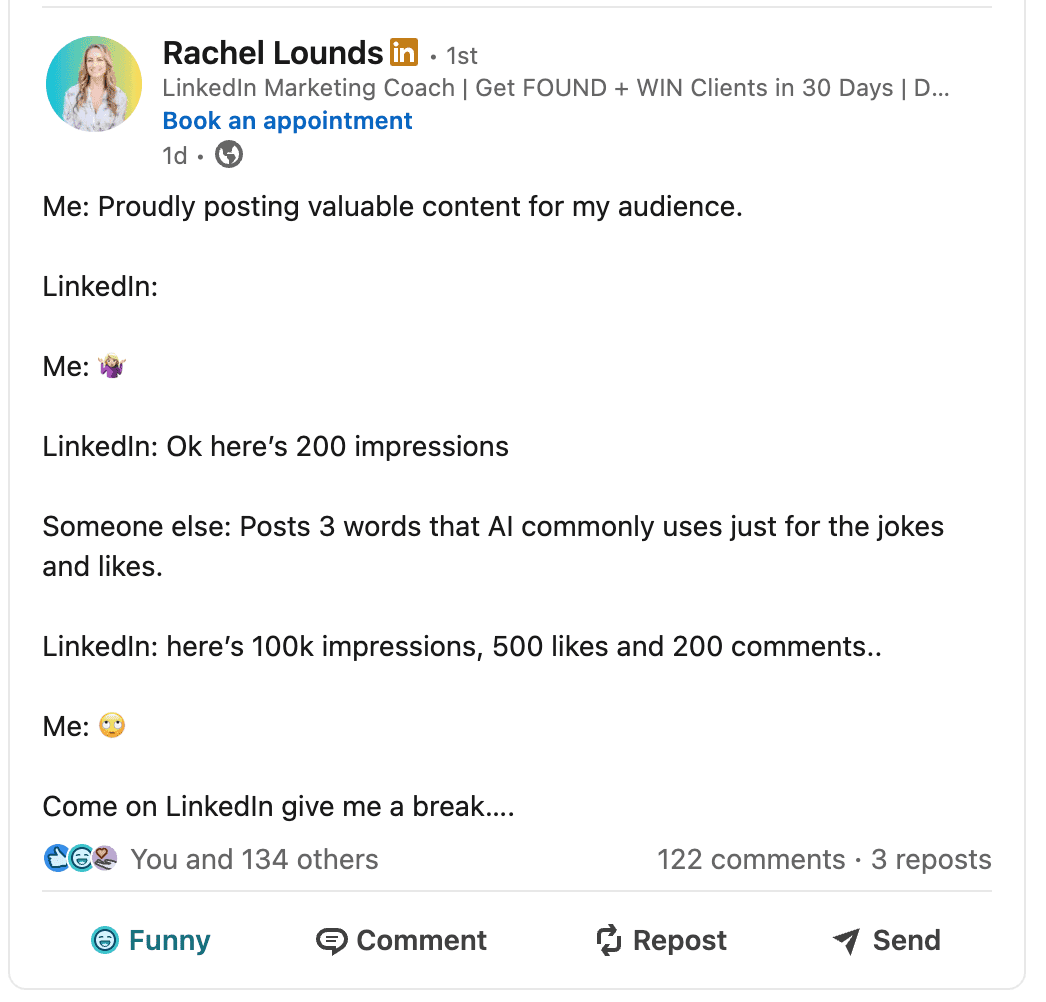
This post from Rachel Lounds pretty much nails it:
That article ended with a question I answered in brief: “Okay, but now what?”
But how can one possibly answer such a loaded question without it devolving into an article as long as a thought piece for The Atlantic? (Seriously, I clocked a half-hour read time on one two weeks ago)
So I did what any reasonable person would do. I called in reinforcements— really, really good reinforcements.
Last week, I hosted a LinkedIn Live with two people whose LinkedIn posts I binge more than people are binging Love Story by Ryan Murphy.
Alicia Teltz is a former Global Client Executive at LinkedIn who grew her following to 39,000 in roughly six months after leaving the company and has actual inside knowledge of how this platform operates at a structural level.
Jillian Richardson is one of LinkedIn's top ghostwriters, hit 25,000 followers in under 12 months, and has made a whole art form out of being unapologetically herself in a space that traditionally tries to sand that down (her seminal post, “make LinkedIn weird” took on a whole movement).
Over 360 people registered. The conversation was — if I do say so myself — a good one. Nay, a great one.
Here's the distilled version and the top notes and reminders I walked away with.
1) Journalists Are Right Here…And Nobody is Talking to Them.
This one doesn't get nearly enough airtime, and I will shout it from my virtual rooftop until it does.
In 2011, Forbes touted the widely-sourced statistic that 94.2% of journalists use LinkedIn to find sources. Now, that figure needs a little bit of calibration. Enter Muckrack’s findings on how journalists planned to engage with social media platforms in 2024 from their “The State of Journalism, 2024” report:
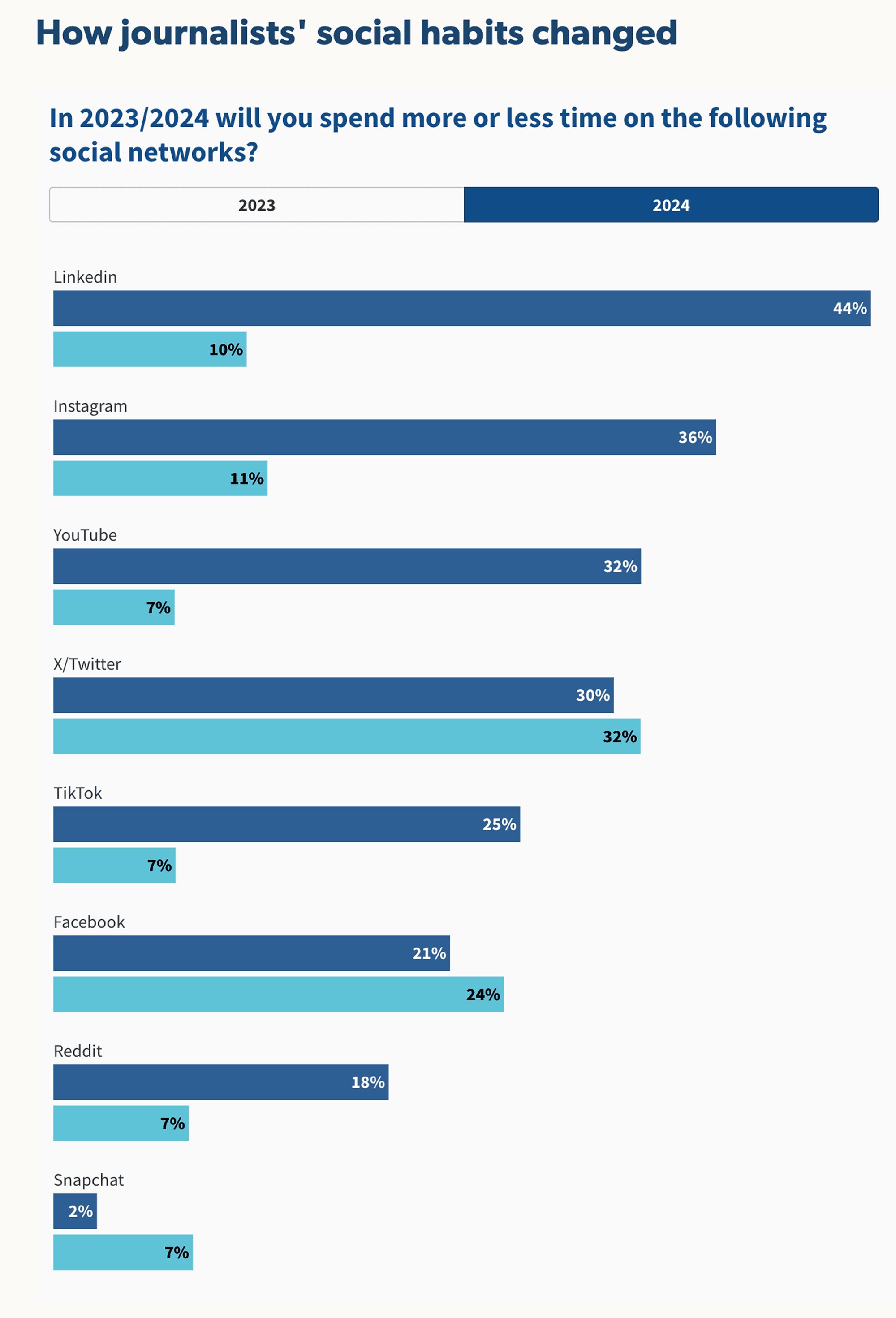
Journalists’ use of this platform is a reality that most of us walk right past while we’re busy wondering why nobody important has noticed us yet.
Here’s what I told the room: when you have a post that performs well — really well — that’s not just a vanity metric. That’s a pitch-ready data point. Reach out to journalists who cover your topic. Tell them the post struck a nerve and there are real stories in the comment section. Offer them the work you’ve already done. They will pay attention.
That’s exactly how I got featured in Forbes and Entrepreneur. Not because I had a giant following. Because I showed up with something useful in my hand.
LinkedIn editors — the ones who hand out Top Voice badges, run newsletters, and curate editorial coverage — work the exact same way. As Alicia put it, “become their intern.” Give them things to talk about. Help them with their newsletters. Get on the radar before you need anything from them.
The people who hold the keys are right here, in this very app. Accessible, scrappy, and almost always looking for a good source. Don’t make them find you. Find them.
2) There Is No "Right" Post Type Anymore. There's Just the Right One for You.
If I had a dollar for every time someone has told me that one specific post format is The Secret to LinkedIn Growth, I’d have enough money to hire someone to ignore that advice for me.
Here’s what Alicia confirmed, and what I’ve now lived through enough posts to believe in my bones: the algorithm has moved away from rewarding formats and toward rewarding meaning. It doesn’t care if you posted a carousel, a selfie, or a wall of text. It cares whether people actually stopped, read, engaged, and responded.
Which means the real question isn’t “what’s the best post type?” It’s “what’s the best post type for you and your audience?”
I have tried text-only. I envy and admire people like Jillian, Mike Rosenberg, and Karen Kluss, who are so whip-smart with copy alone that their posts go viral. I have tried it a bajillion times, with great conviction and a hopeful heart. And consistently, after years of testing, photos just work better for me. Which clocks with what Alicia shared: selfies have longer dwell time. And it fits with my whole message: personal branding. I am, ahem, kind of the brand.
When people see eyes, they linger. It’s biological. It’s pre-Stone Age, which is why we think we saw Einstein’s face in a cloud. And it doesn’t care about your opinion on the matter.
People like Jillian, Mike, and Karen? They are gifted, funny, wildly successful writers who do text-first content, and it’s so core to who they are.
And that’s the whole thing. The format should serve your strengths, not the other way around. Stop trying to reverse-engineer someone else’s playbook. Start testing what actually makes you feel like yourself and what your audience responds to.
3) Video Is Coming. Just... Not Necessarily Today?
Let’s be honest. LinkedIn keeps telling us to post video. We post video. It flops. We feel betrayed. We eat our feelings. We move on.
Here’s the fuller picture that Alicia laid out: the current video experience on LinkedIn is, to put it diplomatically, a mess. The interface is clunky. The algorithm doesn’t yet understand what videos are about, which means it doesn’t know who to show them to. The editorial team in the US is manually featuring videos (not scalable). And if you film vertically versus horizontally, good luck with getting your captions read.
But here’s why we can’t dismiss it forever: Gen Z is entering the workforce, and Gen Alpha ain’t far behind them. They grew up on TikTok-native storytelling. Their standards for video are high. Their attention spans aren’t actually shorter — their expectations are just better. And as they take up more real estate on this platform, the infrastructure will have to catch up with them.
Alicia pointed out that LinkedIn’s own CMO went on record recently to say that video is king and that under 30 seconds is the sweet spot. She posted a video the very next day, did everything right, and it performed really well.
So what do we do with this? Keep writing. That’s still the engine. But don’t write off video forever. Pay attention to which ones capture your attention on Insta and TikTok, and note how you could adapt what’s working for when the hammer drops for real on this platform.
4) Say What You Want Out Loud. On the Platform. Like, Literally Just Do It.
Jillian named the most underutilized tactic of the whole session, and it was so obvious it made everyone feel a little ridiculous:
Ask for what you want.
She asked people in her community what they’re trying to accomplish on LinkedIn. Inevitably, they’ll list five things they want but feel nervous to say publicly. “Well, I’d really love to partner with an HR company”, or “I’ve always wanted to speak at this kind of event.” And Jillian’s response is always: what if you just… posted that?
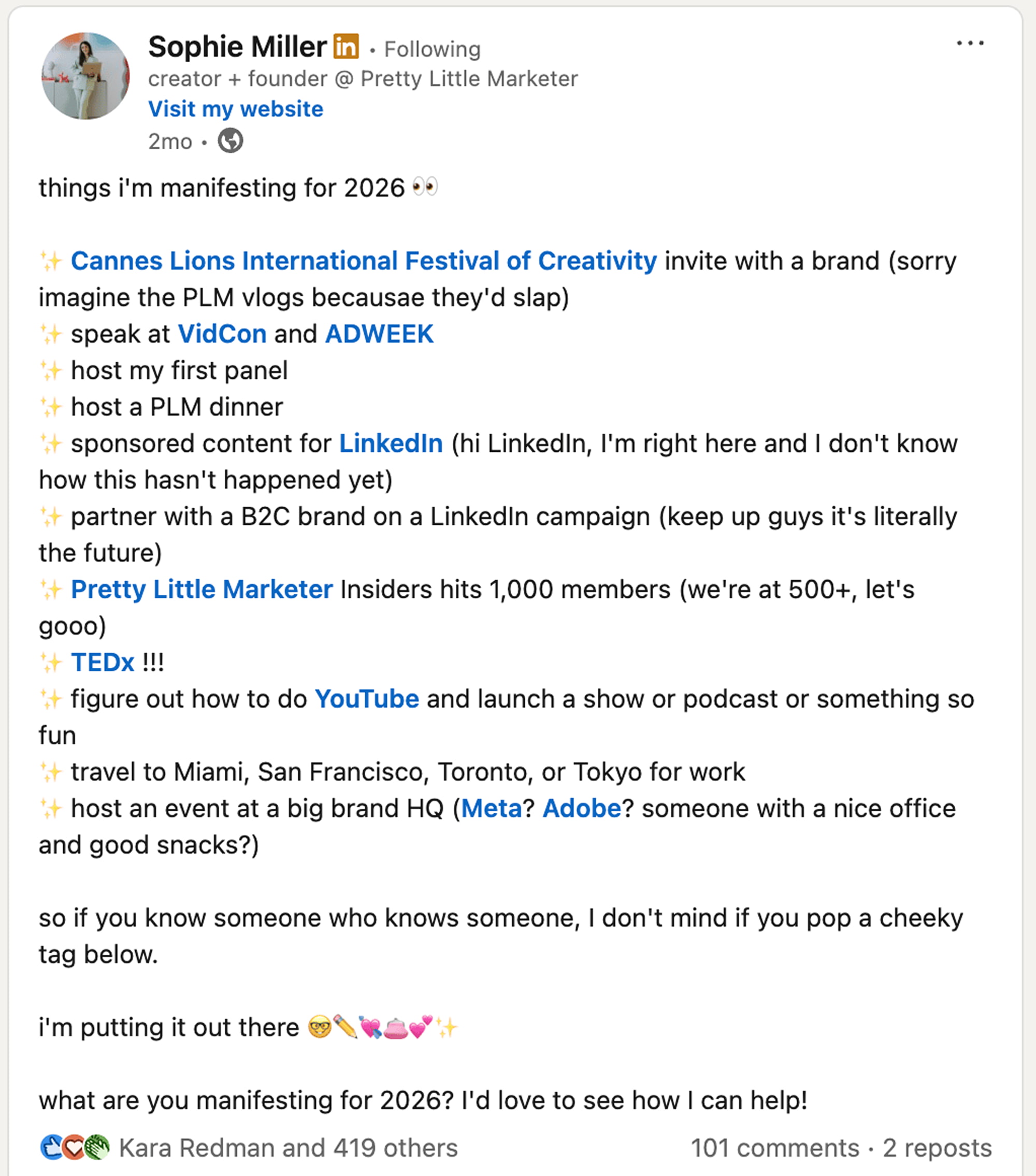
Sophie Miller, of The Pretty Little Marketer fame, did this masterfully at the beginning of 2026. I guarantee you that at least 50% of these things happen for her. The comments section was, of course, full of ideas, intros, and tags:
Alicia shared that she utilized a similar strategy when she told people to watch her grow her LinkedIn following to 10k in 90 days. I’ll let you guess what happened. (spoiler: she did)
Look, worst case, you're just putting it into the universe. But in the best case — which happens more than you'd think — the right person sees it and makes it happen.
You’re not bugging anyone. You’re not being presumptuous. You’re doing what every good networker has known forever: telling people what you need, so they have the chance to show up for you.
5) 360Brew Is a Mud Puddle. The Strategy That Cuts Through It Is Clarity + Consistency.
We’re not going to pretend the algorithm is a solved equation. It isn’t. Alicia, who literally worked inside LinkedIn, is careful to say that nobody — not the gurus, not the insiders, not even LinkedIn itself — can tell you exactly what makes any given post fly.
But here’s what we do know, and what the algorithm increasingly rewards:
Get clear on 1–3 topics you want to own. Then build build build.
Post on those topics. Comment on other people’s posts about those topics. Connect with people who engage in that world. Over time — and Alicia says expect 90 days before it kicks in — the algorithm starts to understand who you are and who should see you. Your “brand” becomes a consistent pattern it can recognize, not a series of one-offs it has to categorize every time.
This is exactly what I wrote about in my pre-webinar article: 360Brew is less about gaming the format and more about giving the platform enough signal to work with. The more topically consistent you are, the easier it is for LinkedIn to say: “This person is for this audience.”
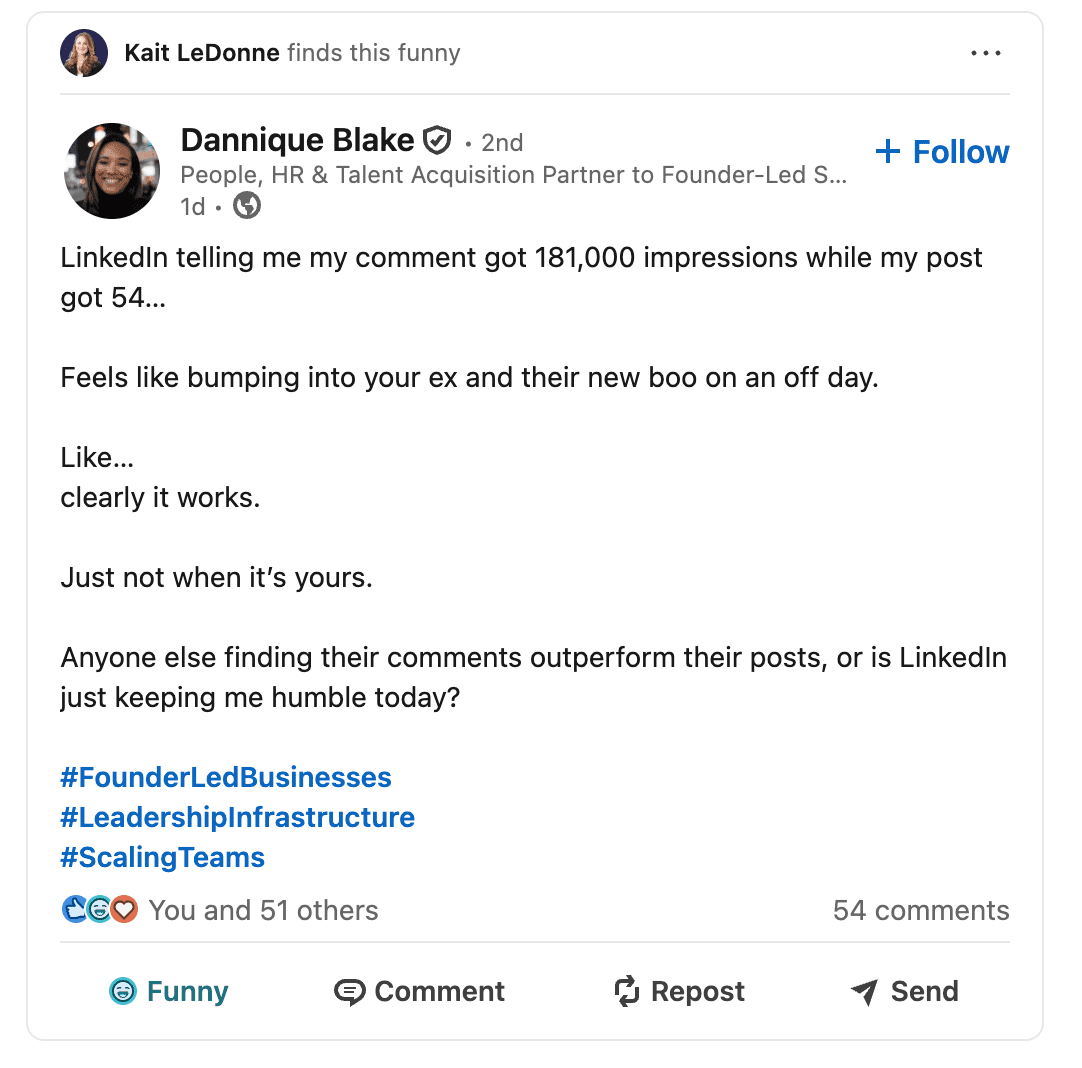
The comment section matters here too, probably more now than ever, as people are raking it in with massive comment impressions. I lol-ed at this post from Dannique Blake, which summed it up well:
Alicia's own method is what she calls the 20-20-20: spend 20 minutes commenting, send 20 DMs, send 20 connection requests. Every day. It's a lot, yes. But engagement is not a nice-to-have anymore — it's literally table stakes for building a brand that the algorithm can place.
And remember: when you're in the DMs with someone, they start seeing your content.
The Throughline in All of This?
Be the thing the robots can't copy.
Not louder or more polished or more hacky. Just more irreducibly, specifically, undeniably you — with a clear topical lane, a willingness to say what you actually want, a willingness to own your tone, and the patience to let it compound.
That's what Alicia, Jillian, and I kept coming back to, from every angle, across every format conversation. The platform will keep changing. The algorithm will keep evolving. All us gurus will probably keep contradicting each other.
But human content, made by actual humans who give a damn, will keep working.