Read Time: 7 minutes
"Why Most LinkedIn Brands Flatline—and How to Break the Cycle in 2025"
Scroll your LinkedIn feed for sixty seconds and you’ll spot it: brilliant people talking to no one and carousel graveyards with five lonely likes. Meanwhile, two posts down, the same person is getting thousands of likes and comments and seemingly “killing it.” At a certain point, you begin to wonder if the Kardashian effect has hit LinkedIn - are these people’s posts just “Famous for being ‘famous’? Is THAT how they get all this engagement?”
After leading 53k+ professionals on this platform and interviewing new voices every week, I knew something was afoot—but I wanted data, not just gut. And I didn’t want data just about going “viral,” I wanted data about how those with real, bought-in communities on LinkedIn are making over $100,000/annually from their efforts. Because what’s the point of being popular if you’re not profitable, after all?
So I asked 352 professionals to spill: What’s tripping you up on the path from “posting” to “paid”? Their answers hit louder than the NYC ambulance sirens that seem to only sound loudest as my 5-month-old is going to sleep:
TL;DR: Three money leaks are draining most LinkedIn brands—Consistency, Positioning, and Storytelling. Plug these and your content engine starts printing cash.
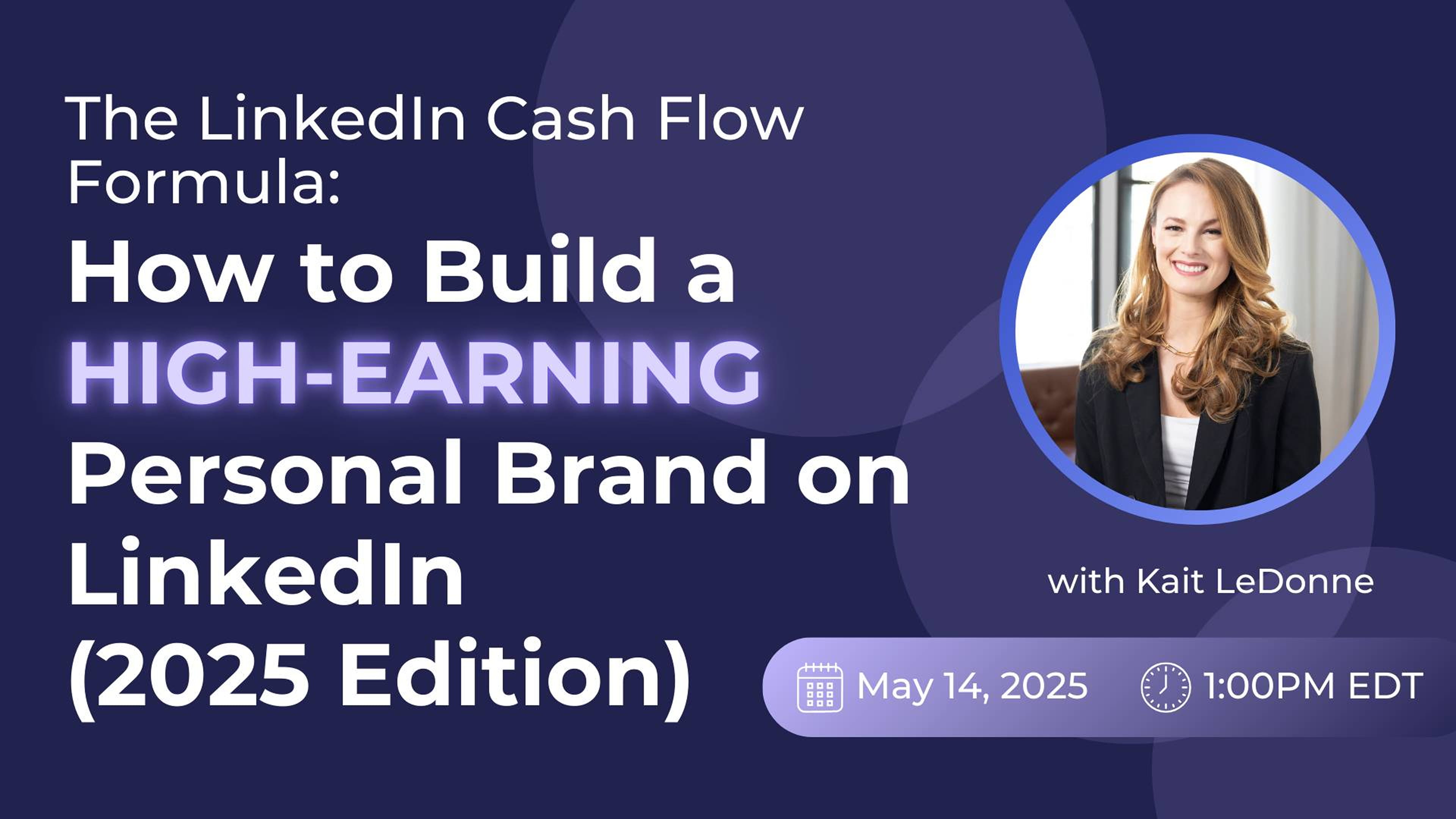
Below is my team’s full autopsy, a few DIY stitches, and—if you want the live walk-through—you can watch the replay of my masterclass “The LinkedIn Cash-Flow Formula: How to Build a High-Earning Personal Brand on LinkedIn (2025 Edition)"
Leak #1 – The Consistency Gap
“If the algorithm can’t find you, neither can your buyers.”
💡 When I crunched the survey, 67.9 % confessed they’re active on zero or one platforms at least three times a week.
Translation: their “visibility score” is, well, nonexistent. And this makes sense. Survey respondents noted the following reasons for keeping their “would be” LinkedIn content buried in Google Drive drafts:
Second-guessing how to phrase their content
Comparing their content to “bigger” creators in their space, then abandoning ship
Choosing a format the algorithm will like
Worried about seeming too “self-absorbed” when sharing good news
Worried HR will come down on them for publishing
Here’s your micro fix — The 5-in-15 Idea Sprint
Pick one burning problem you had in the last month. Keep this SIMPLE. Something like, you couldn’t get a response on a sales email you sent out, and finally broke through. Or, perhaps, your friend needed help updating their resumé and you provided guidance.
Set a 15-minute timer.
Draft five angles of how you overcame (or helped someone overcome) this issue: a shocking stat, a personal mini-story, a step-by-step, a myth-bust, and a nano case study.
That’s next week’s feed—done before your coffee cools. (Yes, I’ll demo this live with you.)

Leak #2 – Positioning Fog
“If your messaging is fuzzy, your lead flow is lonely.”
💡 Over 57.1 % of respondents typed some version of “I’m brimming with ideas but can’t land a clear message.” When your headline says you “help humans unlock their potential,” nobody knows whether to hire you, invite you to speak, or send you aromatherapy candles.
This also makes sense. I’ve worked to sharpen personal brand messages for industry thought leaders for over 10 years, and routinely, I see the following issues cripple clarity:
How far down should I niche? I’m worried I’m going to leave money on the table.
The answer is perhaps less “how” and moreso “when.” Niching in a vacuum often doesn’t provide you the real-time market feedback you need to see what audiences resonate with your content, and more importantly, what specific problems they have that you can solve. Instead, follow this format:
Narrow in on the type of problems you faced 1-2 years ago
Share content about how you solved them
Study which content pops and with whom.
During the “The LinkedIn Cash-Flow Formula: How to Build a High-Earning Personal Brand on LinkedIn (2025 Edition)” masterclass, we actually did a live exercise to take this data and plug it into a magnetic message format you can use to clearly state who you help and your unique edge in a way that turns down the volume of competitor noise and gets eyeballs to your profile.
Leak #3 – Storytelling Freeze
“Likes are vanity; conversion is sanity.”
💡 Exactly 34.7 % of respondents told us they feel “clear-ish”… until a post needs to invite the sale—then the keyboard turns to stone …. That’s one-third of otherwise smart professionals watching opportunities scroll by because the call-to-action feels scarier than a Slack notification at 4:59 p.m.
Why does this happen?
Spotlight Threat. Neuroscience shows that self-promoting lights up the same brain region as physical pain; your amygdala shouts, “Danger: judgment ahead.”
Proof Paralysis. Most people stockpile wins in their heads, not on paper. When it’s “go time,” they can’t find a crisp case study—so they default to “value bomb” fluff.
Mismatch Messaging. If your hook is broad, every story could fit, which means none of them feel right. The overwhelm fuels more silence.
Survey comments reflected this cocktail:
“I can explain concepts all day, but the second I need to ‘sell’ it feels sleazy.”
“My brain goes blank when I try to weave a client result into a post.”
(Yes, those lines came straight from the open-text box.)
What the research adds
Harvard’s Working Knowledge team found that professionals who pair a specific result with a concrete number earn 38 % more inbound inquiries than those who lean on vague “impact statements.” Translation: stories anchored in numbers beat inspirational slogans every time.
Here's how to fix it... During the “The LinkedIn Cash-Flow Formula: How to Build a High-Earning Personal Brand on LinkedIn (2025 Edition)” masterclass, I ran a rapid-fire Story Lab where we did three things in real time:
Surface your silent wins (even if you think you don’t have any).
Link each win to the exact buyer pain it solves—so it never feels “braggy.”
Slot the story into a 2-sentence framework you can paste under any LinkedIn post for an immediate credibility spike.
Participants walked away with one story draft polished on the spot—and a blueprint to rinse-and-repeat for the next quarter.
One Leak Leads to the Next
These saboteurs don’t live in silos. Inconsistency starves you of data. Without data, you can’t test positioning. Without a crisp hook, your stories fall flat. Round and round the doom loop goes.
But here’s the upside: repair one gear and the whole engine starts humming.
Where Do You Fall?
Quick pulse-check:
Self-Score 1-10
Symptom:
I ghost LinkedIn for days because content feels heavy
My headline could fit on a motivational pillow
I sweat the CTA, then delete it altogether
Want the Deep Dive?
Watch the masterclass replay: “The LinkedIn Cash-Flow Formula: How to Build a High-Earning Personal Brand on LinkedIn (2025 Edition)”