Read Time: 8 minutes
Where My Best Buyers Actually Come From on LinkedIn
If you’ve been active on LinkedIn for a year or so, you’ve probably figured out the inescapable rhythm of activities that are going to build your brand on the platform:
Post consistently (3x/week ideally. LinkedIn Top Voice requires a minimum of 1x/week if you want a benchmark for what they consider “consistent”)
Polishing your positioning. (Get clear on who you help and the value your content brings)
Comment and build your network through thoughtful (not automated/mass) DMs
Then, hope the right strangers show up in your DMs, ready to buy
Look, it’s not a bad strategy. It’s actually the best. I hawk it all the time, too. Skip any of these, and you’re dead on arrival. Having said that…
I realized last week that this strategy is not emphasizing the biggest accelerant to brand and business growth on this platform. It’s the “hidden audience” that has driven over $1 million (aka ~50% of the revenue I’ve generated on LinkedIn)…
REFERRALS.
We all know this to be true. You’ve probably even experienced it: LinkedIn isn’t only a cold lead engine. It’s also the most underused referral “flywheel” you have.
But knowing that and building a strategy around it are two very different things. And most people have a tendency (myself included) to obsess over the least efficient wave of growth (cold traffic) without even thinking about how they are incentivizing referrals on the platform.
The 3-part wave of LinkedIn recognition
If you've ever seen the original Sex and the City (not the unfortunate spinoff 🙄), you might remember the moment when Samantha takes the time to educate her boyfriend, Smith Jerrod, about the ins and outs of becoming a famous actor. When he questions whether starring in a sexualized alcohol ad will benefit his budding career, she responds by highlighting the unexpected perks of fame, pointing out the enthusiastic fan base he's gained, which includes a lot of gay men and young girls.

LinkedIn has a similar 3-wave momentum pattern.
First, your peers and friends realize you're putting content out. Then come referrals. Then comes cold traffic.
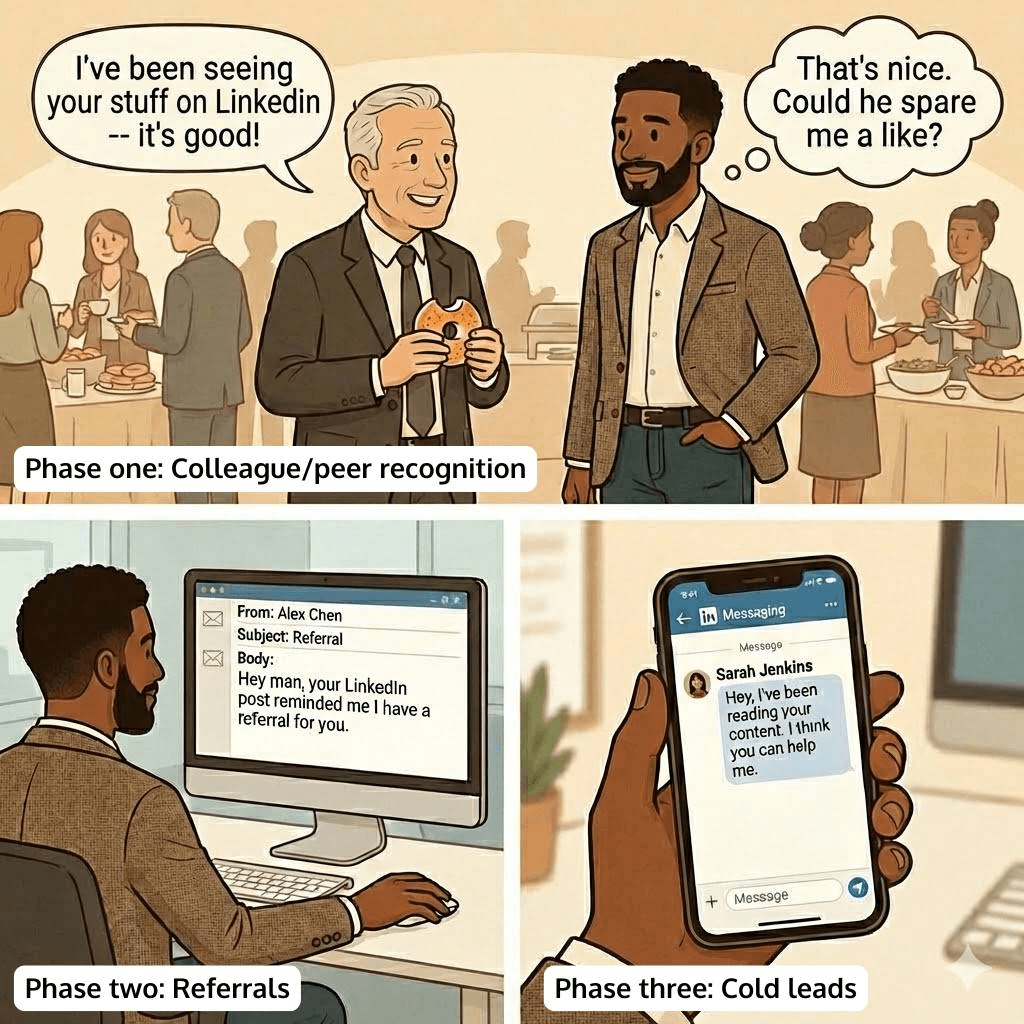
Most people sprint straight to that third wave—cold leads, top-of-funnel growth, audience building—while ignoring the statistically obvious and very lucrative middle.
Referrals are warmer, faster, and easier to convert because trust transfers. Nielsen’s trust research has found that word-of-mouth is the most trusted channel, with 88% of global respondents trusting recommendations from people they know more than any other channel.
So if you’re treating LinkedIn purely like a content distribution platform, you’re leaving money (and ease) on the table.
The mindset shift: stop treating LinkedIn like a megaphone—start treating it like a reminder system
Cold content is a long game. Don't let any 25-year-old who claims to have made a million dollars in two months tell you different. (No offense to them, it's just not realistic.) When you create cold content, you're building familiarity with strangers who have never met you, never worked with you, and have no reason to trust you beyond your sentences.
Referral-driven growth is a different game. Your goal isn’t to convince people you’re good. Your goal is to keep the right people reminded that you’re good.
That’s why your LinkedIn strategy needs a plan for warm traffic, not just cold traffic: peers, past clients, strategic partners, collaborators, and “network-adjacent” people who already have a reason to vouch for you.
And the best part? Referrals have compounding behavior baked in. Harvard Business Review has written about “referral contagion,” where referred customers not only buy more, but also go on to refer 30–57% more new customers than others.
That’s a flywheel, my friend. Not a funnel.
The Wave Framework: the referral flywheel is hidden in Wave 2 (and it escalates into a bonus Wave 4)
Let's map the progression like Samantha would. (Because 90% of my inner monologue is in her voice anyway)
 |
I love early aughts references and will never apologize for including things that make me giggle in my articles. Also, Jason Segel is a king to me.
Wave 1: Your peers and friends notice you
This is the "oh, you're posting now" phase. People don't buy here. They simply update their mental model of you. (Most will be excited. Some will criticize you. Ignore their snide comments.)
Your job in Wave 1 is consistency. Not perfection. Not virality. Just enough visibility that the people who already know you can confidently say, “Yeah, she does this."
Wave 2: Referrals start flowing (this is the money wave)
Wave 2 is where warm introductions happen—because your content gives your network an easy way to remember you, describe you, and recommend you.
And Wave 2 is also where most people have no system.
So here’s your installable playbook.
The “Second Wave" Playbook: 5 things you can do this week
1) Connect with every strategic partner you have (yes, even the obvious ones)
This sounds stupidly simple until you audit your own relationships and realize you’ve collaborated with people for months… and never actually connected on LinkedIn. This happened to me when I was busy running my agency, with 10 employees and 20 clients. Hey, it happens.
Do a 15-minute “partner connect sweep”:
List every strategic partner you’ve worked with in the last 2–3 years.
Connect with them on LinkedIn.
Send a quick note that feels like you:
Connection note script. Personalize to your tone:
“Realized we’ve done actual life together and somehow never connected on LinkedIn. Fixing that now.”
You’re not “networking.” You’re restoring proximity. Proximity creates recall. Recall creates referrals.
2) Make “client connects on LinkedIn” part of your onboarding SOP
When I ran my creative agency, this was literally a standard operating procedure: in the welcome email, we included a step requiring the client and team to connect on LinkedIn.
Not because we needed vanity metrics.
Because familiarity is a relationship fortifier. It keeps you present outside meetings and email threads, which quietly increases the likelihood that your client thinks of you when someone asks, “Do you know anyone who…?”
SOP line you can steal:
“Step 3: Everyone connects on LinkedIn so we stay in each other’s orbit outside of meetings.”
It’s gentle accountability, built into your process.
3) Post a “client win of the week/month” (with permission)
You don’t have to be obnoxious, but you do have to be visible.
A client win post is one of the cleanest referral prompts there is because it answers two questions referral sources are always silently asking:
What do you actually do?
What happens when someone hires you?
Keep it specific. Keep it measurable when you can. And always get permission if there’s any confidentiality.
Win post template:
“This month, a client went from [before] to [after]. The part I’m proudest of is [behavior change/process], because it’s what creates results that actually stick.”
Tag the client if appropriate. They’ll often share it, which reactivates your credibility in front of their network.
4) Try closing posts with a “refer” CTA, not a “buy” CTA
Here’s the truth you’re already saying out loud when you do this: 80–90% of the people reading your post don’t need you right now. That’s life and sales. Timing is always the factor.
So a “book a call” CTA is often mismatched to the moment.
A referral CTA is aligned.
Referral CTA you can paste:
“If this was helpful, but you don’t need this right now, feel free to send it to a friend who’s dealing with this.”
That line does two things at once:
It gives readers a low-friction way to take action.
It helps them self-select who they’d even refer (because they’re only sending it to someone who fits the situation).
5) Measure referrals that happen because of LinkedIn (or you'll keep optimizing the wrong thing)
If you only track cold inbound, you’ll keep designing for cold inbound.
Add two questions to your intake process:
“Were you referred? If yes, by whom?”
“Did LinkedIn play any role in you finding or trusting me?”
Influitive and Heinz Marketing’s benchmark research on B2B referral programs found that organizations with formal referral programs are 3x more likely to reach revenue targets when marketing owns the process and/or uses referral tools.
Translation: referral growth is a channel. Treat it like one. Track it like one. (You don’t make what you don’t measure!)
Wave 3: Cold traffic shows up (and it's easier now)
When Wave 2 is active, cold traffic lands differently. Your content isn't your only proof anymore—your network is doing the proof-work for you.
That's when strangers arrive pre-sold.
Bonus Wave 4: Cold traffic starts referring their friends (this is the “wait, what?” moment)
This literally happened to me yesterday.
An audience member messaged me saying they're interested in my services because someone else spoke highly of me. The fun part? I didn't know that “someone else.” Wasn't a strategic partner or a past client. It was someone who presumably knows my work and has been reading along.
And that's the escalation: your content won't just attract buyers; it will start manufacturing referrers.
And it matches what HBR describes as referral contagion: referred people are more likely to keep the chain going.
So yes, keep writing for cold leads.
But if you want growth that feels lighter—less convincing, less chasing, less “hoping the algorithm blesses you"—build and optimize for the second wave.
Remember… the fastest path to better clients is often not more strangers. It's more people who already trust you remembering to say your name.