Read Time: 8 minutes
If Everyone in Your Space Sounds the Same, Use This Branding Move to Instantly Differentiate Yourself
If you’re making a concerted effort to build your brand on LinkedIn right now, there’s a more than decent chance you’ve had this thought:
“This space feels… crowded. Maybe I missed the boat.”
Or, my other favorite:
”Well (insert name of person who’s crushing), is doing this SO well. I’ll never compare.”
You look around and see dozens (or hundreds) of people talking about similar ideas, offering similar services, using eerily similar language. The conclusion feels logical:
Too much noise = too late.
But that conclusion is wrong.
Not only wrong — backwards.
Look, take it from me. I operate in the most crowded industry on this platform — personal branding for thought leaders and LinkedIn growth. We are a dime a dozen, and some of the biggest platform names occupy this space (Justin Welsh, etc)
But, as a player in a crowded market, I’m here to let you know the truth:
Crowded markets don’t mean opportunity is gone. They mean opportunity has been proven. And what actually determines whether you win has nothing to do with volume, timing, or how loud your competitors are.
It has everything to do with how clearly you differentiate inside demand.
Let’s reframe this properly.
The Saturation Reframe: 3 Truths About “Crowded” Markets
1) Noise ≠ Saturation
Most people confuse visibility with viability.
A market is saturated when demand has flattened. That means buyers have stopped buying, outcomes no longer justify investment, and growth has stalled. Think soda and soft drinks here. For years, per capita consumption has declined as health consciousness rises, so companies are chasing market share in a shrinking pie, rather than growing the category.
But that’s not what most LinkedIn feeds are showing you.
What you’re seeing instead is low-friction publishing.
More people can post. More people are experimenting. More people are trying to be seen.
That creates noise, but it doesn’t indicate saturation.
According to IBISWorld and McKinsey’s work on professional services markets, knowledge-based services continue to grow precisely because expertise scales with trust, not manufacturing constraints. In other words: more suppliers can exist because buyers don’t pick one — they pick their one.
2) Crowds Signal Demand
If no one is talking about your thing, that’s usually the riskier scenario.
Markets become crowded after money starts moving. Attention follows incentives. Content clusters around categories where outcomes are already being rewarded.
This is why you rarely see empty feeds in spaces like:
Leadership
Career growth
Marketing
Sales
Personal brand
AI adoption
Business building
That’s because these aren’t trends; they’re evergreen demand pools. And that’s why even though they are crowded, you consistently see new creators pop up and grab demand quickly. They aren’t creating a new category; they are differentiating themselves within an existing one.
Harvard Business Review’s research on expert-led services consistently shows that buyers prefer specialists within known categories over generalists inventing new ones. Familiarity reduces risk.
So when you see competition, the right takeaway isn’t “I’m late.”
It’s: “There’s a budget here.”
3) Differentiation Beats Volume (Every Time)
Here’s where most people go wrong.
They either take themselves out of the game entirely. Or they respond to noise by posting more.
More tips. More carousels. More “value.”
That’s not how attention works.
People don’t choose the loudest voice. They choose the clearest one with a distinctive edge.
They choose the person who:
Sees the problem slightly differently
Names what they’ve felt but couldn’t articulate
Offers a perspective that feels for them
This is why differentiation isn’t about formats or frequency. It’s about your point of view.
And this is where your advantage actually lives.
A Real-World Example (From the “Most Saturated” Market on LinkedIn)
Let’s talk about my own field.
I’m in arguably one of the most saturated industries on LinkedIn: people teaching other people how to use LinkedIn.
If saturation meant “no opportunity,” this would be a terrible place to operate.
And yet, this past year has been my highest sales year.
I’ve also watched newer creators enter the space and scale quickly.
Take Jillian Richardson.
She’s been posting on LinkedIn for roughly 11 months. In that time, she’s grown to ~25,000 followers and landed features in places like Business Insider for her takes on optimizing LinkedIn profiles.
How did that happen so fast in such a “crowded” space?
Two reasons:
1) She interpreted saturation as market validation, not a warning sign.
She didn’t hesitate. She entered with confidence.
2) She took a different viewpoint.
While most people were obsessed with “beating the algorithm,” she zigged. Her POV was simple and refreshing: make content weird, fun, and unmistakably you.
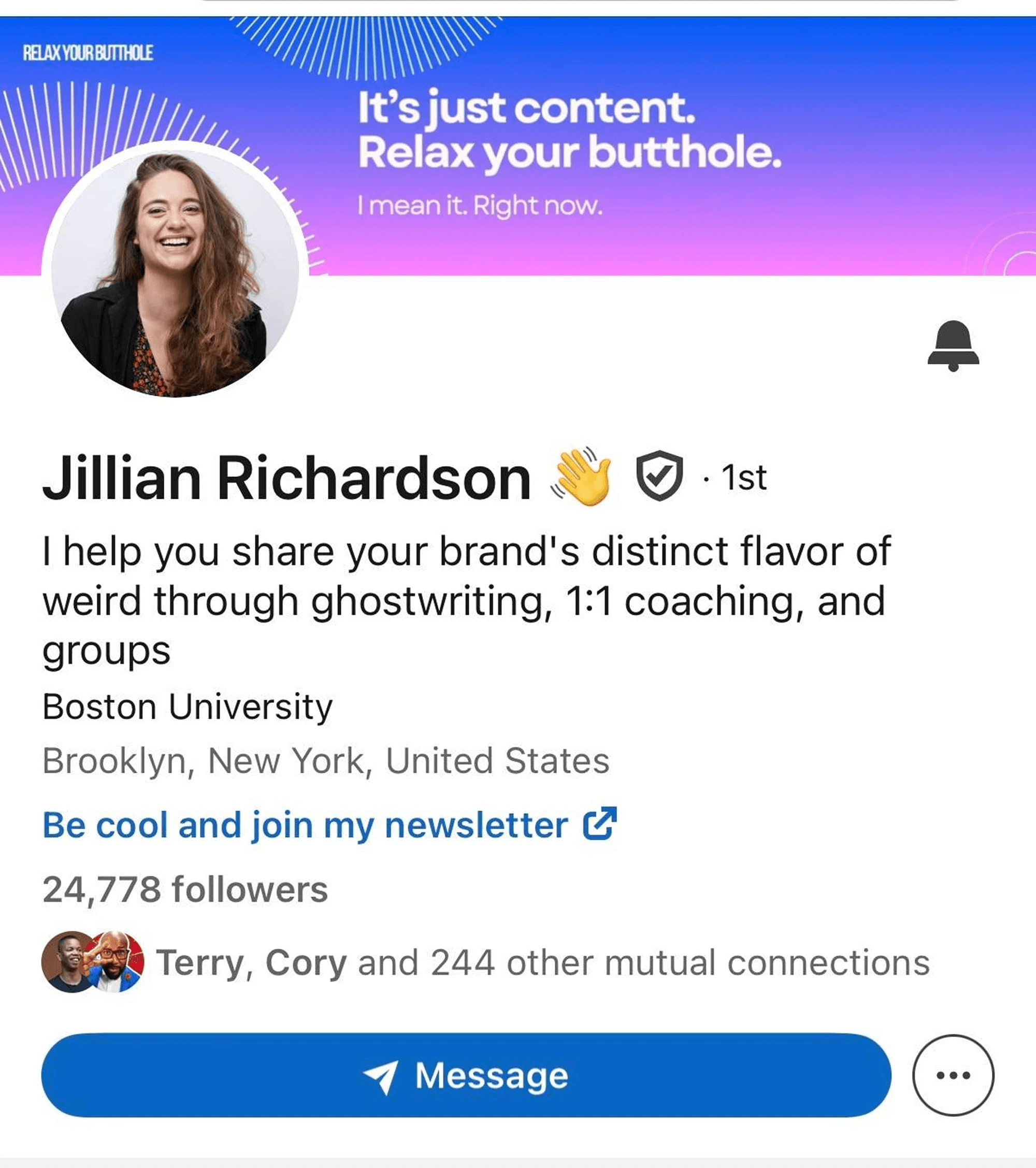
That’s a bold brand angle right there. Don’t worry, you don’t need to use the word “butthole” to stand out from others in your industry. Forced/performative differentiation is not the game. (It’s actually a recipe for failure.) Authentic angles are. This works for Jillian because this is her natural brand of fun and funny. And the hill she is willing to die on is that we are all a little tightly wound on LinkedIn.
What Actually Matters Instead of “How Crowded It Is”
If you strip this down, success in noisy markets comes down to three things:
A clear belief you’re willing to stand behind
A specific audience who recognizes themselves in your message
Consistency in reinforcing that perspective
That’s it.
Edelman’s Trust Barometer and LinkedIn’s B2B Thought Leadership Impact research both show that buyers don’t reward neutrality. They reward judgment. Especially in complex, high-stakes decisions, people look for signals of conviction and clarity…not consensus.
Which brings us to the most important part.
The Installable Action: The Differentiation Pivot
If you want to stop feeling lost in the noise, do this in the next 10 minutes:
Identify the belief in your industry you don’t fully agree with.
Ask yourself:
What does “everyone” say that feels oversimplified?
Where do you see nuance others skip?
What advice makes you quietly cringe?
Then rewrite your positioning like this:
“I don’t believe X. I believe Y. That’s why I help [specific people] do Z differently.”
This becomes your filter for:
What you post
What you ignore
What you repeat unapologetically
Optional but powerful next step:
Pick one constraint your best clients share (stage, fear, friction, context) and write your next post only for them.
If others don’t relate, it’s not necessarily a problem. It’s just differentiation in play.
TLDR;
If your LinkedIn space feels crowded, that’s not a sign you should quit.
It’s a sign you need to get clearer.
People don’t buy from the most visible expert. They buy from the one who makes them feel understood. They buy from people with strong POVs.
A crowd proves demand, but clarity captures it.
So, my personal brand coaching for you today is this…
For the love of all things LinkedIn…
Stop worrying about how many voices are out there, and start deciding what yours stands for.