Read Time: 8 minutes
The Playbook for Turning Team Members into Your Most Powerful Marketing Channel
Let’s start with the truth no corporate marketing team wants to hear: your company page on LinkedIn is pretty much on life support. Algorithms throttle it, most of your employees ignore it, and the only people liking posts are usually your own content team. (I can say this, because I’ve been on said teams.)
What used to work on these pages — polished brand content, high-budget campaigns, “official” posts — now often flops because it isn’t personal, isn’t trusted, and isn’t resonant.
Meanwhile, employees’ voices (their posts, their stories, their takes) are out there building more trust, reach, and influence than your logo ever will.
If you’re a corporate leader, this is the opportunity hiding in plain sight: your people are your new social channel.
This week, I’ll show you why personal brand + employee advocacy is the social strategy everyone else already wants (but few are doing well), and how you (especially in Marketing/HR/PeopleOps roles) can make this your company’s new superpower.
First, a little background on why the old model is fading
Organic reach is declining. Platforms are prioritizing “personal” over “official” content. Posts from individuals are boosted; company posts are often suppressed.
Authenticity matters more than ever. Trust studies show people believe peer content (from someone they recognize) far more than polished brand content.
Employees already have the reach. On average, an employee’s LinkedIn network is ~10× larger than their company’s.
It also works against platforms’ profits…
LinkedIn’s incentives are simple: it wants individuals to create content because that keeps people on the platform. Company pages? Those are potential advertisers. Which is why organic reach on company pages is throttled by design. Ask yourself: why would LinkedIn give you free reach when they want you to pay for ads?
Individuals are the opposite. The platform rewards them. And the numbers prove it: only 3% of employees share company content, but those shares drive about 30% of total engagement. That’s leverage most leaders are ignoring.
What Is Employee Advocacy & Thought Leadership? (in this context)
Before going deeper, let’s get some marketing and corporate speak out of the way:
Employee Advocacy = giving employees the tools, permission, incentives (and psychological safety) to share work, ideas, values, projects, etc., using their own networks.
Thought Leadership = when someone (employee, leader) publishes content that influences, educates, challenges in their domain; not just promos, but ideas, questions, stories.
When these are combined, companies get reach + trust + culture + recruiting + retention.
A proven playbook
Here’s my favorite way to drive this home in corporate personal branding workshops: I ask,
“Which company is home to the most LinkedIn Top Voices in the world?”
The answer is Google. More than 150 Googlers hold the coveted blue badge. Microsoft comes in second, trailing by 40. But here’s the kicker: those Googlers publish across 35+ distinct topics—from Gen Z career advice to gender equity to inclusive leadership. Only a handful post about search tweaks or Cloud SKUs.
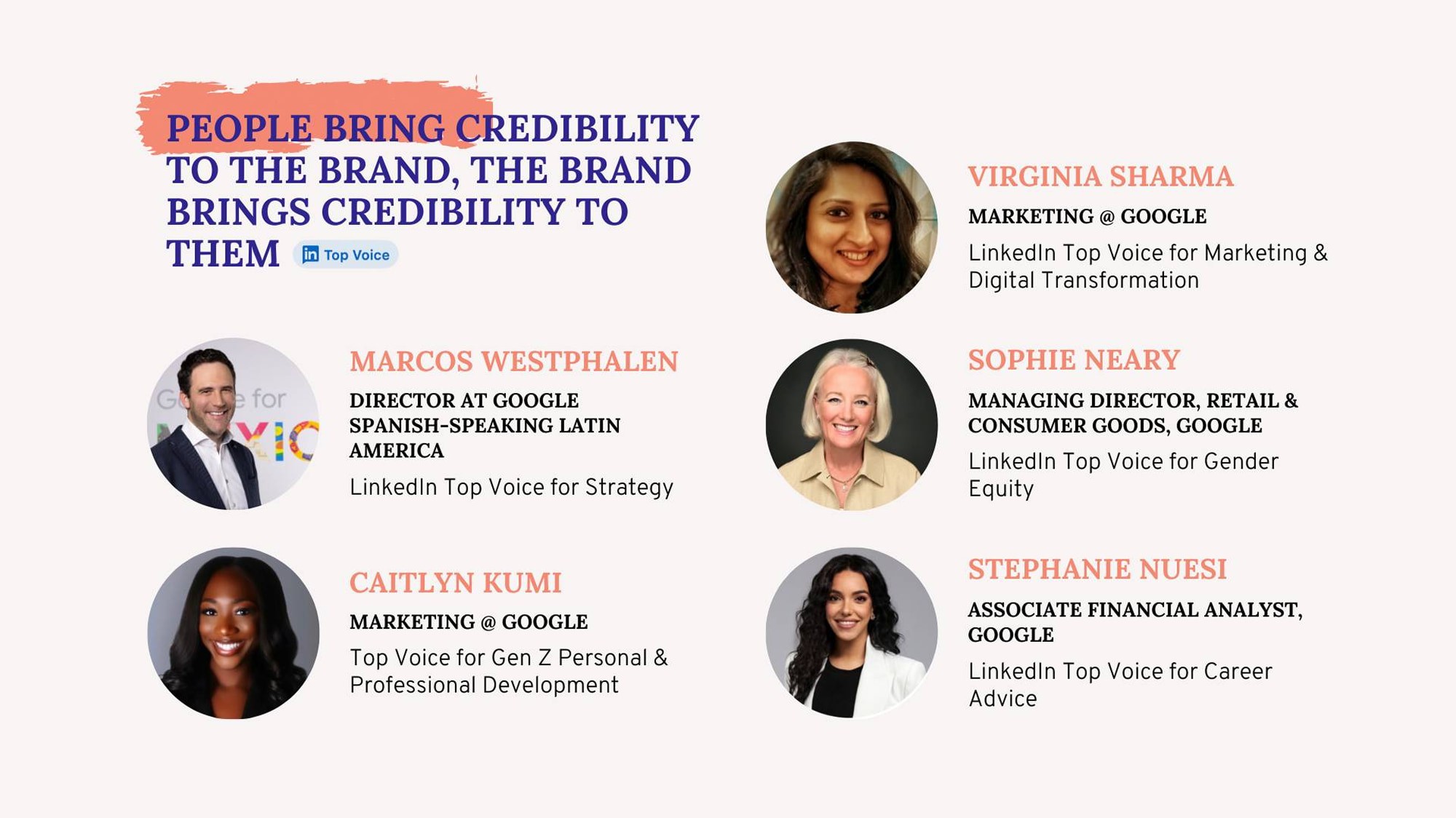
Notice these Googlers’ Top Voice subjects compared to their job title. Source: Slide from my Influence OS corporate training program
That spread isn’t random. It’s deliberate, and it works. Here’s why this strategy benefits both Google and its employees:
Breadth = Bigger Pond.
When employees publish beyond the narrow scope of their job, they tap into whole new audiences. LinkedIn data shows the average employee network is about 10× larger than the company page’s followers, and content shared by employees receives 8× more engagement than content from brand handles. Breadth doesn’t dilute the brand; it multiplies exposure.
It’s a Culture Flex.
Google is famous for its ‘20% time rule’ (giving people 20% of their time to work on passion projects), but the real secret sauce is psychological safety. Its Project Aristotle study of 180+ teams found psychological safety to be the single biggest driver of high performance. That safety translates externally: Googlers feel free to post about passions and projects that might be only loosely connected to their role. The result? A brand that looks curious, innovative, and…most importantly…human.
Zero-Cost Halo.
Every time a Googler earns a Top Voice badge or writes a viral post, Google’s reputation rides shotgun into new communities. No media spend, no campaign budget, just the natural halo effect of employee credibility. This is why companies with strong advocacy programs report brand visibility lifts of up to 561%. (Source: JustConnecting’s Algorithm Insights Report 2025)
Now, you’re probably thinking: “That’s nice for Google, but we’re not Google.” True. You don’t have 150 Top Voices. But here’s the reality: you don’t need them. With the right guardrails, even a midsize company can outperform firms 10x their size and become category leaders. The key is to stop treating your employees as one-dimensional amplifiers and start cultivating creators.
Amplifiers vs. Creators
Most companies only see employees as amplifiers: people who repost company content with a polite 'check this out.' And for some employees, that’s as far as they’ll go—which is fine.
But hidden inside every company is a smaller group with big ideas, passions, and perspectives. They aren’t amplifiers. They’re creators. And when activated, they become the highest-ROI content strategy you could ever invest in.
Research backs this up: content shared by employees is seen as 3× more authentic, and buyers are 92% more likely to trust peer recommendations over brand messages. If you ignore your creators, you’re leaving trust and reach on the table. (And robbing yourself of a great retention strategy for these high performers. Creators love being given the freedom to create.)
The Big 3: Your Anchor Framework
So how do you actually empower employees without chaos? The answer is what I call the ‘Big 3’ framework—three message lanes your people can confidently post into:
Competitive stance — your unique position in the market, how you’re shaping the category.
Cultural stance — what it feels like to work at your company, the rituals and values outsiders can recognize.
Community stance — the causes and commitments you stand for beyond profit.
Google’s Big 3 offer a masterclass in this model:
Competitive stance: ‘AI at planetary scale.’ Posts showcase AI-infused products, open tooling like TensorFlow, and reliability practices.
Cultural stance: ‘High-trust invention.’ Googlers share 20% projects, post-mortem lessons, and day-in-the-life stories that showcase curiosity.
Community stance: ‘Open tech, open doors.’ Posts highlight open-source leadership, digital education, and sustainability milestones.
Each lane is clear, consistent, and reinforced by multiple employee voices. That’s what makes the message sticky.
How to Activate Employee Creators
Here’s how to bring this to life inside your company:
Clarify your Big 3. Nail down your competitive, cultural, and community stances.
Identify creator talent. Look for employees already posting with strong engagement.
Overlap passions with company priorities. Creators thrive when personal interest meets brand relevance.
Provide guardrails, not scripts. Offer training, not word-for-word talking points.
Celebrate wins. Highlight successful posts internally to spark momentum.
Measure outcomes. Track reach, engagement, candidate quality, and employee sentiment.
The Bottom Line
Your company page isn’t dead because LinkedIn is unfair—it’s dead because people trust people more than brands. If you want more reach, more trust, and more cultural pull, stop clinging to the logo. Empower your employees. Anchor them in the Big 3. Support your creators. Do this well, and you won’t just keep up with Google—you’ll outpace companies 10x your size.
Want to Bring This to Your Company?
I regularly train corporations on how to turn their employees into thought leaders. If you know an organization or company that would benefit from this training, introduce us. If we work with them, we'll send you a thousand dollars in whatever format you want. I've trained organizations like CNBC, the United States Air Force, global firms like Minute Media, and more, on how to do this through their employees.