Read Time: 8 minutes
The LinkedIn Strategy Corporate Training Buyers Actually Respond To
Summary: This article breaks down how to use LinkedIn to land more corporate training contracts, even if you’re just getting started.
You’ll learn how to make your profile searchable for learning & development buyers (and AI tools), turn underused LinkedIn features into proof of expertise, and build a pipeline of warm decision-makers who already trust you before you ever get on a call.
About two months ago, I went to a lunch for creators.
If you’re not familiar with that burgeoning new term, a “creator” is someone who creates content online consistently. Simple enough.
Now, there are different levels of creators—ones who earn no money from their efforts and do it for joy, ones that make some money as a side hustle (this is the majority), and then the 4% (according to Kajabi’s reporting) that earn more than 6-figures annually from their efforts.
For context, the crew I went to lunch with was in that 4% space. We ran the gamut in our platforms of choice—one with over one million YouTube subscribers, one with over 60k YouTube subs, one with over 100k LinkedIn followers… You get the picture.
As we finished our appetizer, the conversation inevitably got to:
“So, what’s your biggest revenue driver these days?”
We all talked about how online course sales have been tougher thanks to the acceleration of AI, and that’s when one of my creator buds said:
“Yeah, the landscape is shifting. About $300k of my biz this year is coming from corporate training contracts—companies bringing me in to train their financial teams.”
I smiled. “Yep, that’s the jackpot, isn’t it?”
Why corporate training changes the math
Here’s why corporate training is so delightful.
My main offering is a cohort-based learning program at $300/seat. To make $300k, that means 1,000 sales.
But to make $300k in corporate training, it’s only about six sales.
Now, the sales cycle and sales vehicle between those two are incredibly different, obviously. One is a volume play. The other is more nuanced and requires meetings, discovery calls, and multiple decision-makers.
But the common factor between both?
LinkedIn is the driver.
So today, let’s unpack how to use LinkedIn to land more corporate training gigs if you’re a speaker, trainer, or consultant who wants to be brought in by companies—not just individuals.
Step 1: Become searchable as a corporate trainer (on LinkedIn and in ChatGPT)
1. Put “Corporate Trainer” in your headline and Experience section
Let’s start with the painfully obvious thing most people still don’t do.
If you want to be found as a trainer, your headline has to actually say “Trainer” in some capacity:
Sales Trainer for SaaS Teams
Performance Trainer for Managers
Personal Branding & LinkedIn Trainer
Leadership Trainer for Emerging Leaders
Think of your headline as your storefront sign. When someone in HR or L&D searches “sales trainer,” LinkedIn highlights those keywords in results. If “trainer” never appears in your headline, you’re forcing the algorithm to guess what you do.
And it’s not enough to have it only in your headline. You also want it:
In your current position title
In the description of that role
For example, my company is Kait LeDonne Personal Branding. My position listed at that company is Personal Branding & LinkedIn Trainer.
That simple tweak does three things:
Boosts your chances of showing up in LinkedIn search. The algorithm leans heavily on your current title and headline when pulling up results.
Makes you easier to “label” for AI tools. When people ask ChatGPT, “Find LinkedIn corporate trainers I could bring into my company,” AI looks at publicly visible signals—job titles, headlines, service descriptions—to interpret who you are.
Clarifies your offer for humans. Most buyers scan, not read. If “Corporate Trainer” jumps off the page, they don’t have to decode a vague title like “Consultant” or “Coach.”
If you do nothing else after reading this article, update your headline and current role so they both clearly say some variation of “Corporate Trainer.”
2. Turn on your Services section
The LinkedIn Services section is not a premium profile feature. It’s a part of your profile you can turn on to enter LinkedIn’s matchmaking marketplace between clients with needs (like needing someone to train their managers) and service providers.
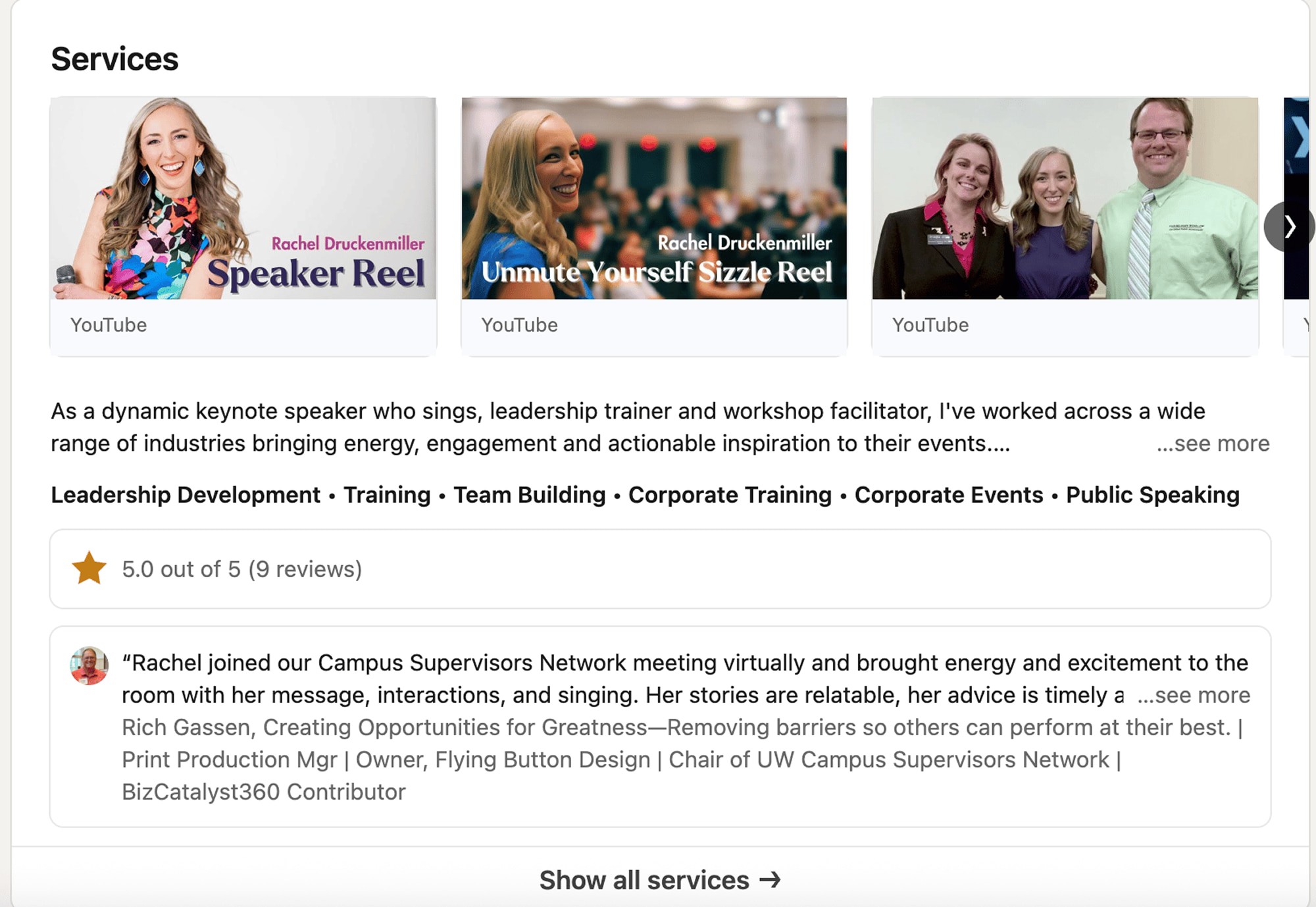
For corporate trainers, it’s a huge win (and vastly underutilized) because:
When you have LinkedIn Premium, you get emailed leads when you match the criteria for someone’s request.
Buyers can view your Service page and specifically request that you apply.
You can add loads of credibility by asking your customers to rate you directly on your Service page, so the social proof is tied to your training services.
You can upload several multimedia assets—like a training highlight reel or workshop sizzle video.
It sits high up on your profile and occupies a significant amount of visual space when you complete it.
In essence, when optimized correctly, your Services page doesn’t whisper, but screams to people:
“I’m a serious corporate trainer, I do this for a living, and I should be paid top dollar.”
To turn it on, click “Add profile section” → “Core” → “Add services.”
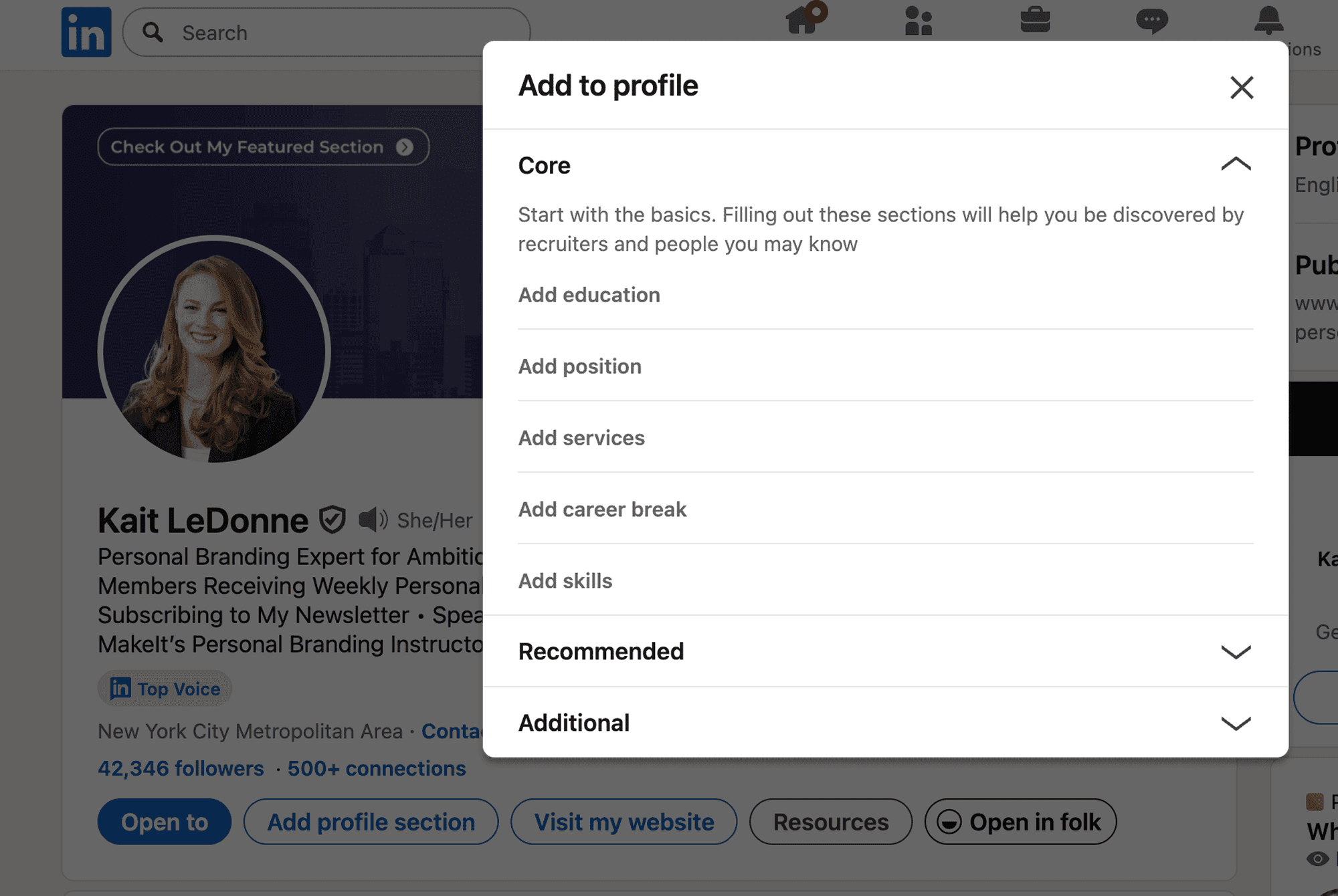
Once it’s live, treat it like a mini training one-sheet:
A short positioning statement (who you help and how)
3–5 named signature workshops or training programs
Logos of key clients (as images or video thumbnails)
Links to your training reel or short clips of you teaching
A sentence on ideal engagements: “Leadership offsites, manager academies, sales kickoffs, new-manager onboarding…”
Because reviews on your Services page are separate from standard recommendations, you can also treat them like searchable testimonials.
When you ask a client to review you there, prompt them to mention:
The audience & context: “We brought Kait in to train 60 front-line managers in a Fortune 500 manufacturing company…”
The business outcome: “Post-program survey scores on clarity and confidence jumped by 18%.”
The booking experience: “Easy to work with, responsive, and tailored the curriculum to our culture.”
This not only persuades human readers; it also gives search engines and AI tools concrete language around what you actually deliver.
3. Publish a LinkedIn newsletter that proves your depth
The more of an expert you are perceived to be, the higher you can ethically command for corporate training.
One of the best ways to demonstrate depth, not just “vibes,” is to create a bi-weekly LinkedIn newsletter that goes deep on the exact topic you train teams on:
A sales trainer publishes “The Modern Sales Meeting,” breaking down one skill per issue.
A leadership trainer publishes “Manager Monday,” focused on real conversations leaders are avoiding.
A personal branding trainer publishes case studies on how employees can show up online without sounding like ads.
Take a page from my friend and client, David Hagan, an in-demand sales trainer for home builders. He’s been on a roll with his LinkedIn newsletter, and those 843 subscribers are his exact prospects—sales leaders and executives in homebuilding.
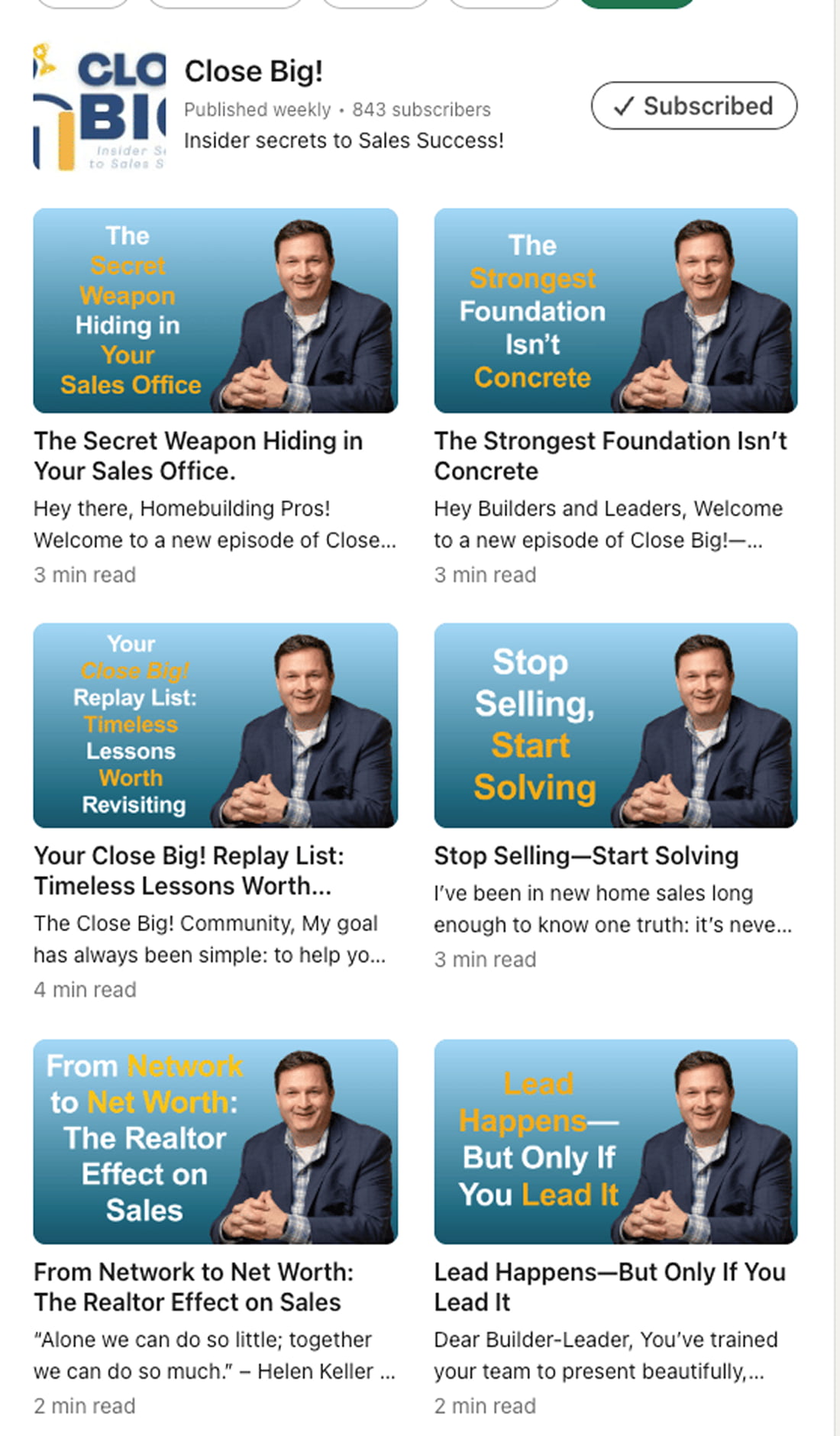
Every issue lands directly in their inbox and tackles a problem they care about. Over time, that consistency does three things:
Builds familiarity. When someone is finally ready to bring in a trainer, they feel like they already know you.
Shortens the sales cycle. They’ve seen your frameworks and stories for months. The call becomes, “How do we bring this to our team?” not “So…what do you do?”
Creates “forwardable” assets. A great newsletter issue can be forwarded internally to a VP, HR partner, or CFO as proof that you’re worth a budget line.
If you want to be considered for six-figure training contracts, let your content make the case before you’re ever in the room.
Step 2: Fill your network with your ideal client profiles
Here’s where LinkedIn is almost unfairly powerful: you can reverse-engineer your following to be your exact target demographic.
You don’t have to hope the right people stumble onto your content. You can go find them and connect.
For corporate training, that usually means:
Heads of Learning & Development
HR and Talent leaders
Sales enablement leaders
Business unit leaders who own a P&L
For me, that means finding and connecting with 20 heads of learning and development a day. Tedious? Also very, very worth it.
A simple daily practice:
Search “Head of Learning and Development,” “Director of Sales Enablement,” or whatever titles own your training budget.
Filter by industry, company size, or location if you have a niche.
Send a short, non-pitchy connection request:
“I work with L&D teams on LinkedIn + personal branding programs for employees. Always learning from peers in this space—would love to connect.”
4. Save relevant searches or lists so you can come back and keep adding a few people each day.
Over a quarter, this quietly turns your audience into a database of warm, relevant decision-makers who are regularly seeing your posts and newsletter.
Step 3: Engage with those people like a future partner
Filling your network is step one. Step two is actually engaging with those buyers before you ever send a message.
Some simple, repeatable practices:
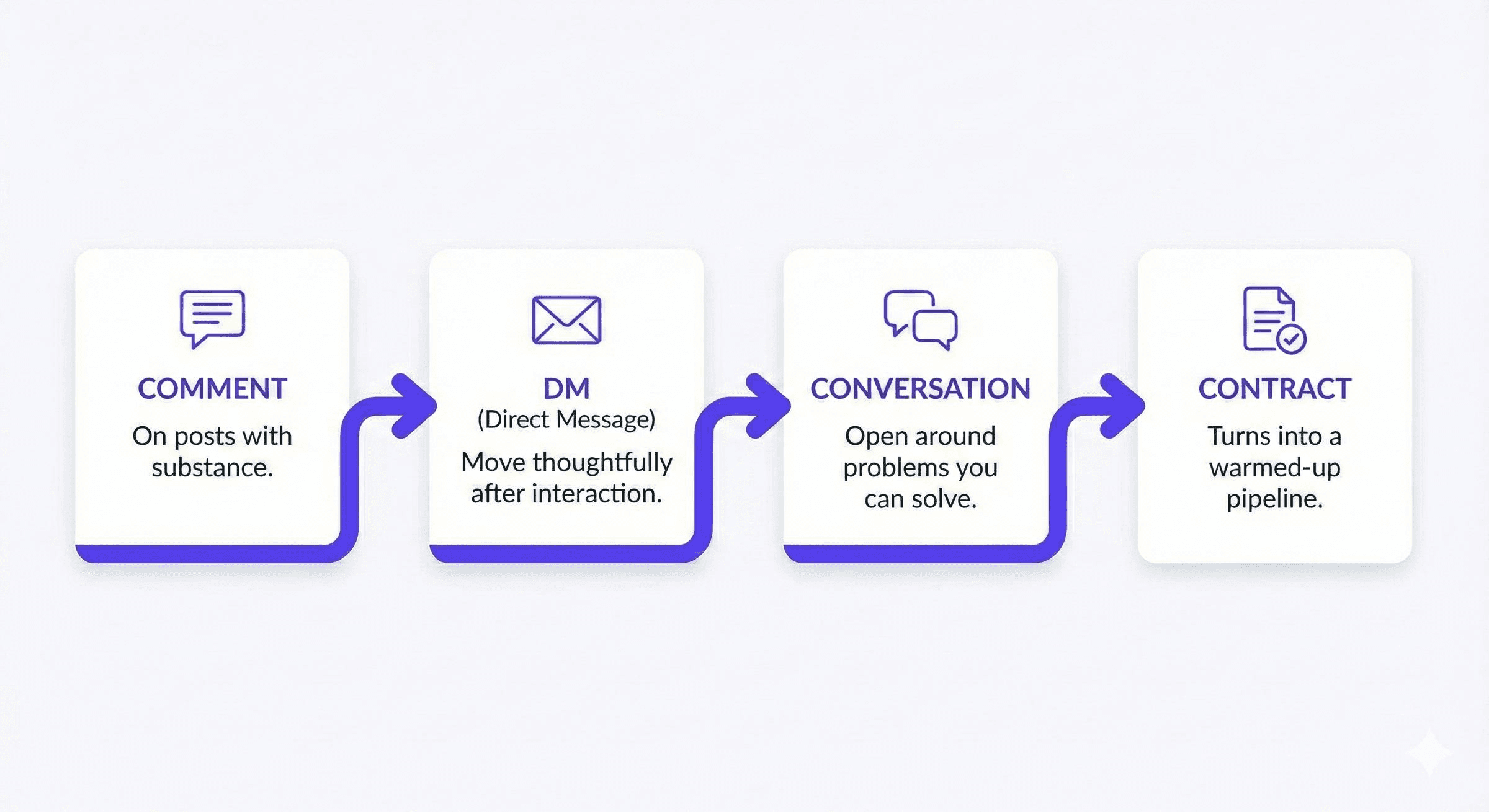
Comment on their posts with substance.
Skip “Great post!” and instead add a short, specific insight:
“Love this, especially your point on manager capacity. In our trainings, the biggest unlock is often teaching managers how to coach in 15-minute windows instead of hour-long meetings.”
Engage with their company’s content.
When their organization posts about change initiatives, culture, or growth, comment through the lens of your training specialty. This signals that you understand their world and can complement what they’re already doing.
Move to DMs thoughtfully.
After a few visible interactions, send a message like:
“I’ve been enjoying your posts about developing frontline leaders at [Company]. Quick question—are you doing anything formal around manager training next year? If helpful, I can send over a sample agenda of how other clients are structuring their programs.”
Notice what’s missing? A five-paragraph pitch deck.
You’re simply opening a conversation around a problem you’re qualified to solve and offering a light, low-pressure next step.
Do this consistently, and your “random” connection list turns into a warmed-up pipeline of decision-makers who see you as a partner, not a stranger with a slide deck.
The Recap
If you want more corporate training contracts, stop treating LinkedIn like a place to post content and start treating it like your corporate training storefront.
Make yourself searchable by putting “Corporate Trainer” in your headline and Experience section.
Turn on and optimize your Services section so it functions like a mini training one-sheet, complete with reviews and media.
Publish a focused LinkedIn newsletter that proves your depth to the exact leaders who could hire you.
Intentionally fill your network with L&D, HR, and business leaders who own training budgets.
Engage with them regularly so, when you finally reach out, you’re a familiar name—not another cold pitch.
Do these consistently, and that “six contracts for $300k” conversation stops being someone else’s story and starts becoming your business model.