Read Time: 8 minutes
Stop Educating for Free: The “TFA “Framework That Turns LinkedIn Posts Into Paying Clients
A few weeks ago, I was meeting with a client. He is, by all rights, a genius in his field.
We’re talking 20+ years deep in the world of patient experience. He can see patterns nobody else sees. He’s the person other experts secretly call when they’re stuck.
The problem when we met?
While he’s probably one of the most qualified people in his space on LinkedIn, his content was getting crickets compared to a handful of… let’s say “less seasoned” voices.
You know the ones:
Loud on the feed
Light on experience
Still somehow “killing it” with speaking invites, podcasts, and inbound leads
It’s maddening when you’re the one who’s actually put in the reps.
When we sat down to dig into a fix, I introduced him to the TFA approach to content.
Thought → Framework → Action
It’s the filter I use to turn “interesting” content into content that actually leads to clients.
Most of those people you see blowing up on LinkedIn—whether they realize it or not—are already creating content in alignment with TFA. That’s why it feels like the algorithm is mysteriously obsessed with them.
You’re not less smart.
You’ve just been missing the structure.
Once you see this, you cannot unsee it.
The TFA Approach
The TFA approach (this is my model, not something you’ll find in a textbook) goes like this:
Thought
The prevailing premise or idea.
Framework
That idea, broken down into a digestible model.
Action
One bite-sized step your audience can take today to improve their situation.
Most experienced professionals are great at the first part. They have more thoughts than they know what to do with.
That’s also exactly why their content doesn’t convert.
The people you’re watching “win” online?
They’re not always smarter than you. They’re just accidentally (or intentionally) hitting all three parts of TFA while you’re stuck at T.
Let’s fix that.
Thought — A good start, but not good enough
Most experienced professionals and thought leaders create content that’s stuck in the Thought phase.
Which makes sense: you have years of experience, you see patterns other people don’t, and your brain lives at the 30,000-foot view.
The issue is this:
If you want people to take a purchase action based on your content,your content has to be actionable to begin with.
It’s incredibly rare that someone reads a post and thinks:
“Wow, this person is so smart! I’m so dazzled by their brilliance that I’ll buy.”
That doesn’t mean there isn’t a place for dazzling people with your brilliance online. There is. It just means that place is much earlier in the sales process.
Credibility building happens when someone becomes aware of you and interested in you.
At the point of conversion, that credibility should already be established.
By the time someone is seriously considering working with you, they’re not looking for more proof that you’re smart. They’re looking for proof that you can help them do something differently.
So before you even think about frameworks or actions, sanity-check your Thought with three questions:
What is the one-sentence idea I’m trying to get across?
Is this idea relevant to a pain or desire my ideal client actually has?
Can I explain this idea to a smart 12-year-old without jargon?
If the answer is “no” to any of these, your Thought needs tightening before it deserves a post.
Once your Thought is clear, we move to the part most experts skip:
The way you package it in your reader’s brain.
Framework — Help their brain out
By definition, a framework is a structured way of thinking about a problem, made up of key components or steps, that helps you analyze, decide, or communicate more clearly and consistently.
It takes a broad idea and turns it into something that’s easy to organize.
Biologically speaking, our brains have tiny working memories. They can only hold a few things in active attention at once (roughly 3–5 “chunks,” not 30). When you drop a big, undifferentiated idea on someone, it feels like:
By definition, a framework is a structured way of thinking about a problem, made up of key components or steps, that helps you analyze, decide, or communicate more clearly and consistently.
It takes a broad idea and turns it into something that’s easy to organize.
Biologically speaking, our brains have tiny working memories. They can only hold a few things in active attention at once (roughly 3–5 “chunks,” not 30). When you drop a big, undifferentiated idea on someone, it feels like:
“Here are 17 things to remember about customer success / leadership / branding…”
The brain gets overwhelmed and quietly says, “Nope. Not doing anything with this.”
A framework tells the brain:
“There are 3 pillars…”
“It’s really 4 stages…”
Now it has hooks. Now your idea has a shape. And this is where a lot of those “less qualified but somehow everywhere” people are winning:
They’re always offering:
“My 3 rules…”
“5 mistakes…”
“4 shifts…”
That’s not just copywriting; that’s their (accidental) use of frameworks.
A simple example
Let’s say your big idea is:
“Most leaders are terrible at giving feedback.”
Thought-only version of a post:
You rant about why feedback matters and how people avoid it. Maybe you even throw in some statistics from your proprietary research. Smart, but fluffy. It’s hard for the reader to remember or apply.
Framework version:
“Most leaders are terrible at feedback because they skip one of these three steps:
Prepare – Get clear on the behavior and desired outcome.
Deliver – Use clear, specific language instead of vague labels.
Debrief – Ask what they heard and agree on a next step.”
Same idea, but now your reader has three hooks their brain can actually hold onto. The details get “nested” under primary buckets. That’s exactly how our cognition handles complexity: by chunking.
Why this matters:
No framework → people nod along, then forget.
Clear framework → people can store and replay your idea later. (Key for brand recognition and purchase actions.)
A good rule of thumb:
If you can’t turn your idea into 3–5 steps, buckets, or stages, it’s not a framework yet. Keep going.
Now we’re ready for the part that turns lurkers into buyers.
Action — Push it all the way to “installable.”
We’ve chunked the big idea into a framework. That’s great if you’re giving a keynote or writing a book.
But online content, especially on LinkedIn, needs to be extremely actionable.
That’s why people log into social in the first place. They want something they can use today. If they wanted to dive into a big concept, they’d do something that takes more time—like read your book or attend your workshop.
LinkedIn itself confirms this. I sat on a webinar with other creators hosted by LinkedIn’s editorial team, and the host shared that the most viral, high-credibility content tends to answer the audience’s unasked question:
“How can I use this today?”
The creators who are quietly getting inbound leads, referrals, and speaking invites?
They are really good at answering that question, post after post.
Turning big thoughts into bite-sized actions lets you do the work for your prospects and deliver small wins that ultimately lead to a conversion or purchase event.
The Installable Action formula
A simple way to get there is this:
Installable Action = 1 step from your framework × a tiny time frame.
Pick one step from your model.
Ask: “What could they do in 5–10 minutes to practice just this step today?”
That’s your installable action.
Using the feedback framework above, an installable action might be:
“Before Friday, pick one direct report and write out exactly one behavior you’ve seen, the impact, and what ‘better’ would look like. Don’t deliver it yet—just practice getting specific on paper.”
That’s not “think about feedback more.”
That’s: “Do this one concrete thing this week.”
In practice: Mel Robbins’ “Let Them” theory
Let’s look at how this plays out in the wild with Mel Robbins’ “Let Them” theory. You’ve probably heard of this repackaged version of the Serenity Prayer or stoicism (not a dis to Mel, she’s an expert at packaging, most thought leaders are.)
I’m going to mark each part so you can literally see Thought → Framework → Action in real time:
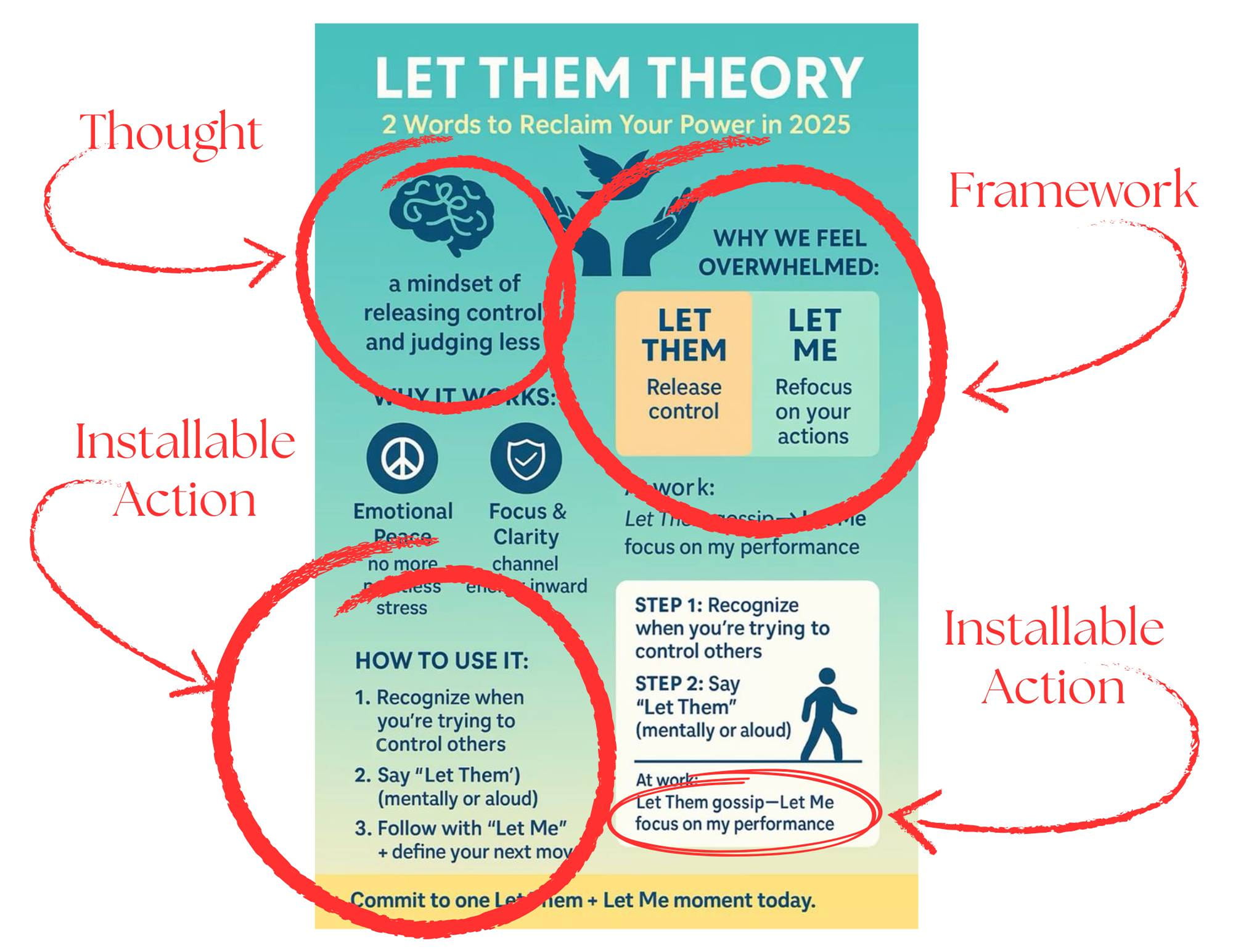
Thought
You can’t control external things or people; you can only control how you respond.
Framework
Let Them – Release control of external things.
Let Me – Identify what you can control and choose what you’ll do.
Action (the resulting content)
You recently heard your coworkers gossiping about you. Here are three ways to apply the “Let Them” theory:
1. In the moment: Let them + leave.
If you overhear it, don’t freeze and stew.
Think: “Let them. This is about them, not me.”
Close the tab. Leave the room. Protect your peace first.
2. Later: Decide if it needs a convo.
Ask yourself:
Is this just petty noise? → Let them and move on.
Is it untrue or hurting my work/reputation? → Have a clean, direct chat:
“If there’s feedback about me, I’d rather hear it from you directly.”
3. Long term: Let it inform your circle, not your self-worth.
Spend less energy on the gossip crew; more on people who act like pros.
Keep building your track record so the work speaks louder than whispers.
If it becomes bullying or impacts the team, loop in your manager or HR.
You can’t control who gossips. But you can control your boundaries, your behavior, and who gets access to your energy.
When you strip it down, here’s what just happened:
Thought: You can’t control other people; only your response.
Framework: Let Them (release control) → Let Me (refocus on your actions).
Installable Actions: 3 specific moves you can make at work today.
This is the same spine your LinkedIn posts need if you want them to do more than get likes:
One clear idea. One simple model. One tiny next step.
And again: the people you’re watching go viral and get opportunities?
This is what they’re doing, consciously or not.
The TFA Pre-Post Audit
Before you hit “Post” on LinkedIn, run this quick audit:
Thought: Can I state my main idea in one sentence that my ideal client cares about?
Framework: Did I break it into 3–5 steps, buckets, or stages so their brain can follow it?
Action: Did I give them one thing they can do in the next 24 hours to apply this?
If you don’t have all three, you probably don’t have a client-getting post yet.
TLDR: Bringing it back to you (and your LinkedIn “crickets”)
If your content isn’t getting you clients, it’s probably not because you’re not smart enough.
It’s because you’re stopping at Thought.
You’re tossing big, brilliant ideas at an already overwhelmed brain, and then wondering why nobody moves. Meanwhile, people with half your experience are quietly following (or stumbling into) TFA:
They hook you with a sharp Thought.
They organize it into a simple Framework.
They hand you one clear Action.
The good news? You now have the same playbook.
Remember:
People don’t buy from “Wow, that’s interesting.”They buy from “I know exactly what to do next.”
That’s what the TFA model is for:
Thought – One clear idea your ideal client actually cares about.
Framework – 3–5 buckets, steps, or stages that make that idea digestible.
Action – One tiny move they can make in the next 24 hours.
If your post doesn’t hit all three, you don’t have a client-getting asset. You have a beautifully crafted, free masterclass you just donated to the algorithm.
So here’s your challenge:
Before you hit “Post” this week, take one piece of content and run it through TFA:
Write your core Thought in one sentence.
Turn it into a Framework with 3–5 parts.
Add one Action your reader can take today.
That’s it.
No rebrand. No new funnel. No 40-post-a-week content calendar.
Just smarter posts that do what your smartest clients are already silently asking:
“How can I use this today?”
Start there, and the next time you see someone less qualified “killing it” on LinkedIn, you won’t feel FOMO.
You’ll think, “Got it. They’re using TFA.”
And you’ll know you are, too. :)