Read Time: 8 minutes
Predictions for Personal Branding and The Creator Economy in 2026
Every year, I sit down with my team to plan our annual goals. We review what worked well in the last 12 months and make some significant, strategic bets on what we anticipate will be on the horizon for the upcoming year.
I decided this year, instead of keeping this as an “internal activity,” I’m going to share with you all our big predictions for 2026 trends, and how we are making strategic moves in alignment.
But I also thought I’d make it a party, so I tapped some big-deal creator friends (yeah, I said it, these people are impressive!) to share specific insights and predictions they’re counting on in the year ahead.
So, without further ado, here are the big 9 predictions for 2026.
1. The continued rise of the “LinkedIn creator” and sponsorship money flooding into these individuals.
2025 was a banner year for me when it came to getting paid sponsorships for my LinkedIn content, and I’m no anomaly here. LinkedIn’s own research shows that 75 % of B2B brands already collaborate with creators on the platform, and 90 % of CMOs say they’ll deepen those partnerships in the coming year.
At long last! Business-to-business brands seemed to have finally figured out what business-to-consumer brands, who have been spending oodles of money with Instagram influencers, already knew…
People love buying from other trusted people! Eureka! What a concept!
Here’s the macro-trend: B2B influencer budgets are exploding
Budgets are following results. Adoption of B2B influencer programs has leapt from 34 % in 2020 to 85 % today, and 94 % of marketers now call these programs successful.
Spend is scaling fast. CreatorIQ’s 2024 benchmark shows 55 % of organizations raised their influencer budgets year-over-year, and one in four now spends more than $1 million annually.
C-suite confidence is peaking. TopRank’s 2025 budget study found 61 % of B2B leaders believe influencer content deserves a bigger slice of spend; 53 % say their budget will grow this year, rising to 72 % among the most mature programs.
Takeaway: Brands have cash earmarked for credible voices. Position yourself as one of them, and the money is waiting.
But wait! It’s not just B2B brands leading the charge.
It’s also good ole’-fashioned consumer product goods.
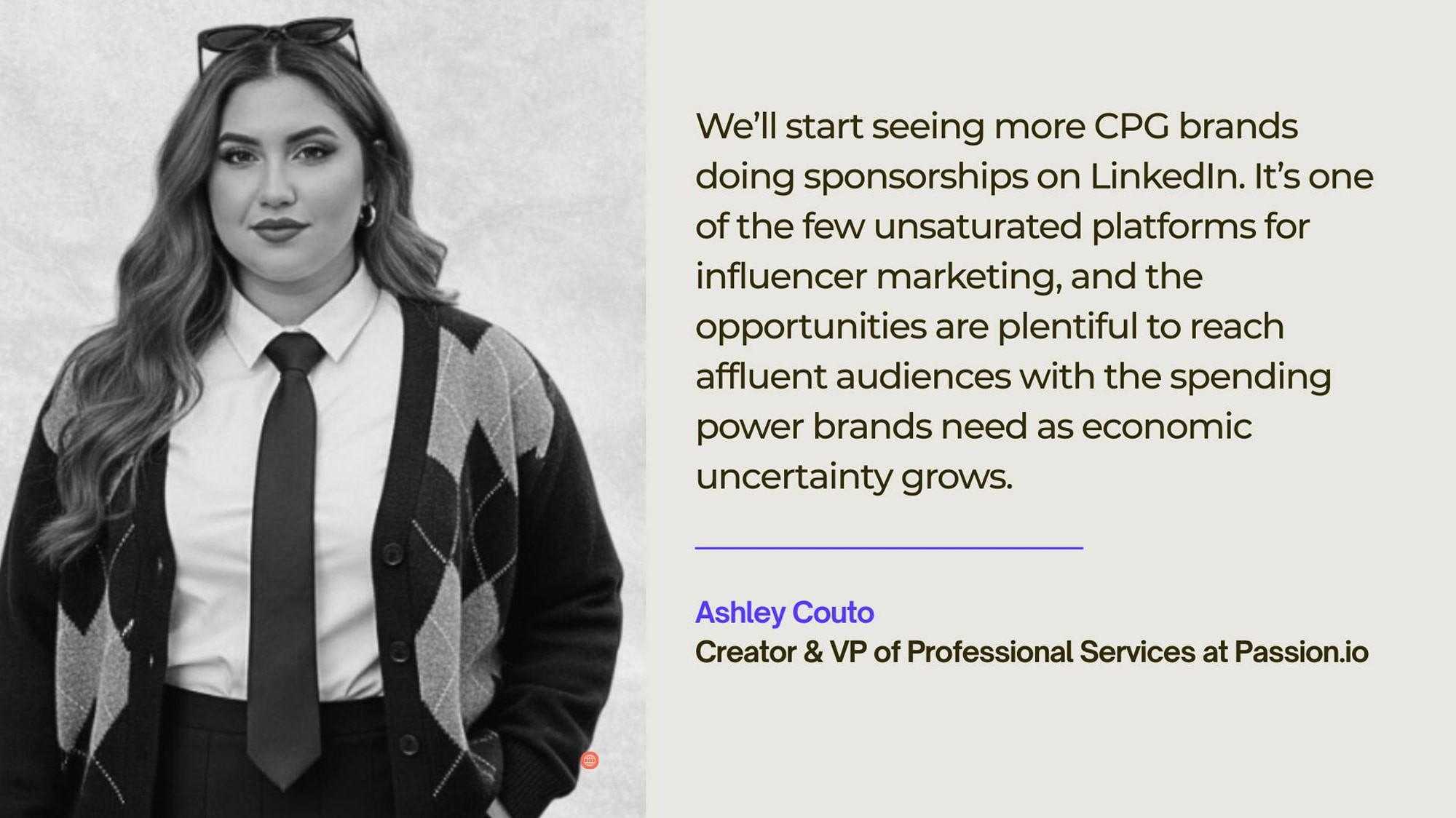
As, Ashley Couto, Creator & VP of Professional Services at Passion.io, shares:
Join 125k+ who follow Ashley
It’s true. We’ve already seen this with consumer product brands, such as haircare company Vegamour, which have already shelled out major money for LinkedIn advisors.
Says their CMO, Michelle Miller:
“We were looking for a platform that had a lot of trust. In doing a lot of research, we saw that [LinkedIn] has a different kind of trust than Instagram or TikTok, but there are not a lot of brands paying for advertising on the platform.”
2. The Great Divide Between “AI Slop” and “Genuine, Good, Content” Will Sharpen
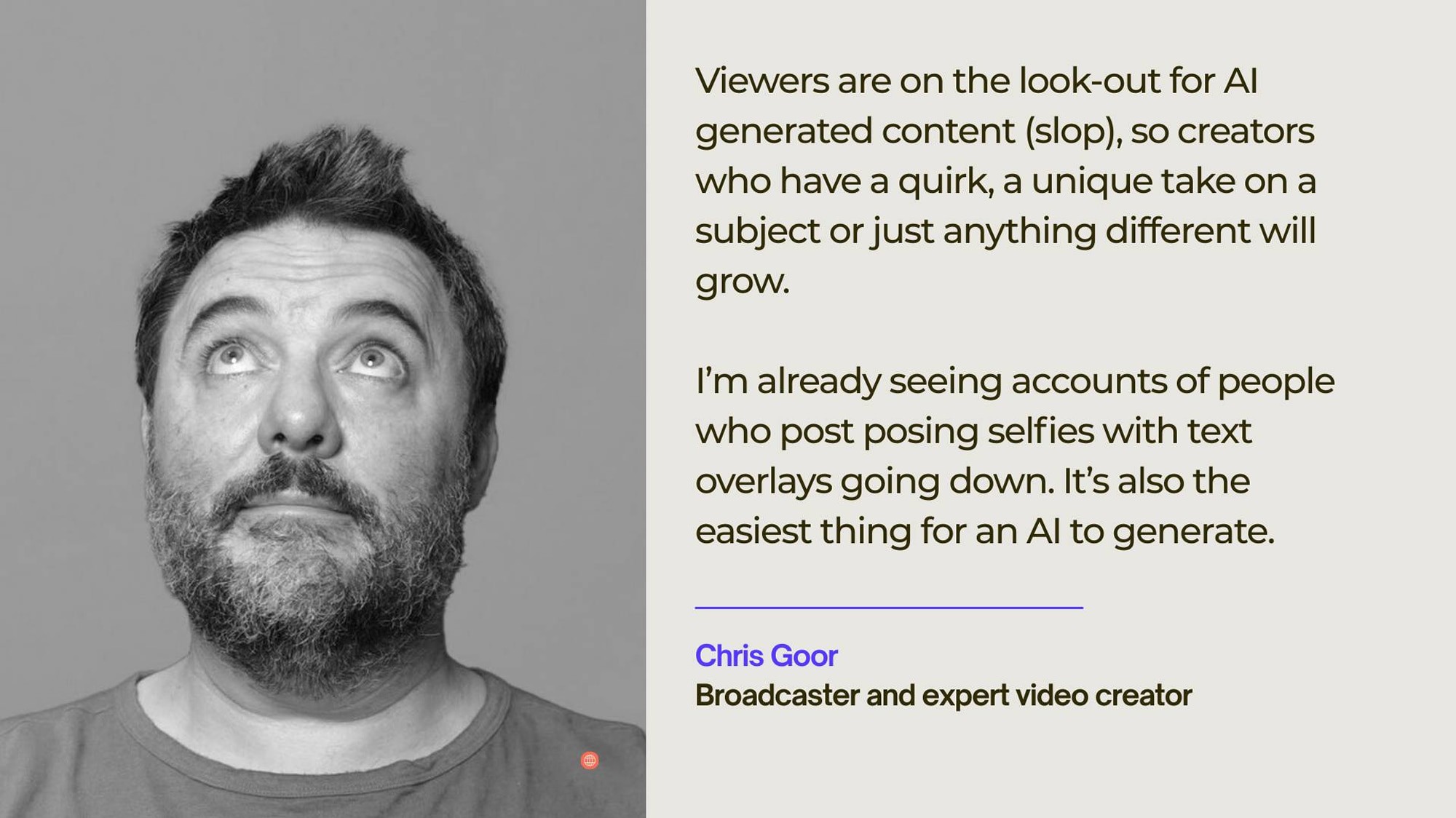
As broadcaster and expert video creator, Chris Goor, shares:
Join 70k+ creators following Chris for all things video here.
Ashley Rutstein, Founder of Stuff Above Advertising, agrees, adding:

She goes on to say, “I call this The Effort Signal. It can show up in three ways. Effort in the process, where brands show how their ads or products get made. Effort in understanding, where they prove they actually know their audience through community involvement, data, or cultural fluency. And effort in the form, choosing formats that require real intention, whether that’s something physical, handmade, or just deliberately not optimized for the algorithm.”
Join 44k others who can’t get enough of Ashley’s insights here.
3. IRL, please!
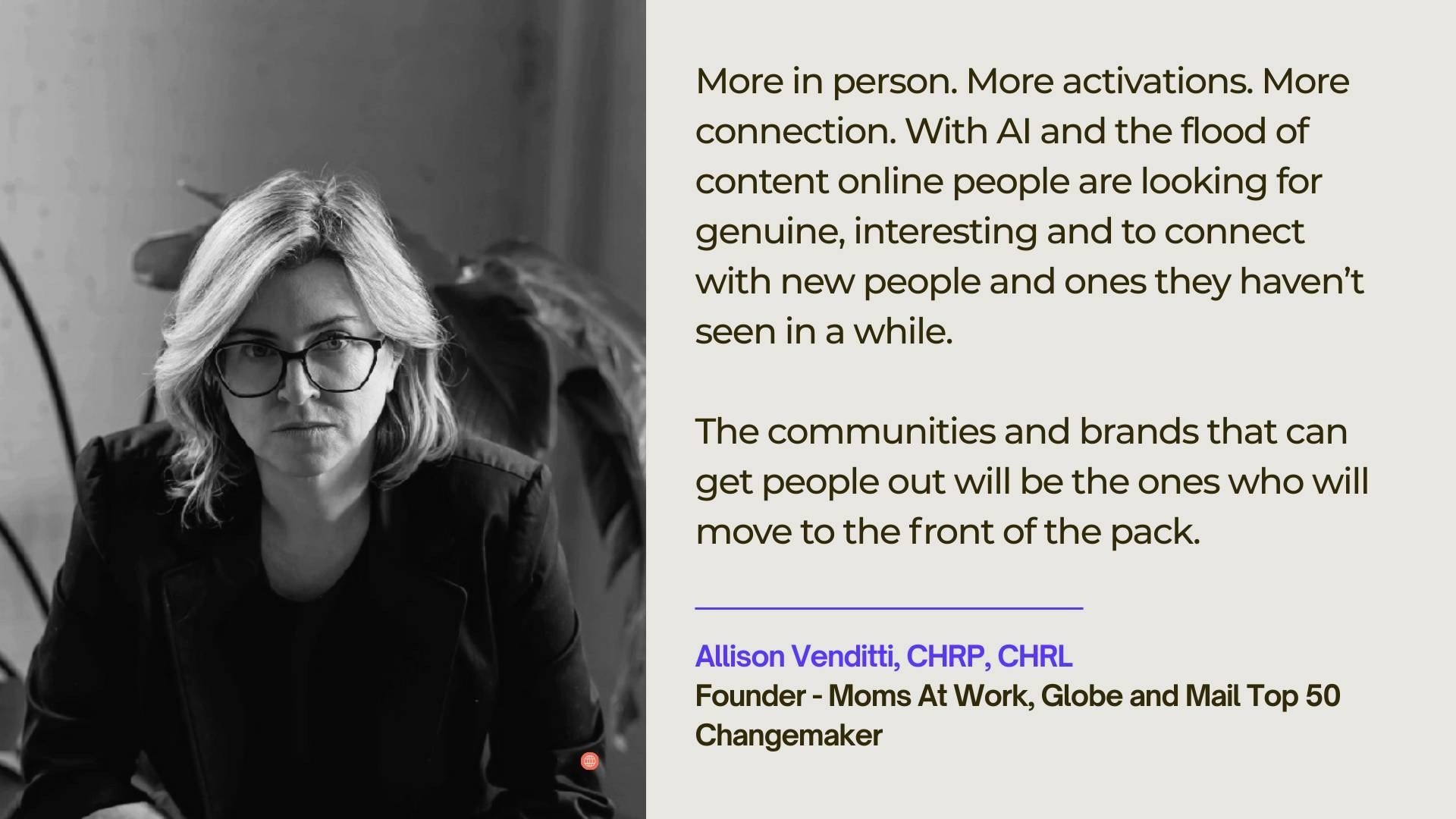
People have been on Zoom calls for 6 years straight now. We are TIRED. We want a return to 3D, and not the kind Zucks keeps trying to make happen in the Metaverse. I’m talking about the real deal, I can smell your breath as we talk, in-person:
True, true, and oh yeah…true.
Join 24k+ others following Allison’s takes here.
4. Good design will be a competitive differentiator
Not much to add to what Ashley Couto again shares here:
As more tools come out that equalize carousel and infographic content production, we’re going to see a resurgence in design as a key differentiator for creators. While others have designs that all look the same, top creators will push their aesthetics further to build greater differentiation between their brand and others on the platform.
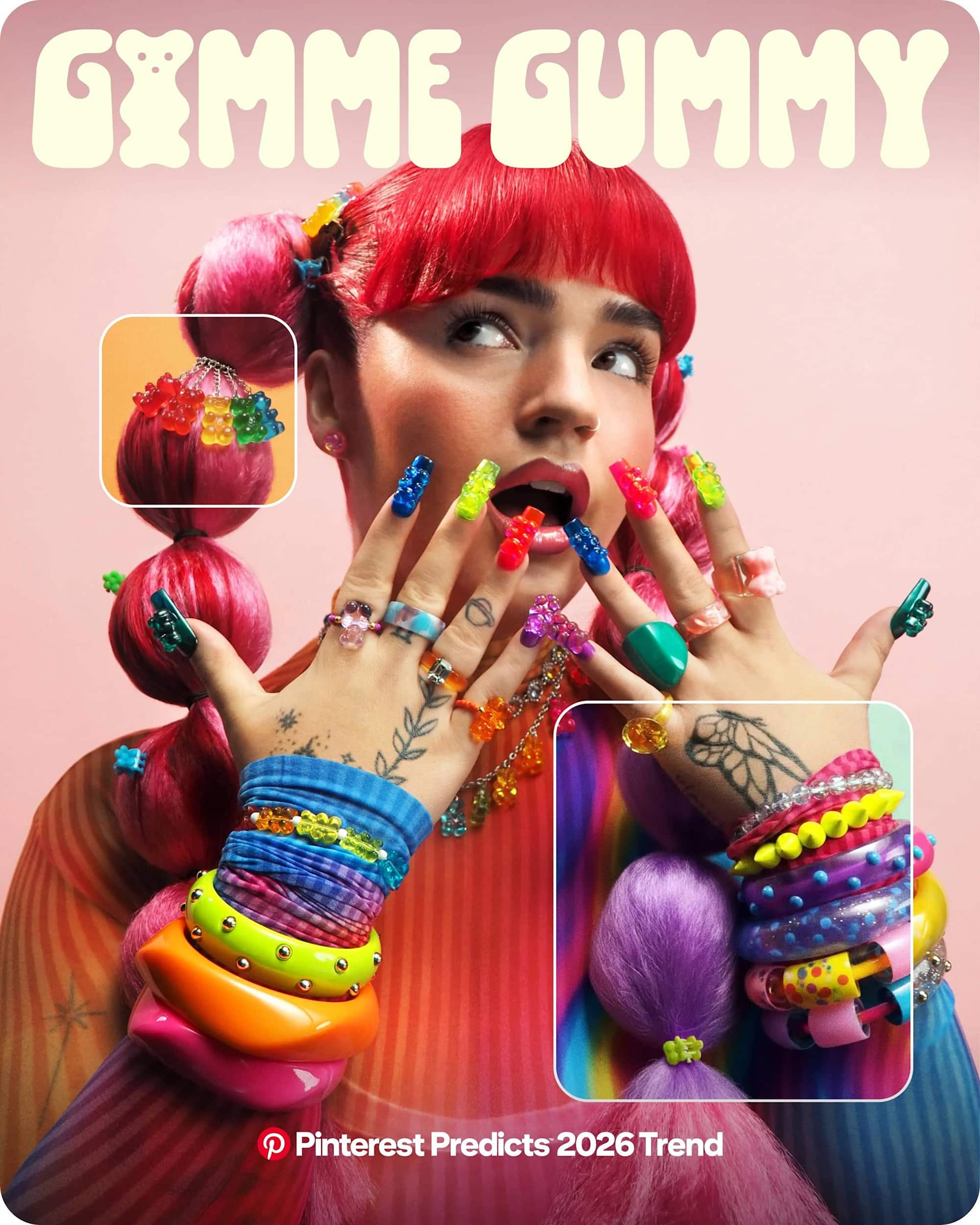
I agree with this wholeheartedly, and in reading Pinterest’s 2026 trend report, some of those design choices will embrace things that are “asmr-friendly” — like this:
5. Betting long on long-form
I really don’t need to try to articulate my thoughts around this, as Jay Clouse said it best:
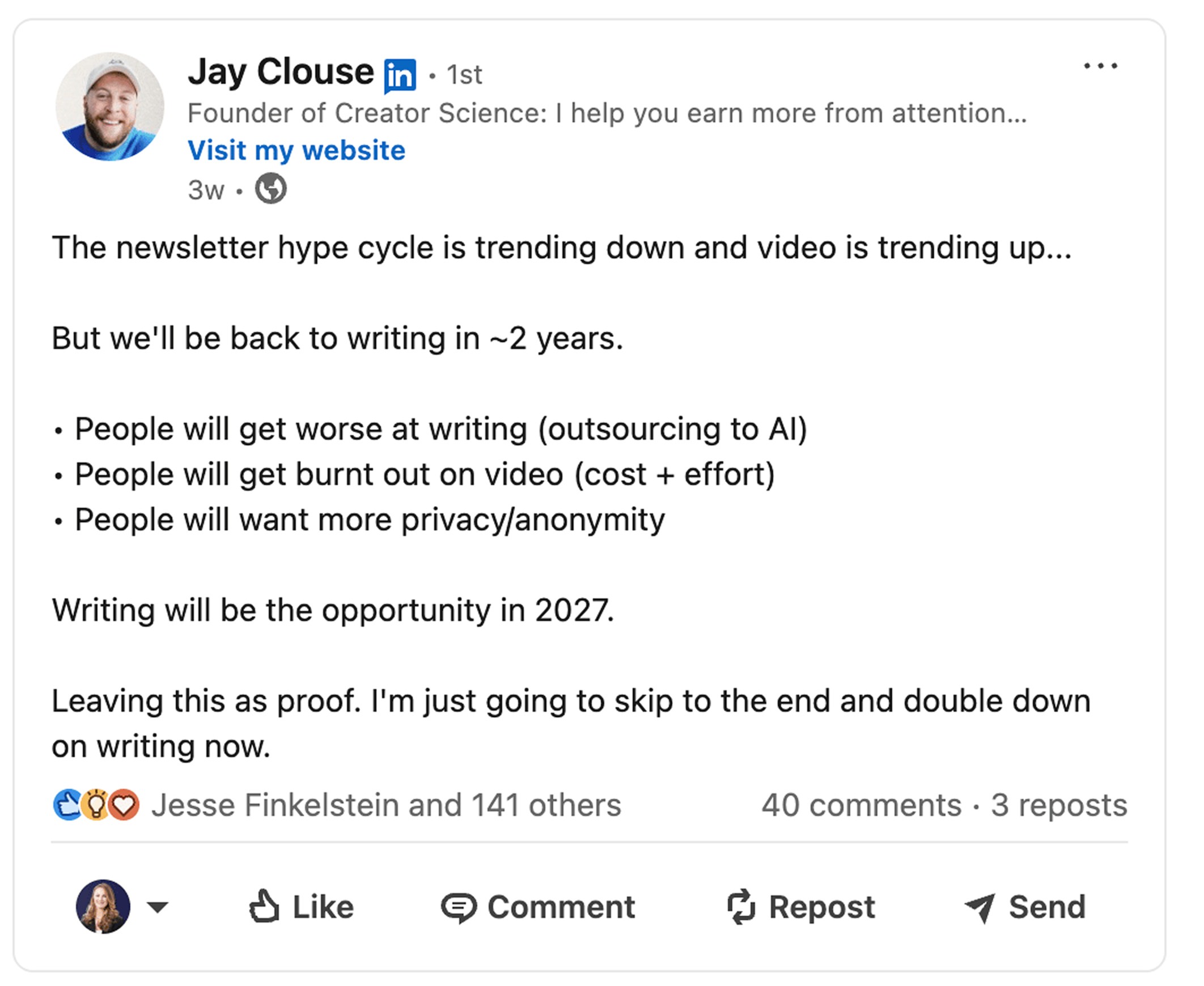
But I guess I’ll make the further case…
It’s easier than ever to falsely believe that heading into 2026, attention has completely disappeared. But that’s not quite right. It just got choosier. Decision-makers are still hungry for substance that helps them make calls, align teams, and de-risk moves. In fact, Edelman + LinkedIn’s latest B2B Thought Leadership Impact work shows high-quality thought leadership opens doors “where ads fall short,” especially with “hidden influencers” who drive consensus behind the scenes. (Think corporate decision-making committees, where perhaps your tech department isn’t the primary buyer, but is still assessing and providing an opinion around a marketing tool as they have to deal with troubleshooting it.)
In these complex decisions, long-form is the only format with enough real estate to show your method, evidence, and judgment—all signals buyers use to separate category experts from parrots.
And audiences will stick with you when the extra words add extra value. Chartbeat’s research finds average engaged time rises with word count up to ~2,000–4,000 words (!!!). Indeed, you have permission to go deeper when the depth is doing work. That matters in complex B2B decisions, where nuance beats novelty.
Still not convinced long-form is here in a major way? We need only look at Substack’s surge. The platform crossed roughly 5 million paid subscriptions in early 2025, buoyed by an influx of veteran journalists and niche experts.
The translation? Long-form isn’t a niche; it’s a mainstream behavior that’s finding new delivery vehicles when the voice is trusted and the value is real.
Depth ≠ length. It’s density of value.
6. A revolving door of white collar knowledge workers: Employees will leave corporate, consultants will return
LinkedIn dropped a stat recently:
The platform saw a 69% surge in Americans adding "founder" to their profiles.
This makes sense. We are witnessing mass layoffs across white-collar industries. But there’s also a second trend hiding underneath the “69% more founders” headline that many of us “in the game” are seeing:
A quiet wave of people trying entrepreneurship… and then trying to come back.
Not because they’re “not cut out for it” or because they’re weak. But because most people massively underestimate what they actually signed up for.
When you leave corporate to go solo, you think you’re choosing freedom. And you are. But you’re also choosing a job you didn’t know you were accepting:
You didn’t just become a [designer/strategist/coach/marketer/ops leader].
You became:
Salesperson (pipeline, outreach, follow-ups, proposals, handling rejection)
Marketing team (content, positioning, offers, messaging, distribution)
Account manager (scope control, client expectations, boundaries, retention)
Project manager (timelines, deliverables, systems, tools, SOPs)
Finance department (pricing, cash flow, taxes, invoicing, bookkeeping)
Legal-lite (contracts, terms, chasing payment without feeling like a jerk)
Customer support (emails, questions, “quick things,” “just circling back”)
CEO (strategy, decisions, no boss to hand it to when you’re stuck)
And here’s the part that fries people:
In corporate, those functions are spread across departments. As a solopreneur, they all land on… your nervous system. 😮💨
So a lot of smart, capable knowledge workers do the same predictable loop:
Leave corporate exhausted
Start a business for freedom
Discover they just recreated a 6-person company inside one brain
Burn out
Look back at corporate like: “Wait… benefits. A paycheck. A team. Structure. Someone else runs payroll?”
That’s what I call the “knowledge worker” revolving door. I saw it rotating at high speeds in 2025, and I think it will enter hypermode in 2026.
Because it’s not really corporate vs. entrepreneurship anymore.
It’s:
Do you want stability from a company…
or do you want to build stability from scratch?
Both are hard. One just hides the difficulty inside meetings and politics. The other makes you face it in your bank account (and with PITA clients).
So if you’re thinking about going solo in 2026, don’t ask:
“Could I do the work?”
Ask:
“Could I do the work and run the business that sells the work?”
Because in my experience, the work is rarely what breaks people. It’s everythinggggg wrapped around it.
7. The more platforms change, the more they look the same…
I recently saw this on Instagram and giggled:
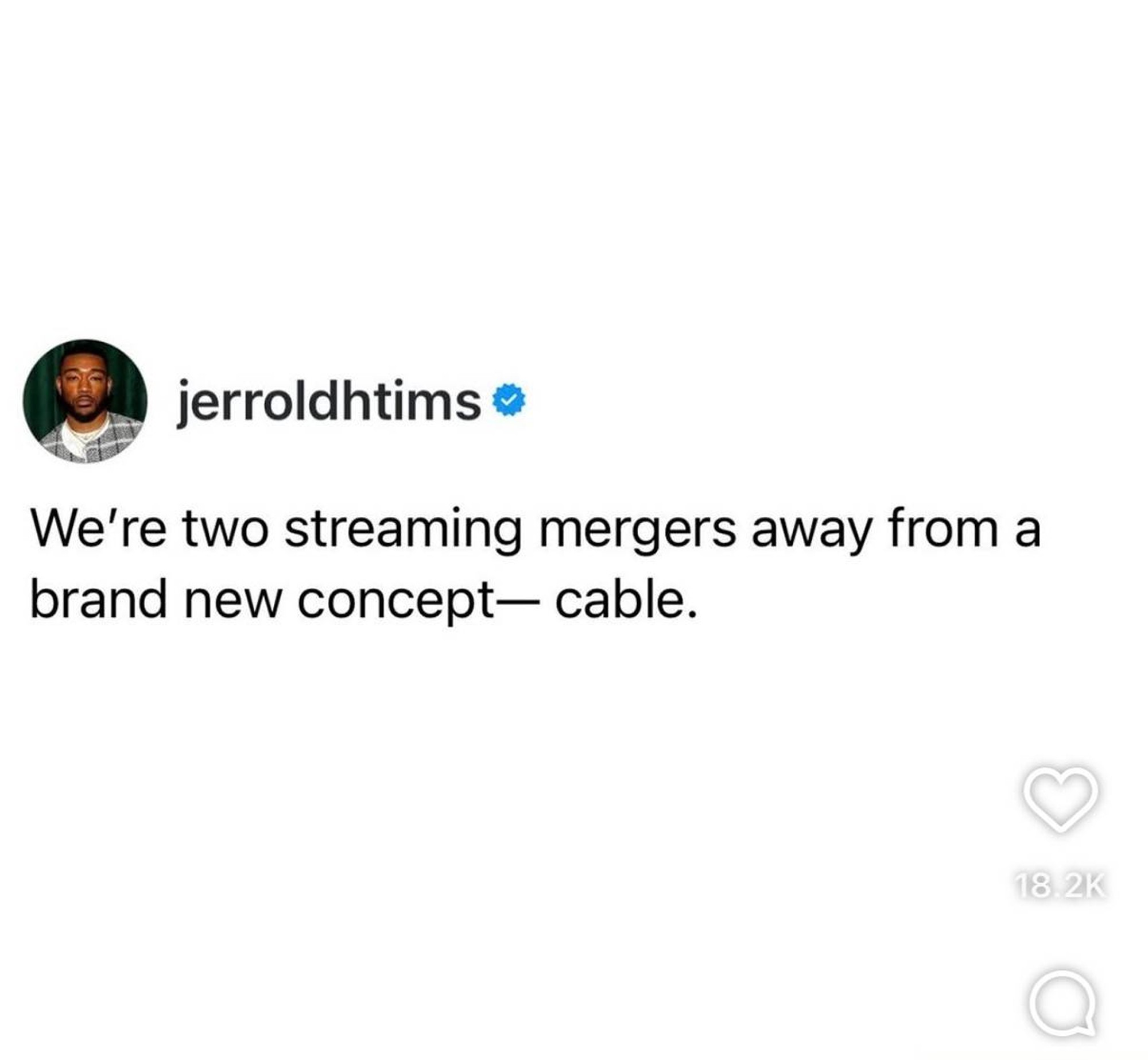
The same is true of social media. We are seeing a blending and “collapsing together” of social media and traditional media platforms like never before. A few examples:
Spotify features video podcasts (so, YouTube?), but wait, Netflix is going to show some Spotify video podcasts on Netflix (so, like a good ole’ fashioned talk show?)
YouTube is now testing carousel posts (so, Instagram?) but on YouTube shorts (so, TikTok?)
Substack lets you do short-form posts, long-form posts, and now video (so, LinkedIn/Facebook?)
Instagram has just launched an app for your TV (IGTV), allowing you to watch reels directly on your TV instead of your phone. (a la YouTube?)
You see what I’m saying? It’s not just that social media platforms are adding features and apps that make them similar to each other; it’s that they are also adding apps and, in some cases, partnering with streaming services to make them similar to “mainstream media.” The line between all of this media is increasingly porous. Where the hell do you build? When here is there and there is…everywhere?
What I’m doing? Tripling down on the platform, I know by leaning into new offerings instead of trying to figure out a new platform. So, for instance, although many will think I’m crazy, I’m not going in on a Spotify video podcast; I’m just going to do the damn video podcast on LinkedIn, as I count on LinkedIn to roll out its version of “LinkedIn TV” (…so like CNBC?)
8. EGC, Yeah, you know me
Ashley Couto again:
Employee-generated content will continue to grow as employers attempt to connect to Gen Z workers. SMBs stand to gain the most if they can be savvy, in line with LinkedIn’s 2026 prediction that Gen Z will turn to small companies to gain experience as larger orgs shut them out and replace them with AI.
Layering in my further insights here…
LinkedIn company pages are playing with one hand tied behind their back. Your people aren’t. LinkedIn-cited benchmarks say your employees’ collective networks are ~10x larger than your company’s follower base. And when those people share? The same research that is frequently quoted suggests that brand messages can reach 561% further when employees share them compared to the brand’s own channel. Translation: your “real reach” is sitting in your org chart.
Here’s the punchline: you don’t need a 500-person creator army. You need a motivated 15. Another LinkedIn-cited benchmark: when just ~3% of employees share company content, it can drive ~30% more total engagement than company shares alone. And it’s not just vanity metrics—LinkedIn-reported analysis (covered by Social Media Today) found click-through rates lift ~1.8%+ when employees share versus the original company share.
So the question isn’t “Should we do employee-generated content?” It’s “How long can we afford to pretend our best distribution channel isn’t already on payroll?”
And companies are acting like it. Business Insider reported Deloitte Germany basically pioneered a full-time “corporate influencer” role and built an internal influencer cohort of about 250 employees. Meanwhile, money is flowing into the infrastructure to systematize this: Credence Research projects the employee advocacy software market growing from $725M (2024) to about $1.42B (2032) (~8.8% CAGR). That’s not “a trend.” That’s budget. That’s headcount. That’s a strategic admission that the brand page isn’t the brand anymore—the people are.
9. Kill your bulky darlings
I came back from mat leave in April of this year, poised and ready to sell, “Brand Launch” my comprehensive course with 5+ modules and hours of video content, all to see the largest, size 350 Impact Font writing on the wall:
“Ain’t nobodddyyyy sitting through your course, girlfiend. AI is here.”
Sigh, I killed my darling and my team, and I worked double-time to put out a 30-day fast-action cohort-based learning program, which became our bestseller this year.
Becky Pierson Davidson agrees:
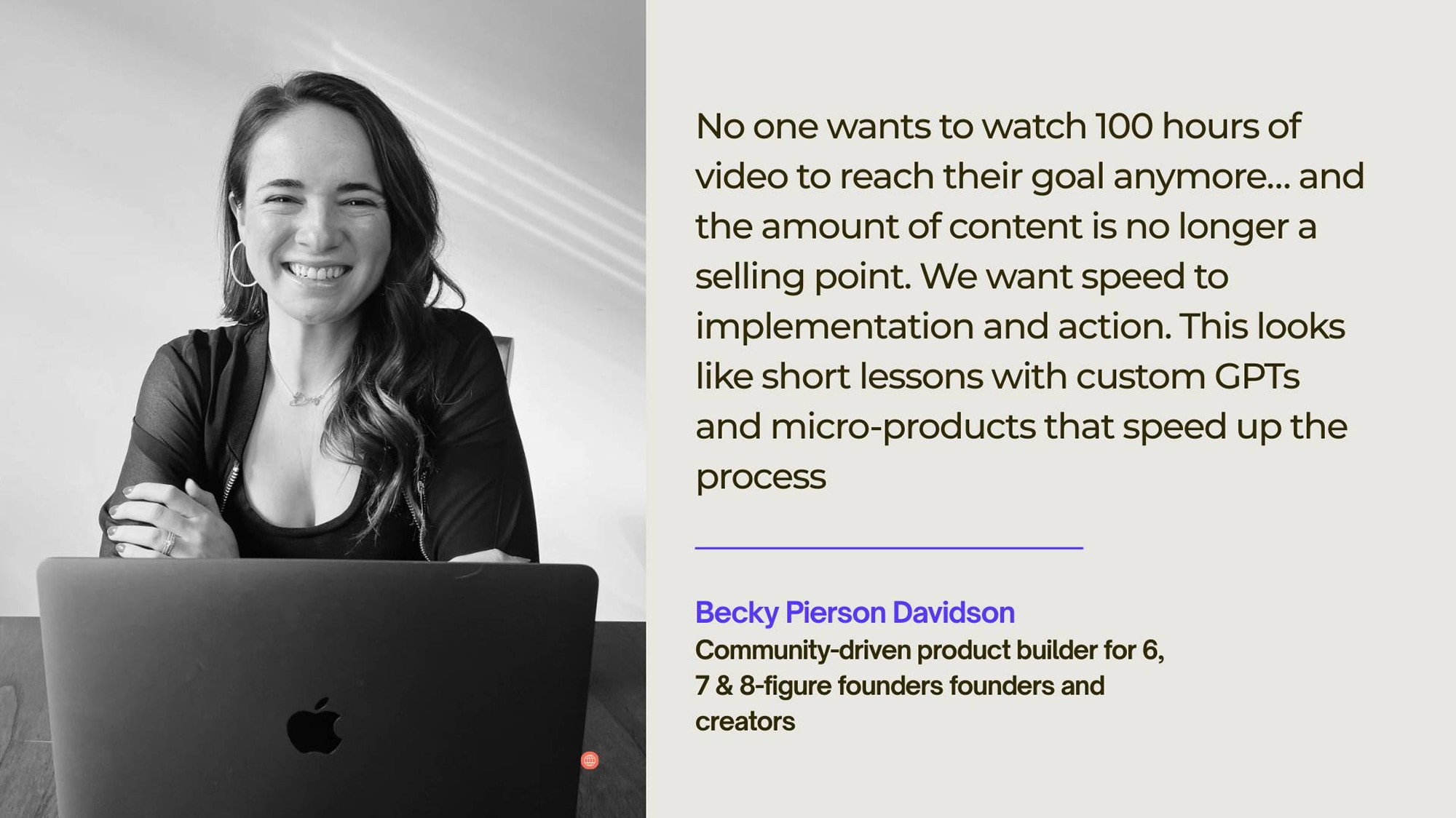
Pierson goes on to say, “The question to ask is how can I get my clients results as quickly as possible and leverage the latest tech to do it?
Well, mic drop to that.
Join all the top creators I know following Becky to build their communities here.
The 20,000 Foot View Wrap Up
If you zoom out, every single one of these predictions is pointing to the same reality: the advantage is moving away from faceless brands and toward real humans with real signal—clear thinking, good taste, lived experience, and a point of view. The platforms will keep morphing, AI will keep flooding the zone, and the job market will keep nudging people into creator-mode whether they asked for it or not. But the winners in 2026 won’t be the loudest. They’ll be the most trusted.
That’s the hopeful part: you don’t need to out-post everyone. You need to out-care everyone. Care about clarity. Care about substance. Care about the work. Care about the people on the other side of the screen. If you can do that and build a simple system that makes it sustainable, you won’t just keep up with 2026. You’ll create leverage inside it.