Read Time: 8 minutes
How to Translate Expertise into Buyer Language (So Your Personal Brand Drives Actual Purchases)
If you’ve ever had someone say:
“This is really interesting.”
“We should definitely talk.”
“Let me think about it.”
…and then disappear, you’re not dealing with a “bad messaging” problem.
You’re dealing with a translation problem. (or you’re on a dating app, and people are just flaky. (But let’s talk business here.)
You’re likely speaking in expert language — accurate, nuanced, professional.
And your buyer is listening for buyer language — clear, specific, and easy to decide.
Until your expertise is translated into the language of outcomes, risk, proof, and effort (behavioral economics), your message will keep landing as “smart,” but not actionable.
Let’s fix that.
The real gap: experts explain, buyers decide
Fractional leaders, consultants, and coaches are especially vulnerable to this because you actually know too much.
You can see the real issue behind the issue. You understand complexity. You’ve lived the tradeoffs.
I call this the “Expert Trap.”
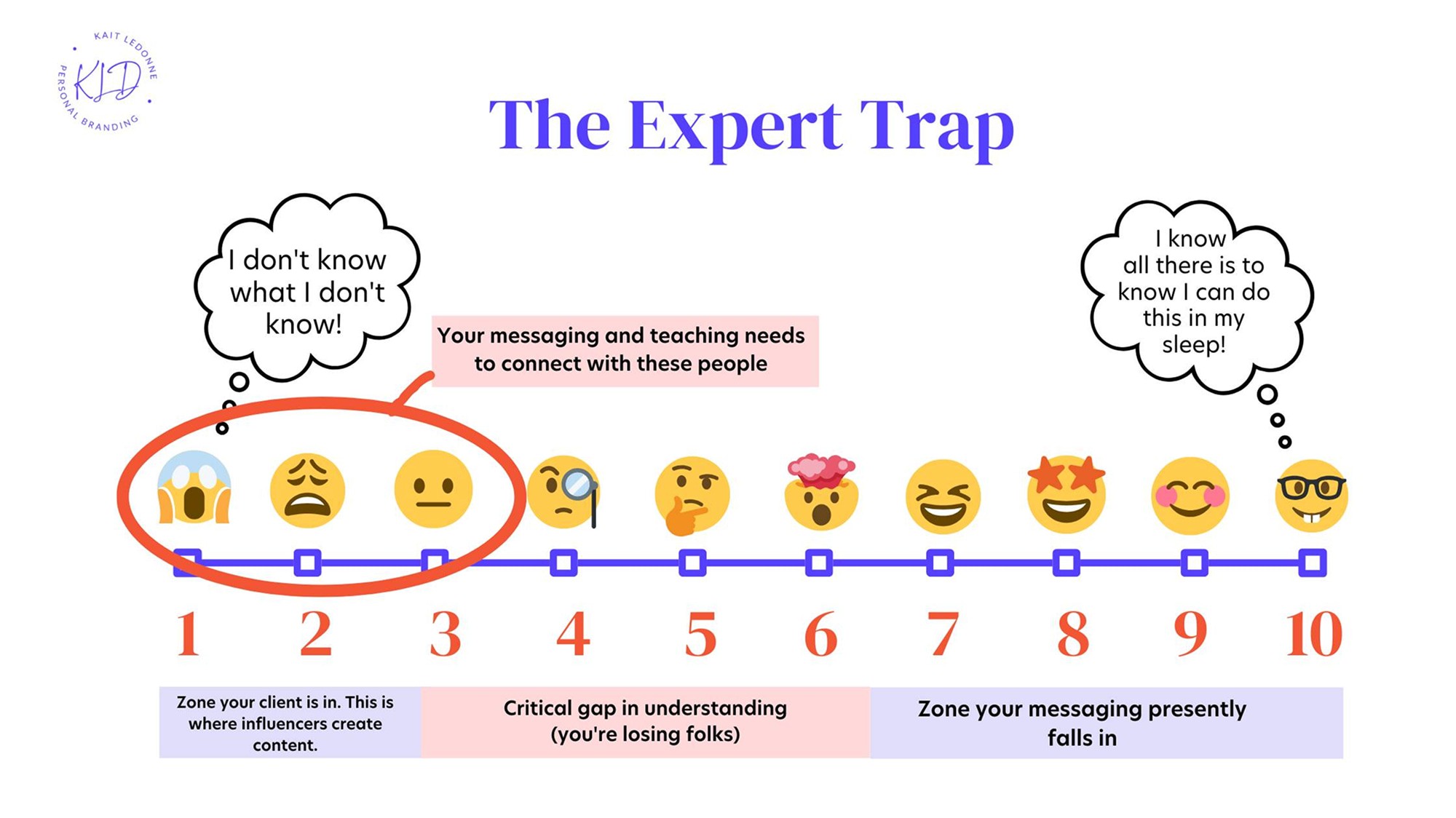
So your messaging sounds like this:
“I help organizations drive strategic alignment.”
“I support leaders through transformation.”
“I provide fractional operations leadership.”
“I coach executives to elevate performance.”
None of this is wrong. It’s just untranslated.
Because buyers aren’t waking up saying, “I need strategic alignment.”
They’re saying:
“Our exec team is not on the same page, and it’s slowing everything down.”
“I’m inheriting a mess, and I can’t afford a noisy first 90 days.”
“We’re scaling, and operations is duct-taped together.”
“My leadership team is strong… but they avoid the hard conversations.”
Buyers make decisions when they can clearly answer:
What changes?
How do I know this will work for us?
What will it cost me (time, money, reputation, distraction)?
What’s the next step?
If you don’t answer those, the buyer defaults to the safest option: doing nothing. (…or doing something with your competition who is better at messaging. Ouch.)
The Buyer Translation Principle
If you want your message to incite action, it needs to do three things:
Create desire (I want that outcome)
Build trust (I believe you can get me there)
Reduce friction + risk (I can say yes without fear)
If your buyer doesn’t feel pulled, safe, and clear, they won’t move.
So instead of “trying to sound more compelling,” your job is to translate your expertise through those three filters.
Here are five translation moves that do it without burning down your entire brand strategy.
Translation Move #1: Name the outcome (with constraints), not the role
Let’s move through some tangible examples:
Your buyer doesn’t buy “fractional CFO.”
They buy cash clarity, fewer surprises, and smarter decisions.
Your buyer doesn’t buy “executive coaching.”
They buy confidence under pressure, better leadership decisions, and less second-guessing.
Try these before → after translations:
Before: “I offer fractional COO support.”
After: “I help founders stop running the company through Slack and heroic effort — by building a weekly operating rhythm, clear owners, and predictable execution.”
Before: “I help with strategic planning and alignment.”
After: “I turn ‘we agree in meetings, but nothing changes’ into a plan that actually gets executed — with priorities, accountability, and decision rules your team uses when it matters.”
Before: “I do GTM advisory for B2B.”
After: “I help B2B teams stop generating ‘maybe later’ leads by tightening positioning and building a repeatable pipeline that doesn’t depend on the founder doing everything.”
Constraints matter because they communicate: “I understand your reality.”
“without adding headcount”
“without a 6-month reorg”
“without burning out your top performers”
“even if the exec team is stretched thin”
That’s when it feels like you’re reading your prospect’s mind. You want them to think you know exactly how a Tuesday in their life feels.
Translation Move #2: Make the invisible cost of “doing nothing” visible
Most buyers can’t justify action until they can justify inaction as costly.
Not dramatically, but practically — and not just in their day-to-day. You need to spell out how it starts to change what other people think is true about them.
Because the silent tax of staying put is usually paid twice: in results and in reputation.
And psychologically, the reputational hit is more unbearable: humans are wired to avoid status loss. When our standing in a group feels threatened — credibility, respect, influence, belonging — the brain treats it like danger, not inconvenience. That’s why “looking incompetent,” “losing trust,” or “falling behind peers” can motivate action even faster than the promise of a better outcome.
Examples:
The cost of misalignment isn’t “lack of clarity.” It’s decision drag, duplicated work, and quiet resentment — and eventually a team that stops taking “priorities” seriously.
The cost of avoiding hard conversations isn’t “culture” issues.” It’s top performers leaving while the problems remain — and the leader quietly earning a reputation for tolerating what they claim they won’t.
So your message doesn’t just promise a better future. It names what they’re already paying for (internally and through their social circle’s lens):
“Every week you delay, execution becomes more personality-driven — and your team learns the plan is optional.”
“Without clear decision rules, you’ll keep re-litigating the same issues — and people start managing around leadership instead of following it.”
“When leaders avoid conflict, accountability doesn’t disappear — it just relocates into hallway conversations and attrition.”
You’re not scaring them. You’re helping them see what’s already happening — and what it’s starting to signal to everyone around them.
Translation Move #3: Add proof that matches the buyer’s identity
Generic proof doesn’t convert sophisticated buyers.
“We loved working with her!” isn’t a decision-maker’s proof.
They want evidence that someone like them got results under similar constraints.
Examples that work for your audience:
“In 60 days, we implemented a weekly exec operating cadence and reduced missed deliverables by creating clear owners + deadlines.”
“We restructured reporting so the founder stopped being the bottleneck — and decisions moved down the org.”
“We stabilized cash flow with a weekly cash forecast and tightened spend decisions.”
“We reduced leadership churn by addressing the conflict everyone was politely avoiding.”
Even if you don’t have perfect metrics, you can still be specific:
timeline (“first 30 days”)
what changed (“decision cadence,” “accountability,” “forecasting,” “meeting structure”)
what it felt like (“fewer surprises,” “less firefighting,” “cleaner handoffs”)
The goal of proof isn’t applause. It’s to reflect back your buyers’ exact predicament.
Translation Move #4: Reduce risk with clarity (not more hype)
If your message is strong and buyers still hesitate, it’s usually because of perceived risk.
They’re not asking, “Is this good?”
They’re asking, “What if this creates chaos or exposes me?”
Hence, the old saying, “No one gets fired for hiring IBM.”
We need to acknowledge risk as the purchaser’s Achilles’ heel by removing ambiguity:
Explain what happens after yes:
Week 1: diagnose + align on success metrics
Weeks 2–4: implement operating rhythm / decision cadence
Month 2: tighten execution and owner clarity
Ongoing: coaching, enablement, and handoff
You’re not selling a mystery box. You’re selling a path.
Clarify what it is / isn’t:
“This isn’t a 70-slide strategy deck.”
“This isn’t therapy.”
“This isn’t ‘more meetings.’ It’s a rhythm that makes meetings shorter and decisions cleaner.”
Sophisticated buyers relax when they can predict the experience. Remember, the mind loves certainty!
Translation Move #5: Make the next step absurdly easy
A lot of call-to-actions (CTAs) are emotionally heavy:
“Book a discovery call.”
“Apply.”
“Reach out if interested.”
For your audience, a better first step is one that feels low-risk and useful.
Examples:
“If you’re considering a fractional COO, I’ll tell you in 10 minutes whether your issue is ops, strategy, or leadership.”
“Send me your org chart and your weekly meeting cadence — I’ll point out the most likely bottleneck.”
“Reply with your #1 execution problem right now (one sentence). I’ll tell you the most common root cause I see.”
Small step → small yes → momentum.
A quick Buyer Translation Checklist (3 minutes)
Before you publish your next headline, bio, or offer description, ask:
What outcome does this create in plain language?
What’s the real “cost of doing nothing” here?
What risk do they fear if they choose wrong?
What proof would matter to someone in their role?
What makes this doable in their current reality?
Is the next step obvious, light, and safe?
If you can answer those, your messaging becomes usable — and usable messaging converts!
TL;DR
If your content is getting polite interest (“this is really interesting…”) but not decisions, it’s probably not a “bad messaging” problem — it’s a translation problem.
Buyers take action when they can quickly answer: what changes, why it’ll work for them, what it’ll cost (time/reputation/distraction), and what to do next.
So your job isn’t to “sound more compelling.” It’s to translate your expertise through three filters: desire, trust, and low-risk clarity.
Use these five translation moves:
Name the outcome (with constraints) — not your role/title.
Make the cost of doing nothing visible (results and reputation).
Use proof that matches your buyer’s identity (someone like them, under similar constraints).
Reduce perceived risk with clarity (sell a path, not a mystery box).
Make the next step absurdly easy (small yes → momentum).
Before you publish, run a quick checklist to make sure your message is usable — because usable messaging converts.
Get your message audited by an expert…
If you’re reading this thinking, “Okay… I get it. But translating my expertise like this every week — for my posts, my bio, my offer, my newsletter — is where I stall,” you’re normal.
Because the expert trap isn’t a knowledge problem. It’s an execution + feedback problem: you’re too close to your own work to hear what a buyer hears.