Read Time: 8 minutes
How to Niche Without Feeling Like You're Leaving Money On the Table
A guide to radical personal brand-clarity for even the most multi-passionate, multi-hyphenate among us.
Recently, during a live coaching call with my students, a brave participant took themselves off mute and said,
“I keep creating, then shelving projects because each one feels not enough. I don’t know when to share or how to turn it into a business. I want to do all the things, so instead I do none.”
I wanted to hug her through the screen because I felt that so deeply in my bones. Even today, a decade into my business, I still feel the pull of exploring all the things I love, which recently include: color season analysis, speaking, writing a book, and teaching.
The number of times I have correctly identified a friend as a ‘deep autumn’ color season and told them what colors to shop for and their response has been, “Wow! You are really good at this and I feel so much better after. You should seriously do this as a business,” has been too many to count.
Ten years ago, I would have thought, “Hmmmm, maybe I should!” And then I would have tried to fold it into my brand or business. Or, worse yet, I would have stalled building my brand as a personal brand expert as I “tried on” the color season business idea.
All the while, I’d keep spinning all these passion plates in the air, and none would take off. Instead, most fell to the floor and shattered, and I had nothing in terms of the way of a viable business to show for it. Groan.
Why “Niching” Feels Like Losing a Limb
We are humans, and as such are complex beings. We are not GPT generated experts that exist to march in one lane.
As such, the anxiety to “niche” isn’t just tactical; it’s existential. “If I choose one offer, am I betraying all the other ideas that make me me?” another student echoed the same pang of fear as the first. To her, multiple buckets feel safer than betting on one, even though the clutter freezes momentum.
The real problem here is this:
💡 We mistake focus for finality. It triggers grief, as if we’re amputating healthy, creative limbs. No wonder we stall.
If this hits home with you, my beautiful, enthusiastic, and creative friend, allow me to share a field guide for how to focus your brand without sacrificing your passions.
1. Name Your 180-Day Season of Genius
There’s a quote that is often attributed to Betty Friedan, an American feminist, writer, and activist, that goes, “You can have it all, just not all at the same time.” It’s often used as a response to the very famous quote, “Who says women can’t have it all?”
I like to tell those in a brand identity-quagmire the same thing. “Look, you can do all the passion-fueled things you want, but do one of them at a time. Once you get one down, using it as a roadmap to success for your next passion is a cheat code.”
Here’s how to put this into action:
Write out every idea begging for airtime.
Circle the one that promises the fastest, clearest win for the audience you most want right now.
Commit “I serve X promise for 180 days” on a sticky note above your monitor.
Remember, seasons end and expertise compounds. The rest of your ideas will still be here, even stronger, when you return. And the best part? You’re bringing with you a roadmap fortified with all your learnings of the first thing that you can then apply to the second.
2. Ship a “Minimum Viable Niche”
Multi-passionate brand confusion gets even more muddled when it meets another sinister brand hijack…perfectionism. When these two things couple up, it’s like a marketing Molotov cocktail, destroying any potential in its path.
You sit there with all your “brand and business concepts trying to perfect all of them in a vacuum of a Google Drive before simultaneously launching all at once. And what ends up happening 20 times out of 10? None of them ever sees the light of day as a result. Or you have fits and starts but see no real progress and feel massively defeated. Been there, felt that.
Instead of trying to get your arms around all of this and come up with one clear “master brand” that straddles your passion for music with your business idea of software consulting, instead, pick a minimum viable niche and roll with it.
What’s the simplest, most testable slice of your expertise?
When it lands, you can layer in additional dimensions. If it doesn’t, you haven’t burned the whole proverbial orchard—just one branch.
3. Map out your brand pillars
Consider that every personal brand consists of three core content pillars, whether you realize it or not. The degree to which you share content from these pillars will effortlessly root your knowledge in a personable and engaging manner. Here’s the breakdown:
~ 60% - “Professional Advice & Stories”
The majority of your content should focus on providing wisdom, stories, strategies, and tips to your audience to help solve the problem they're challenged by in your industry.
~ 20% Story Posts
These are vignettes from your career/professional life that show how you navigated through something. Since it's a first-person experience, it's a bit easier to express yourself naturally. You're not spouting off theory, after all. You're sharing your experience!
~ 20% Passion Posts
This is content that reflects your personal values and interests. For example, I focus on personal branding, but I'm wildly passionate about living in NYC, and I write a lot of content about it:
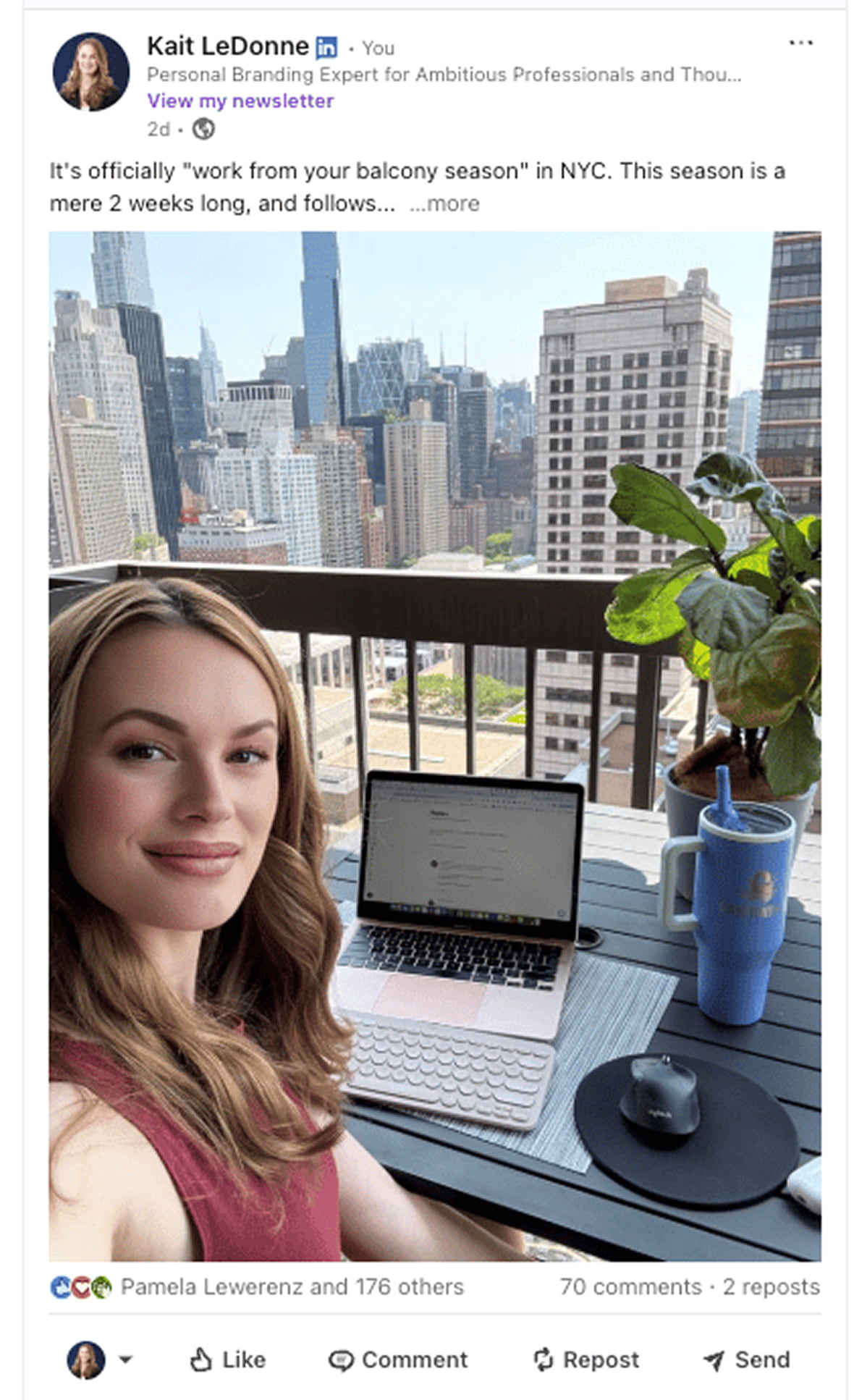
Now, even though this content always knocks it out of the park in terms of engagement, I don’t share it more than about 1 in every 5 posts because then I may be mistaken as a “NYC Tour Guide,” instead of my expertise.
I had a former student, Dan Binstock, do this in masterclass fashion with one of his passions, which is playing music. While the majority of his personal brand content centers on helping partners get placed at top-tier law firms (that’s his business), every so often, he now shares his “Chords and Counsel” series, which is part of his passion for music. It doesn’t hurt that he’s covering bangers like “Pink Pony Club.”
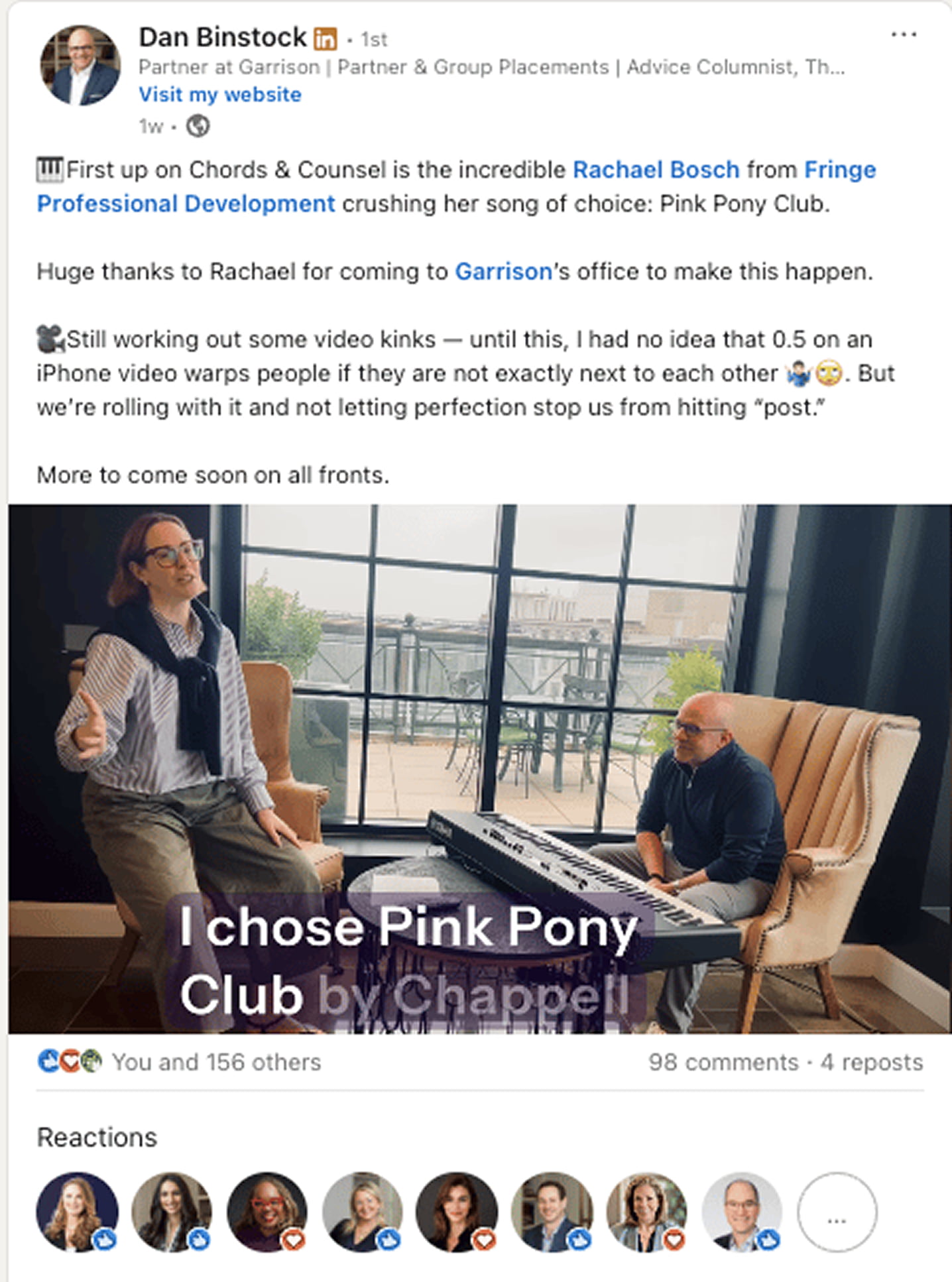
It’s SO fun and, of course, he got incredible engagement from it, and you bet your bottom dollar it’s a great way to connect with his clients.
Because when you get clear on what topics go in each of your pillars and you ratio them out, you naturally anchor your brand in a way that integrates professionalism and personality. You sound less like a corporate robot and more like a fully-baked, natural person — the type your audience likes to buy from and do business with.
Want to put this into action? Here’s the 6-Day Focus Framework
Day | Action | Why It Matters |
1. Idea Purge & Season Pick | • 20-minute brain-dump of every project or passion. • Highlight the one delivering the fastest, clearest win for the people you most want to serve. • Declare it your 180-Day Season of Genius (post a selfie with the sticky for public accountability). | Clarity accelerates; clutter paralyzes. |
2. Craft & Test Your Minimum-Viable Niche | • Write a single, 6-to-10-word headline that captures the core transformation you deliver (e.g., “Turn Silent LinkedIn Profiles into Daily Lead Generators”). • Add one sentence that spells out the pain you solve in 30 words or less—this becomes the anchor for your 60 % “Pro Advice” pillar tomorrow. | A razor-sharp message is the fastest way to verify that your expertise lands before you package or price anything. |
3. Map the 60 % “Pro Advice” Pillar | • List 6–8 how-to or insight topics that fix your audience’s biggest pain. • Draft headline hooks for three of them. | Consistent value posts anchor your authority and drive leads. |
4. Map the 20 % “Stories” Pillar | • Inventory milestone wins, face-plants, and client case studies. • Pick two stories that reveal a lesson related to your offer. | Stories humanize expertise and build trust faster than tips alone. |
5. Map the 20 % “Passions” Pillar | • List personal interests/values that spark connection (music, NYC life, fitness, etc.). • Choose one passion that subtly ties back to your brand promise. | Passion posts differentiate you from look-alike experts and deepen rapport |
6. Build a 4-Week 60/20/20 Content Calendar | • Slot the Pro-Advice, Story, and Passion ideas into a 20-work-day grid (e.g., Mon–Fri for four weeks). • Use a free scheduler to load posts today; set a mid-month review to tweak ratios. • Add one soft CTA each week pointing to your MVP offer. | A pre-planned calendar removes “what do I post?” friction and keeps the 60/20/20 balance intact. |
Giving yourself the gift of focus is one of the kindest and clearest moves you can make for your brand. Follow this six-day sprint, share your progress out loud, and watch clarity turn into conversations that convert.