Read Time: 8 minutes
5-Step Blueprint Breakdown for Overnight Thought Leaders Like Mel Robbins, Simon Sinek, Emily Oster, Ramit Sethi, Andrew Huberman
Every few months, someone asks me a version of the same question:
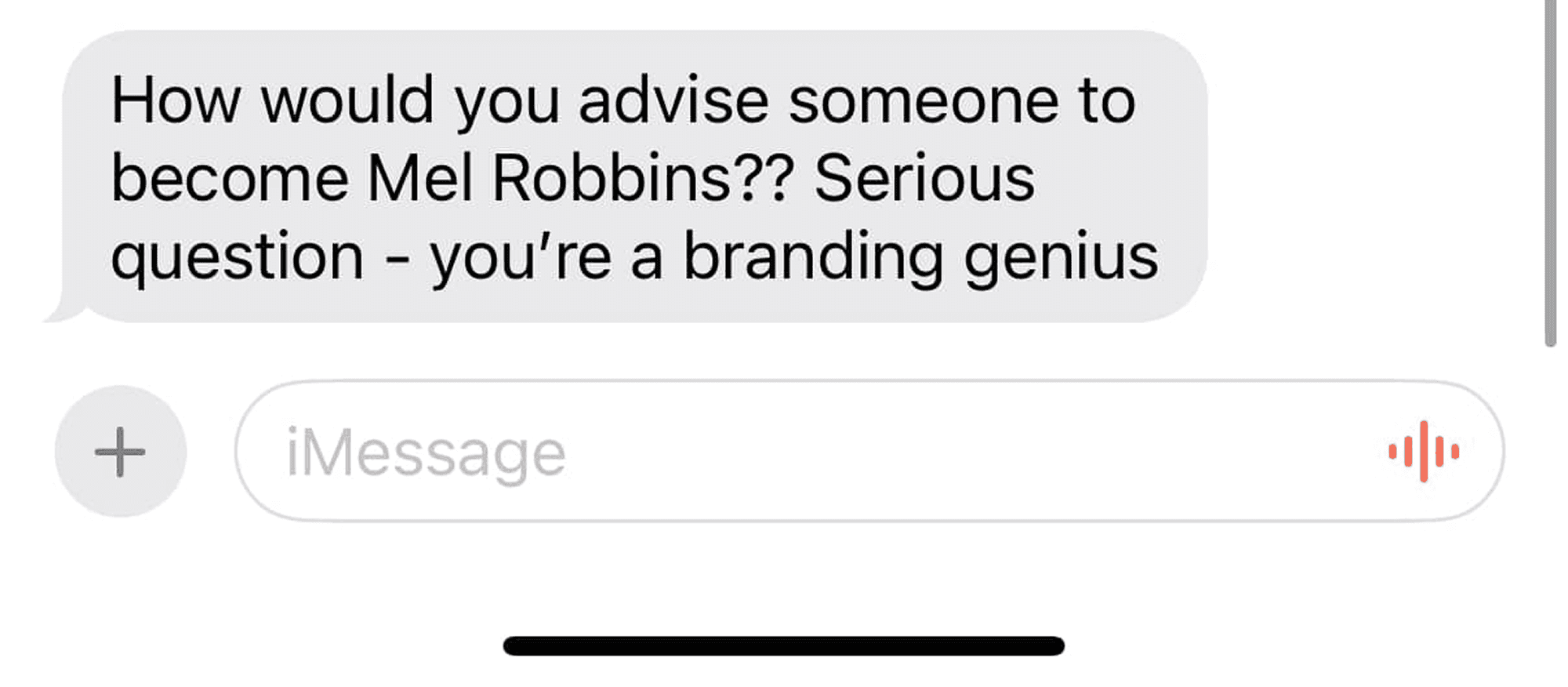
Yes, this is a real screenshot from someone. Also, yes, I included it because they called me a branding genius! (Kidding, but hey, if the iMessage compliment fits, I’ll wear it.)
My ego aside, this question comes to me all the time. Sometimes it’s Andrew Huberman. Sometimes it’s Ramit Sethi, Simon Sinek, or Emily Oster. The names change, but the spirit of the question is the same: What does it actually take to go from smart professional to household thought leader whose ideas shape the culture?
It’s a fair question—and an even better one if you understand that Robbins, Huberman, Oster, Sinek, and Sethi didn’t just “go viral.” They executed deliberate plays on the right platforms, at the right time, against the backdrop of the right cultural waves.
So here’s the most tactical breakdown I can give you: the steps that led to their ascent, the cultural tailwinds that fueled them, and—crucially—the platforms that matter right now in 2025 if you want to follow suit
Step One: Anchor Around One Unforgettable Idea
The fastest way to stay invisible? Spread yourself across five frameworks. The fastest way to become unignorable? Own one.
Mel Robbins built her empire on The 5-Second Rule. Three words, one motion, instantly repeatable. That phrase alone powers a $100M+ brand.
Simon Sinek offered leaders a rallying cry: Start With Why. Simple diagram, universal question. To this day, most executives can draw the Golden Circle on a cocktail napkin.
Emily Oster branded herself the parenting economist. At a time when “mommy bloggers” dominated, she brought cold data to hot parenting debates.
Ramit Sethi was audacious with I Will Teach You To Be Rich. The title itself was a contrarian act in a culture obsessed with frugality.
Andrew Huberman carved out “protocols”—science-backed tools you can apply to your daily life. He didn’t just explain neuroscience; he gave people scripts for sleep, stress, and dopamine.
Check out this video for a breakdown on how Simon Sinek employed this tactic.
👉 The lesson: you don’t become memorable by stacking frameworks. You do it by planting one sharp, sticky flag first.
📋 Wanna cement your unforgettable idea? Grab my “10 Thought Starters for Thought Leaders Notion Workbook” here. Probably my most downloaded resource ever. I use it myself to make my ideas “sticky.”
Step Two: Nail the Breakout Platform
Behind every “overnight success” is a breakout stage that served as the rocket booster.
Robbins and Sinek had TED/TEDx in the early 2010s, when TED talks were the cultural watercooler. Now? Eh. I’m not saying there isn’t something there, but it isn’t the stage that launched a dozen careers like it used to be when Dr. Amy Cuddy taught us how to power pose.
Huberman had The Joe Rogan Experience—tens of millions of listeners during the podcast boom.
Oster had The Atlantic and her COVID-19 School Data Hub, which the New York Times, NPR, and school districts cited daily. She also had Amy Schumer touting her book.
Sethi had Netflix, whose 2023 docuseries How to Get Rich introduced him to an audience far beyond his blog readers.
One big stage can compress five years of organic growth into six months.
Step Three: Ride a Cultural Wave
Timing matters as much as talent. No one says it better than my queen, branding mogul and billionaire behind pretty much every Kardashian commercial product, Emma Grede (her 20-second response here is a masterclass - starts at minute 1:35, ends at minute 2:15):

Here’s how that moment “manifested” for our thought leaders below:
Robbins’ 5-Second Rule exploded in the age of micro-habits and burnout hacks.
Huberman’s podcast launched in 2021, right as pandemic listeners craved long-form health content. Edison Research reported podcast listening jumped 17% during that first year of lockdowns.
Oster became indispensable when parents were drowning in COVID chaos.
Sinek’s “why” resonated in a post-recession workplace searching for meaning—a tension that still echoes in the Great Resignation.
Sethi’s Netflix debut coincided with inflation topping 6% in the U.S., making his “Rich Life” framing more relevant than ever.
The takeaway: cultural timing isn’t luck. It’s attentiveness. If your framework doesn’t attach to a live cultural anxiety, you’ll feel irrelevant no matter how polished your content is.
Need help? Here are some things I do since my job requires me to stay pop-culture alert…
Kait’s Quick Guide: How to Stay Attentive to Cultural Timing
Track Google Trends weekly. Spend 5 minutes scanning rising queries in your niche. If a term spikes, build content around it fast.
Follow editorials, not just influencers. Skim outlets like The Atlantic, Wired, Harvard Business Review, or Axios. Journalists are often the early signalers of cultural anxiety.
Join 2–3 niche Substacks. Writers with a tight lens often catch waves before they hit mainstream.
Scan your own inbox/DMs. The questions your audience repeats are leading indicators. If you hear it three times in a week, the cultural tension is alive.
Piggyback on reports. Edelman Trust Barometer, LinkedIn’s Workplace Learning Report, and Deloitte’s annual trends—each contains themes you can translate for your audience.
Listen for jokes. When something becomes meme material, it’s proof that a tension has gone mainstream. If your framework explains or solves it, you’re on the wave.
Step Four: Build a Content Supply Chain
The modern thought leader is less “writer” or “speaker” and more “media operator.”
Robbins clips every keynote into Reels and TikToks.
Huberman chapters his three-hour podcasts, then spins 20+ shorts for YouTube and IG.
Oster turns raw datasets into charts that spread across Substack and Twitter.
Sethi’s scripts appear as podcast episodes, Netflix vignettes, and short-form negotiation tips.
The flagship format—talk, podcast, or newsletter—isn’t the end product. It’s the source material that fuels a dozen other channels.
Step Five: Ladder the Business Model
Breakthrough attention without monetization is a sugar high. The leaders who last build rungs of value for different audience tiers.
And here’s where most people get it wrong: they assume the book is the starting line because all these people have one. It isn’t!!!
A book is rarely the launchpad for a household name—it’s a monetization milestone once you’ve already built visibility. Too many people spend years writing a manuscript that no one is waiting to read. The sequence works in reverse: you build an audience first, then a book multiplies and monetizes what already exists.
Look at the actual order:
Robbins: keynote → book → podcast → live tour.
Sinek: TED talk → book → corporate keynote → enterprise training.
Oster: data hub/newsletter → book → paid subscribers.
Huberman: podcast → sponsorships → live events → book (coming in 2026, already on pre-sale because the audience exists).
Sethi: blog → book → courses → Netflix.
Each rung expands authority while de-risking revenue. The book wasn’t the ignition—it was fuel poured on an already burning fire.
The Platforms That Matter Now
Ok, so here’s the natural big question regarding step two that many people ask me: TED had its moment. Rogan had his. Netflix had its. So, where do you focus in 2025?
1. Substack and Newsletter Ecosystems
Substack isn’t just “email as blog.” It’s a stage. Oster’s ParentData scaled into hundreds of thousands of subscribers. Lenny Rachitsky’s newsletter spawned courses, a community, and a podcast worth millions annually.
The breakout newsletters of today share three traits: they provide decision tools, codified routines, or insider doors. If you’re repurposing LinkedIn posts, you’ll blend in. If you’re publishing benchmarks, playbooks, or data dashboards, you’ll stand out.
2. YouTube-First Podcasts
Huberman proved the point: YouTube is now a podcast search engine. Steven Bartlett’s Diary of a CEO built one billion views by going video-first, with a shorts engine that fueled discovery.
Audio-only podcasts grow slowly. YouTube-first shows, optimized for clipping, grow exponentially.
3. LinkedIn News + In-Platform Editorial
LinkedIn isn’t just a feed. It’s becoming a newsroom. Being quoted or featured by LinkedIn’s editorial team is a credibility accelerator: it merges distribution with authority.
Many chase viral posts. Few chase LinkedIn’s editors. Writing timely analysis that slots into trending workplace debates is one of the most overlooked “now” moves. I follow LinkedIn editors with Taylor Swift-level fan excitement. You should, too.
4. Docu-Style Streaming
Sethi’s How to Get Rich proved that streaming platforms are hungry for “helpful reality.” For experts with a system, pitching producers is an untapped white space.
Netflix and YouTube Originals are actively hunting for relatable experts. Thought leaders rarely pitch—but those who do often find the mainstream waiting.
5. Short-Form Video (TikTok, IG Reels, YouTube Shorts)
This is the memetic layer. Robbins’ “Let Them Theory” spread on TikTok before it became a book tour. Dr. Julie Smith (therapist) parlayed TikTok into a global bestseller.
Short-form isn’t a promo channel. It’s the discovery engine.
6. Live Event Circuits (Back with Force)
Post-pandemic, corporate budgets are flowing back to live events. A single killer keynote can still be a rocket ship—if you treat it as content creation.
Events aren’t the end game. They’re the filming set for your shorts, carousels, and case studies.
What People Miss
Here’s what most aspiring thought leaders overlook:
The LinkedIn–Newsletter Hybrid. Viral posts vanish in days. Newsletters endure. The pros cross-pollinate the two. Set yours up quickly here.
Data as Distribution. Oster’s school dashboards became a media product. Leaders who publish proprietary benchmarks get cited.
Short-to-Long Integration. Shorts for discovery → podcasts/newsletters for trust → email for conversion. It’s not either/or—it’s sequencing.
Niche-to-Mass Strategy. Oster started with data about pregnancy, then parenting data in a pandemic, before expanding. Huberman began with neuroscience protocols, not “all of health.” The right way is narrow-to-broad.
Blind Spots That Kill Momentum
Launching on too many platforms at once. You need a keystone, not a buffet.
Confusing a viral post with a brand. Virality doesn’t compound. Systems do.
Avoiding controversy. Oster was criticized. Robbins was memed. Huberman is scrutinized. If you want ubiquity, you need resilience.
Skipping the ladder. Without a $0 → $500 → $5k → $50k offer stack, attention burns out fast.
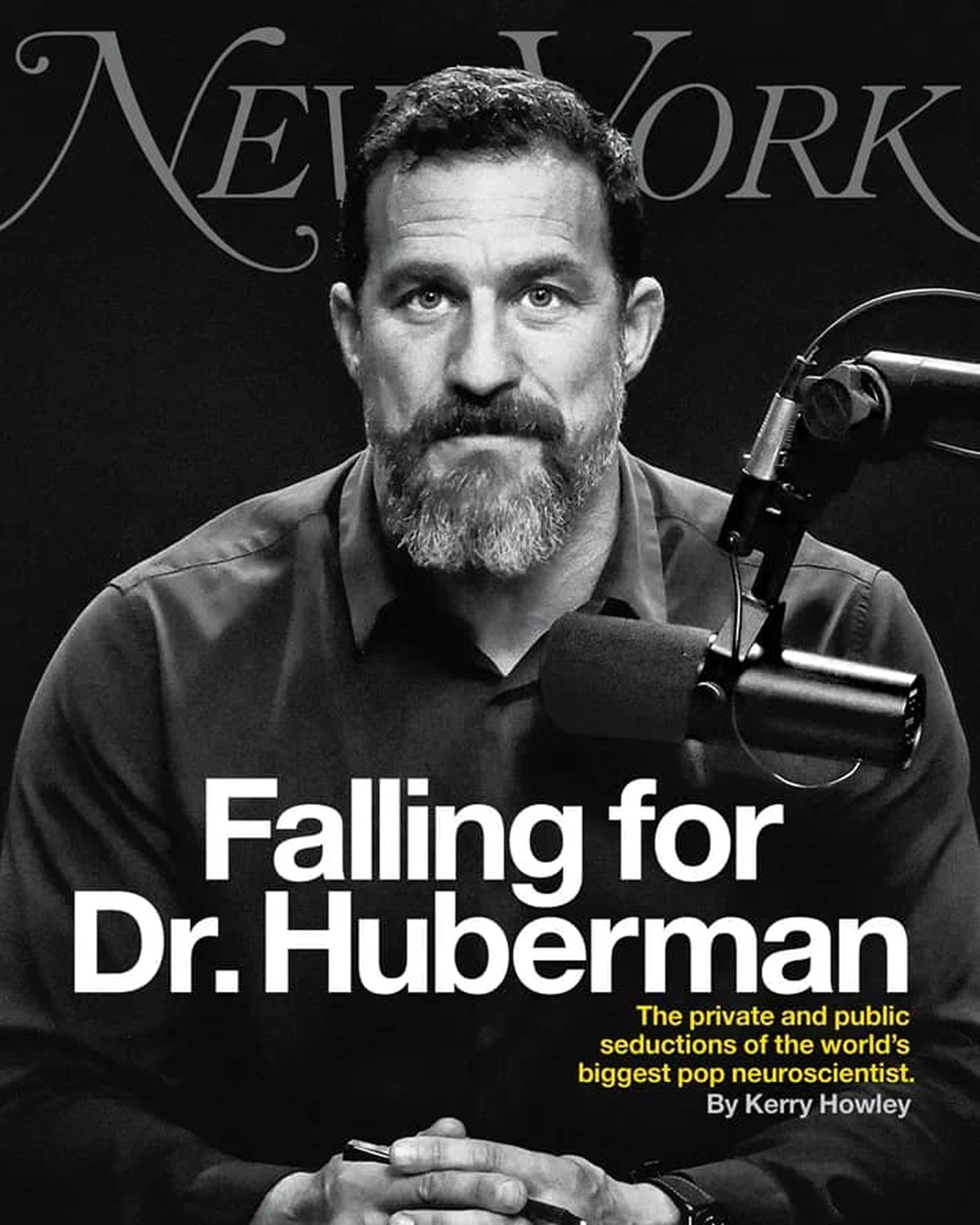
Ok, I’m sorry, and don’t let this undercut my feminist street cred, but when you become a cover star for New York magazine’s story about how you’re a playboy, you can officially say, “I’ve made it.” I can only think the world must have been slow on stories at the time of publication, because to cover him like Harry Styles was really something to see.
The Real Answer
So, how do you become the next Mel Robbins?
You don’t.
You become the first you. But you use the same levers nearly every thought leader has:
Anchor one unforgettable idea.
Nail one breakout platform.
Attach to one cultural wave.
Build one content supply chain.
Climb one business ladder.
In 2025, that breakout platform might be a Substack that delivers data no one else has. Or a YouTube-first podcast that feeds TikTok. Or a LinkedIn News feature that cements you as the voice of a movement.
Do this with discipline for two to three years, and people won’t be asking how to become the next Mel Robbins. They’ll be asking how to become the first you.